

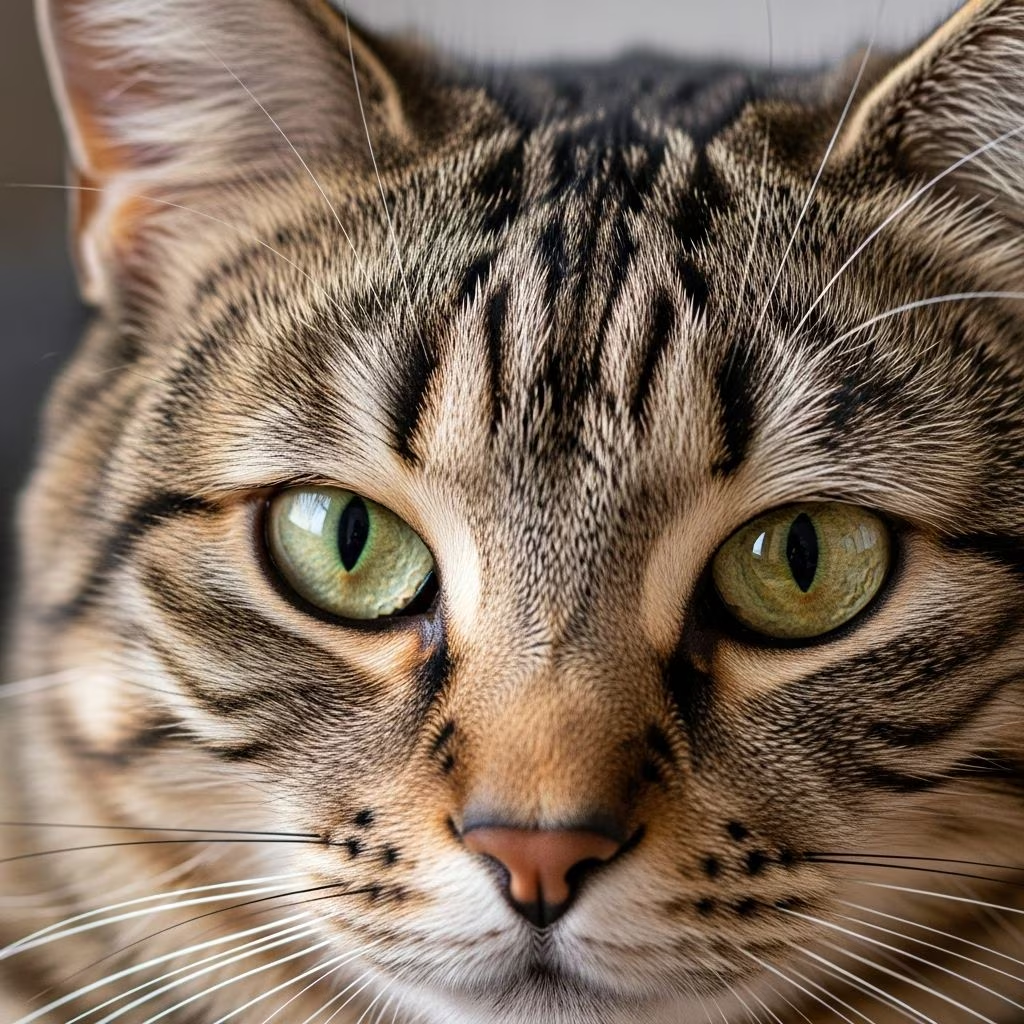
Cats captivate us with their expressive faces, and those whisker-like tufts above their eyes often look strikingly like **eyebrows**. But do cats actually have eyebrows? The short answer is no—cats lack true eyebrows composed of short, specialized hairs like humans. Instead, they possess **superciliary whiskers** (vibrissae), which mimic the appearance and serve protective, sensory functions far beyond mere aesthetics. These thick, sensitive hairs are deeply rooted sensory organs connected to the nervous system, helping cats navigate, hunt, and stay safe in their environment.
Understanding these features reveals the ingenuity of feline anatomy. Inherited from wild ancestors, whiskers enhance survival in low-light conditions and tight spaces. This article explores cat whisker anatomy, their eyebrow-like roles, breed variations, functions, health concerns, and care tips, drawing from veterinary-verified facts.
Cat Whisker Anatomy: Beyond the Obvious
Whiskers, or vibrissae, are not ordinary hairs. They are **2-3 times thicker** than regular fur, with roots embedded three times deeper into the skin, surrounded by a dense network of blood vessels and nerves. Each follicle contains sensory cells that transmit vibrations and pressure changes directly to the brain, acting like radar for farsighted cats.
A typical domestic cat has about **12 whiskers on each upper lip (mystacial whiskers)**, a few on the chin (genal whiskers), **three above each eye (superciliary whiskers)**, and smaller sets on the wrists (carpal whiskers) and ears. These positions are evolutionarily precise: mystacial whiskers measure spaces (roughly matching the cat’s body width), genal whiskers detect ground obstacles, and carpal whiskers sense paw placement. Superciliary whiskers, the ‘eyebrow’ stars, guard the eyes while detecting nearby air shifts.
| Whisker Type | Location | Primary Function |
|---|---|---|
| Mystacial | Cheeks/Upper Lip (12 per side) | Navigation, spatial judgment, hunting |
| Genal | Chin | Detect low obstacles, prey below |
| Superciliary | Above Eyes (3 per side) | Eye protection, close-range sensing |
| Carpal | Back of Wrists/Paws | Ground sensing, balance during movement |
This table summarizes whisker distribution, highlighting their specialized roles. Unlike coat hairs, whiskers don’t grow continuously; they shed and regrow in cycles every few months, but damage can impair function until replacement.
What Are Those Whiskers Above a Cat’s Eyes?
The tufts above a cat’s eyes are **superciliary vibrissae**, often mistaken for eyebrows due to their arched position. These three stiff hairs per eye are highly sensitive, detecting minute air currents, vibrations, and touches from as little as a millimeter away. Touching them triggers an involuntary blink reflex, shielding eyes from debris like dust, grass, or insects—crucial for outdoor or feral cats.
Cats are farsighted, excelling at spotting motion 20-50 feet away but struggling with close-up focus (under 6 inches). Superciliary whiskers compensate, providing tactile ‘vision’ for near objects. A breeze from an approaching predator or toy will make them twitch, alerting the cat. In emotional displays, relaxed cats point them backward, while hunting cats flare them forward.
Do All Cats Have Eyebrow Whiskers?
Not all cats display prominent ‘eyebrow’ whiskers equally. Breeds like **Ragdoll, Persian, Norwegian Forest Cat, Maine Coon, and Siberian** boast thick, bushy superciliary vibrissae, enhancing their expressive faces. Hairless breeds such as the **Sphynx** may have sparse, thin, or absent whiskers due to minimal fur, though follicles remain and can produce fine versions.
- Long-haired breeds: Persian and Maine Coon often have the most visible, fluffy eyebrow whiskers blending with facial fur.
- Short-haired breeds: Domestic Shorthairs show them clearly against sleek coats.
- Hairless breeds: Sphynx or Devon Rex may lack them visibly, but sensory function persists if present.
- Individual variation: Kittens start with finer whiskers that thicken with age; nutrition affects growth.
Importantly, no cat has true eyebrows—muscles don’t control these hairs for expression as in humans. All rely on vibrissae for equivalent utility.
How Do Whiskers Benefit Cats?
Whiskers are multisensory powerhouses, elevating cats beyond sight alone. Here’s how they shine:
1. Navigation Masters
As farsighted hunters, cats use whiskers to map surroundings. Mystacial whiskers gauge if a gap fits their body; superciliary ones detect walls or branches inches away. In darkness, they sense air disturbances from prey or obstacles, preventing clumsy collisions.
2. Hunting Precision
Whiskers turn cats into stealth assassins. Forward-flared during stalks, they track tiny movements via vibrations. A mouse’s rustle displaces air, pinpointing location even unseen. Without them, hunting success drops dramatically.
3. Protecting the Eyes
Superciliary whiskers act as bumpers: contact prompts blinking, blocking dirt, pollen, or claws. Essential in tall grass or bushes, they prevent scratches and infections.
4. Balance and Body Awareness
Proprioceptors at whisker tips monitor body position, aiding leaps and tight turns. They detect wind shifts mid-jump for stable landings.
5. Emotional Communication
Whisker posture signals mood: relaxed and back for contentment, forward for curiosity/aggression.
Why Are My Cat’s Whiskers Missing or Broken?
Healthy whiskers shed naturally, regrowing in 2-3 months. Persistent loss signals issues—don’t ignore.
1. Infections
Bacterial, fungal (e.g., ringworm), or parasitic (mites causing mange) infections inflame follicles, leading to fallout. Ringworm creates bald patches; mange itches severely. Treatable with antifungals or antiparasitics; contagious between pets.
2. Allergies
Food, environmental, or flea allergies prompt face-rubbing, snapping whiskers. Secondary infections follow; identify allergens via vet tests for recovery.
3. Other Causes
- Trauma: Fighting, accidents, or tight collars break them; regrow if follicles intact.
- Nutrition: Poor diet slows regrowth.
- Stress: Overgrooming in anxious cats.
- Age: Seniors may thin out naturally.
If whiskers don’t regrow or asymmetry appears, consult a vet for exams, bloodwork, or biopsies.
5 Quick Tips for Healthy Cat Whiskers
- Never cut whiskers: Even for ‘neatness,’ it disorients cats for weeks.
- Provide space-matched environments: Boxes or tunnels should fit whisker width.
- Balanced diet: Omega-3s, proteins support growth.
- Groom gently: Avoid face brushing; check for damage weekly.
- Vet checkups: Annual exams catch issues early.
Frequently Asked Questions (FAQs)
Q: Do cats have eyebrows like humans?
A: No, cats lack true eyebrows but have superciliary whiskers above eyes that protect and sense like eyebrows.
Q: Can I trim my cat’s eyebrow whiskers?
A: Absolutely not—trimming impairs navigation, balance, and eye safety. They regrow slowly.
Q: Why do some cats have bushier eyebrow whiskers?
A: Breed genetics; Maine Coons and Persians have thicker ones, while Sphynx may have fewer.
Q: What if my cat loses its eyebrow whiskers?
A: Monitor for regrowth; if persistent, see a vet for allergies, infections, or nutrition issues.
Q: Do kittens have eyebrow whiskers?
A: Yes, but finer; they thicken by adulthood for full sensory function.
Q: How do superciliary whiskers help cats hunt?
A: They detect air vibrations from prey, aiding precision strikes despite poor close vision.
Whiskers define feline prowess—respect them for your cat’s well-being.
References
- Do All Cats Have Eyebrows? Vet-Verified Feline Anatomy Facts — Hepper. 2023-10-15. https://articles.hepper.com/do-all-cats-have-eyebrows/
- Why Do Cats Have Eyebrow Whiskers? — YouTube (Transcript). 2023-05-20. https://www.youtube.com/watch?v=ajoKeNrex4g
- Feline – Anatomy, Behavior, Hunting — Encyclopædia Britannica. 2024-01-10. https://www.britannica.com/animal/feline/Form-and-function



