

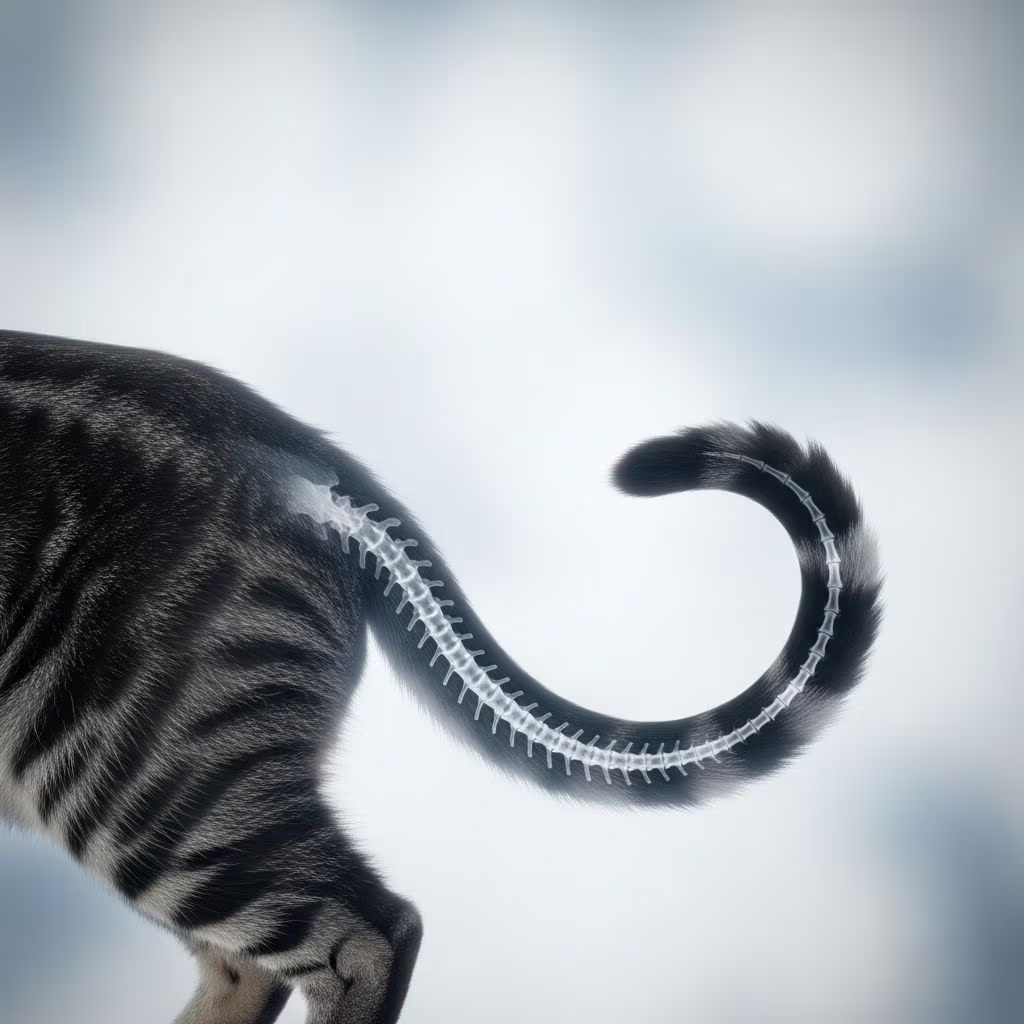
Do Cats Have Bones in Their Tails? Feline Anatomy Explained
Yes, cats do have bones in their tails. These specialized bones, called caudal vertebrae, are a remarkable adaptation that sets felines apart from many other animals. Long-tailed cats can have anywhere from 19 to 23 bones in their tails, while short-tailed or tailless breeds, such as the Manx, have fewer or none at all. A cat’s tail is far more than a simple appendage for balance—it is a sophisticated structure composed of bones, nerves, blood vessels, and muscles that serves multiple critical functions in feline survival and communication.
Understanding Cat Tail Anatomy Basics
To truly appreciate the complexity of a cat’s tail, it is essential to understand its anatomical composition. The tail is fundamentally an extension of the cat’s spine, consisting of multiple vertebrae connected by intervertebral discs and supported by an intricate network of muscles and ligaments. These caudal vertebrae are significantly more numerous than those found in humans—humans possess only three to five caudal vertebrae, which are fused together to form the coccyx, whereas cats have up to 23 individual, articulate vertebrae in their tails.
The structure of cat tail vertebrae demonstrates remarkable adaptation. At the base of the tail, the vertebrae are at their largest, gradually decreasing in size as they extend toward the tip. This progressive size reduction allows for increasingly fine motor control, enabling cats to manipulate their tail tips with precision. The vertebrae are connected by soft discs that provide flexibility and allow for the supple, articulated movements characteristic of feline tails.
Cat Tail Vertebrae: Structure and Function
The caudal vertebrae that compose a cat’s tail are connected by muscles, tendons, and ligaments that work in concert to create the remarkable flexibility and control cats exhibit. The tail muscles lie primarily on the lumbar vertebrae and sacrum of the lower back, extending onto the tail vertebrae themselves. These muscles are attached to the tail vertebrae by tendons, with the most posterior tendons inserting directly into the final tail vertebrae.
Research on feline tail anatomy has identified six primary muscles on each side of the tail that enable its full range of motion:
- Sacrocaudalis dorsalis medialis (SDM)
- Sacrocaudalis dorsalis lateralis (SDL)
- Coccygeus lateralis (CL)
- Coccygeus medialis (CM)
- Sacrocaudalis ventralis lateralis (SVL)
- Sacrocaudalis ventralis medialis (SVM)
These muscles enable cats to bend their tails in multiple directions: dorsal (upward), lateral (sideways), ventral (downward), and rolling motions. The long tendons of the SDL and SVL muscles are particularly significant, as they produce rapid and strong tail movements that contribute to a cat’s ability to maintain balance during complex maneuvers.
Comparison of Tail Vertebrae Between Species
| Species | Number of Caudal Vertebrae | Function |
|---|---|---|
| Domestic Cat | 19-23 | Balance, communication, agility |
| Human | 3-5 (fused) | Minimal; part of coccyx |
| Short-tailed Cat Breeds | Fewer than 19 | Limited balance function |
How Many Bones Does a Cat Have Overall?
To understand the significance of tail bones in a cat’s skeletal system, it is helpful to examine the total bone count. A domestic cat typically has 230 to 250 bones, depending on factors such as breed, individual variations, tail length, and conditions like polydactyly (extra toes). This bone count exceeds the 206 bones found in the human skeleton, largely due to the cat’s elongated spine and the presence of numerous tail vertebrae.
The feline skeleton is organized into distinct regions, each contributing to the cat’s remarkable agility and balance:
- Skull: Approximately 29 bones that protect the brain and sensory organs
- Spine: 52 to 53 vertebrae divided into cervical, thoracic, lumbar, sacral, and caudal regions
- Rib cage: Provides protection for vital organs
- Limbs: Approximately 40 to 50 bones per limb, including phalanges
- Tail: 19 to 23 caudal vertebrae
The Role of the Cat’s Spinal Column
The cat’s spine is a marvel of evolutionary adaptation, consisting of 52 to 53 vertebrae divided into five distinct regions. The cervical (neck) region contains seven vertebrae that support head movement and neck flexibility. The thoracic region, comprising 13 vertebrae, anchors the ribs and supports upper body strength. Seven lumbar vertebrae enable the powerful hindlimb movements necessary for jumping and sprinting. Three sacral vertebrae connect the spine to the pelvis, providing stability, and the caudal region contains the tail bones that enhance balance and enable communication.
This segmented structure, connected by elastic ligaments, allows cats to twist, bend, and leap with extraordinary ease, making them exceptional climbers and jumpers. The spine’s flexibility is crucial to a cat’s survival and is one of the defining characteristics of feline agility.
Limb Bones and Feline Mobility
While this article focuses on tail bones, understanding how other skeletal components work in concert with the tail is important for appreciating feline anatomy. The forelimbs include the scapula, humerus, radius, ulna, and carpals, while the hindlimbs comprise the femur, tibia, fibula, and tarsals. Each limb contains approximately 40 to 50 bones, including phalanges (toe bones).
The retractable claws, anchored to terminal phalanges, further enhance grip and hunting precision. Together with the tail’s counterbalancing action, these limb structures enable cats to leap up to five times their body length—a feat that would be impossible without the coordinated function of the entire skeletal system.
Functions of the Cat’s Tail
The cat’s tail serves multiple critical functions that extend far beyond aesthetic appeal. The caudal vertebrae enable several essential capabilities:
- Balance and Coordination: The tail acts as a counterbalance during high-speed chases and jumps, allowing cats to make mid-air adjustments for precise landings. This function is so crucial that cats with damaged tails may experience significant balance difficulties.
- Communication: Cats use their tails to express emotions and intentions to other cats and humans. A raised tail indicates confidence, while a tucked tail suggests fear or submission.
- Temperature Regulation: The tail contains blood vessels that can help regulate body temperature by increasing or decreasing blood flow to the extremity.
- Hunting Assistance: The tail’s movements help cats maintain stability while pouncing on prey, contributing to hunting success.
Variations in Tail Bone Count by Breed
Not all cat breeds have the standard 19 to 23 tail bones. Breed-specific variations occur due to selective breeding and genetic factors. Short-tailed breeds, such as the Manx, Japanese Bobtail, and Pixiebob, have significantly fewer caudal vertebrae, while completely tailless breeds have none at all. Interestingly, these tailless cats do not experience significant impairment in balance or agility, thanks to compensatory adaptations in their feline physiology that redistribute balance functions throughout their skeletal and muscular systems.
Longer-tailed breeds, such as the Maine Coon and Turkish Van, may have tail bones closer to the upper end of the typical range, providing extended reach and enhanced balance capabilities.
Bone Composition and Durability
Feline bones, including caudal vertebrae, are composed primarily of calcium phosphate and collagen, providing both strength and flexibility. These bones also contain bone marrow, which produces blood cells essential for oxygen transport and immune function. A specialized layer called the periosteum covers the bones, enabling growth and facilitating repair after injury. This composition supports the durability and lightweight nature of the entire cat skeleton, allowing cats to achieve remarkable feats of agility without the burden of excessive weight.
What Happens When a Cat’s Tail Is Injured?
Because the tail is an integral extension of the spine with its own nerve supply and blood vessels, injuries to this structure can have serious consequences. Damage to tail bones can affect other areas of the body and cause complications ranging from chronic pain to loss of bladder or bowel control, particularly if the injury involves the base of the tail where nerves are concentrated. Cats that have sustained tail injuries may display behavioral changes, decreased mobility, or signs of discomfort.
Pet owners should take special care to protect their cats’ tails from being stepped on, caught in doors, or pulled by children or other animals. If you suspect that your cat is suffering from a tail injury, seeking immediate veterinary attention is essential.
Frequently Asked Questions About Cat Tail Bones
Q: How many bones does a cat have in its tail?
A: Long-tailed cats typically have between 19 to 23 bones in their tails, known as caudal vertebrae. The exact number varies depending on the breed and individual cat. Short-tailed or tailless breeds have fewer or no tail bones.
Q: Are cat tail bones connected to the spine?
A: Yes, the caudal vertebrae (tail bones) are an extension of the cat’s spine. They are connected by intervertebral discs and surrounded by muscles, tendons, and ligaments that enable flexible movement.
Q: Can a cat survive without a tail?
A: Yes, cats can survive without a tail, as demonstrated by naturally tailless breeds like the Manx. However, they may experience some loss of balance function. The cat’s body compensates for this loss through adaptations in other areas of the skeletal and muscular systems.
Q: What is the purpose of a cat’s tail?
A: A cat’s tail serves multiple functions, including balance during movement, communication of emotions and intentions, temperature regulation, and assistance during hunting. The tail is essential for the cat’s overall coordination and survival.
Q: How do cat tail muscles work?
A: Six pairs of muscles control the tail’s movement, enabling cats to bend it upward, downward, sideways, and roll it. These muscles are attached to the caudal vertebrae by tendons, creating the precise and flexible movements characteristic of feline tails.
Q: What should I do if my cat’s tail is injured?
A: If you suspect your cat has a tail injury, seek veterinary attention immediately. Tail injuries can affect other areas of the body and cause serious complications if left untreated. Avoid attempting home treatment and allow a professional veterinarian to diagnose and treat the injury.
Conclusion
The cat’s tail is a truly intriguing part of feline anatomy that serves numerous critical purposes in terms of survival, balance, and communication. Yes, cats absolutely have bones in their tails—specifically, between 19 and 23 caudal vertebrae that form an articulated, flexible structure. These tail bones, supported by muscles, tendons, and ligaments, enable the remarkable agility and grace for which cats are renowned. Understanding this aspect of feline anatomy helps pet owners appreciate the sophistication of their cats’ bodies and emphasizes the importance of protecting this vulnerable and essential structure from injury.
References
- Cat Skeletal System: A Closer Look at Feline Anatomy — Vet Today. 2024. https://vettoday.com/blog/pet-health/cat-skeletal-system/
- Do Cats Have Tail Bones? — Laurel Veterinary Clinic. 2024. https://laurelpets.com/blog/do-cats-have-tail-bones/
- Structure and Function of the Tail in Cats — PetPlace.com. 2024. https://www.petplace.com/article/cats/pet-health/structure-and-function-of-the-tail-in-cats
- Do Cats Have Bones in Their Tails? Feline Anatomy Explained (Vet Reviewed) — Catster. 2024. https://www.catster.com/cat-health-care/do-cats-have-bones-in-their-tails/
- Anatomical structure and action of the tail muscles in the cat — PubMed/National Center for Biotechnology Information. 1997. https://pubmed.ncbi.nlm.nih.gov/7696400/



