

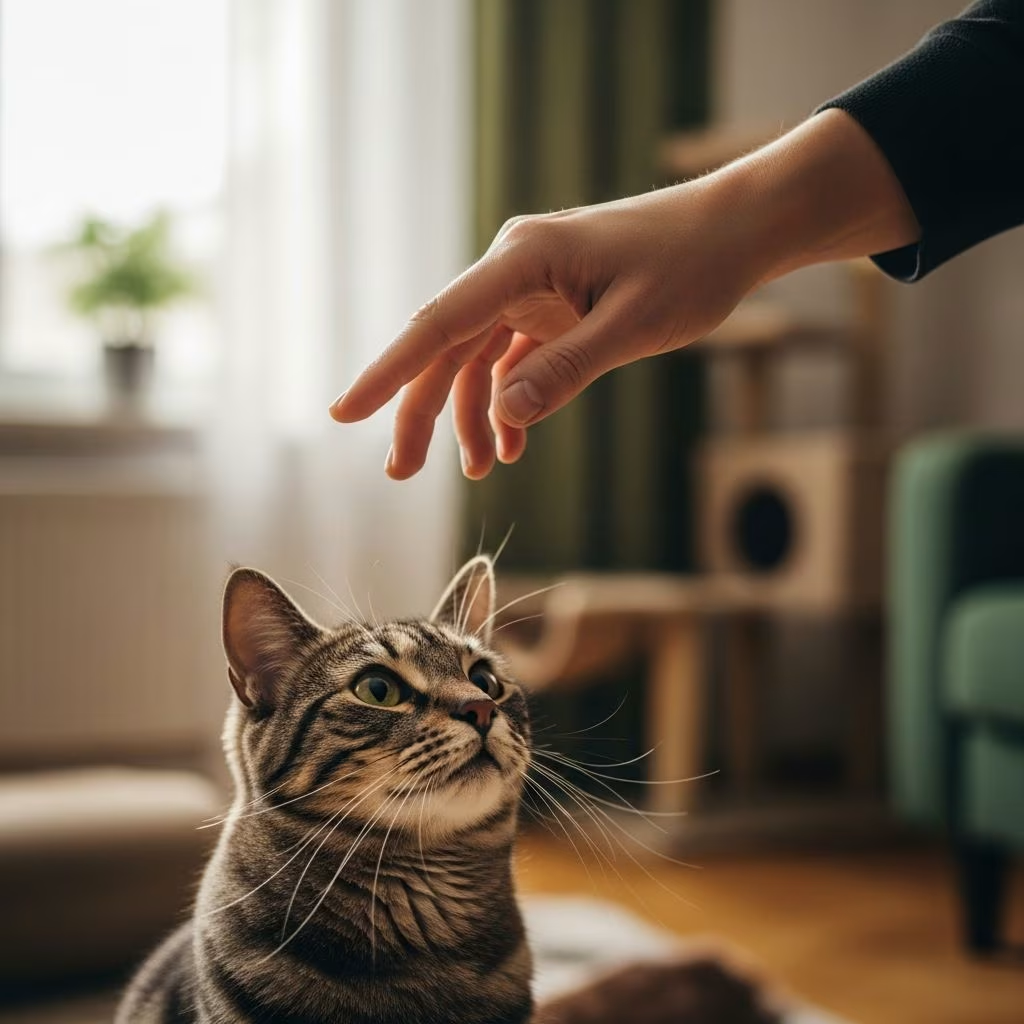
Cats do not recognize humans as “alpha” leaders in the way dogs might in a pack structure. Domestic cats view their human families more as convenient providers and affectionate companions rather than hierarchical superiors. This misconception stems from outdated wolf-pack theories misapplied to pets, which have been thoroughly debunked for both dogs and cats. Instead, cats maintain loose social tolerances shaped by individual personalities, early socialization, and resource availability.
Understanding this helps cat owners foster better relationships without dominance-based training, which can harm trust. Cats are **facultatively social**, meaning they choose interactions based on comfort, not rigid hierarchies. In multi-human or multi-cat homes, preferences emerge from positive associations like feeding, play, and gentle handling.
Cat Social Structure: No Alphas in Sight
Feline society differs fundamentally from canine packs. Wild cats, like lions, form prides only under specific conditions, but most felines are solitary hunters who maintain territories with minimal overlap. Domestic cats adapt to group living in resource-rich environments, such as homes or colonies near food sources, but they use **active spacing**—visual cues, marking, and schedules—to avoid conflict.
Cats do not form linear hierarchies with alphas. They exhibit “living apart together,” tolerating housemates while prioritizing personal space. Kittens learn social tolerance during a critical 2-7 week window, forming attachments to species present then, including humans. Poor socialization leads to fear or avoidance, not submission to an alpha.
- Solitary roots: Cats evolved as independent hunters, avoiding fights due to injury risks.
- Tolerance over hierarchy: In homes, cats coexist if resources abound, but conflict prompts relocation, not dominance battles.
- Human bonds: Cats treat familiar people like mothers—rubbing, kneading, seeking pets—indicating ectepimeletic (care-seeking) behavior, not pack obedience.
Studies confirm cats distinguish personal (intimate contact) and social distances, allowing only trusted individuals close. Females show more affiliative grooming; opposite-sex approaches are common. This fluid dynamic debunks alpha myths.
The Myth of the Alpha Theory
The “alpha” concept arose from flawed 1940s wolf studies observing captive wolves, later corrected by observing wild packs led cooperatively by breeding pairs, not bullies. Applying this to dogs, then cats, ignores species differences. Modern ethology shows no evidence of alpha roles in felines.
Cats begging for food or demanding attention aren’t submitting; they’re operantly conditioned, knowing behaviors yield results. Jokes about cats seeing humans as “can openers” hold truth—cats bond over benefits, not authority. Owner compliance correlates with cat affection, suggesting mutual respect over dominance.
| Myth | Reality | Source |
|---|---|---|
| Cats view owners as pack leaders | Cats see humans as resource providers and playmates | |
| Bullying = establishing alpha status | Bullying stems from fear, poor socialization, or resource guarding | |
| Dominance training works on cats | Positive reinforcement builds trust; punishment erodes it |
Do Cats Choose a Favorite Human?
Yes, cats often prefer one person, based on interaction quality. A study found the most interactive human becomes the favorite, as cats associate them with positive outcomes. Factors include:
- Feeding and play: The food provider or toy-wielder tops the list.
- Gentle handling: Cats favor calm, respectful people over boisterous ones.
- Sex and age: Stronger bonds with women; weaker with children due to erratic movements.
- Personality match: Open owners have relaxed cats.
Cats respond more to owners’ emotions than strangers, using vocalizations and rubbing to soothe negativity. This selective attachment enhances welfare, as cats gain social support. To become favorite, engage consistently with play, treats, and respect boundaries.
Alpha Cat Syndrome: Behavior, Not Biology
Some cats display **alpha-like behaviors**—bullying housemates, ignoring commands, chasing others—earning the label “Alpha Cat Syndrome”. This isn’t hierarchy-seeking; it’s often fear-driven aggression or unmet needs.
In multi-cat homes, the “alpha” cat may monopolize resources, prompting others to yield space. Undisciplined cats persist because owners avoid confrontation, missing cats’ trainability.
- Signs: Persistent unwanted actions despite correction, pursuing others, resource guarding.
- Causes: Poor socialization, stress, health issues, or learned impunity.
- Solutions: Behavior mod with positive reinforcement, vet checks, environmental enrichment.
Cats avoid fights evolutionarily; tolerance fails when options dwindle. Train via clickers and rewards—cats learn compliance like dogs.
Understanding Cat-Human Interactions
Cats communicate via body language: tail up for greeting, slow blinks for trust, ears back for threat. They match human emotions cross-modally, preferring owners’ cues. Socialized cats seek novelty from strangers but comfort from familiars.
Enhance bonds by mimicking maternal responses: scheduled feeds, play mimicking hunt, safe spaces. Avoid forcing interactions; respect signals to prevent stress.
Multi-Cat Homes: Managing Dynamics
In groups, provide ample resources—litter boxes (n+1 rule), perches, feeding stations—to reduce tension. Introduce slowly, monitor for bullying. Neutering curbs territoriality.
Cats form devoted pairs or tolerate loosely; protect vulnerable ones. Enrich with toys, scratching posts for energy outlet.
Frequently Asked Questions (FAQs)
What does it mean if my cat ignores me?
Your cat isn’t defying an alpha; it’s independent or uninterested. Increase play/affection to build association.
Can I train my aggressive cat?
Yes, using positive methods. Consult vets/behaviorists; rule out pain.
Why does my cat prefer one person?
That person offers most positives (food, pets). Others can compete with effort.
Do feral cats have alphas?
No, colonies are matriarchal with loose tolerance, not strict hierarchies.
Is alpha theory dead for all animals?
Debunked for dogs/cats; varies by species. Focus on science-based training.
Building a Strong Cat-Human Bond
View cats as equals: provide security, stimulation, respect. Respond to vocalizations, match energy. This yields affectionate, well-adjusted companions. Avoid anthropomorphism; observe ethology for insights.
In conclusion, cats lack alpha humans, thriving on mutual benefit. Embrace their independence for rewarding relationships.
References
- Does My Cat Have an Alpha Human? Vet-Reviewed Social Facts — Hepper. 2023. https://articles.hepper.com/does-my-cat-have-an-alpha-human/
- Feline Social Behavior — Veterian Key. 2016-10-26. https://veteriankey.com/feline-social-behavior/
- Unanswered Questions and Hypotheses about Domestic Cat (Felis silvestris catus) Social Behavior and Cognition — PMC / NIH. 2021-10-20. https://pmc.ncbi.nlm.nih.gov/articles/PMC8532687/
- How Cats Choose Their Favorite Human — Union Lake Veterinary Hospital. 2023. https://unionlakeveterinaryhospital.com/blog/how-cats-choose-their-favorite-human
- Do You Have an Alpha Cat? — Feline Engineering. 2022. https://felineengineering.com/blog/alpha-cat/



