

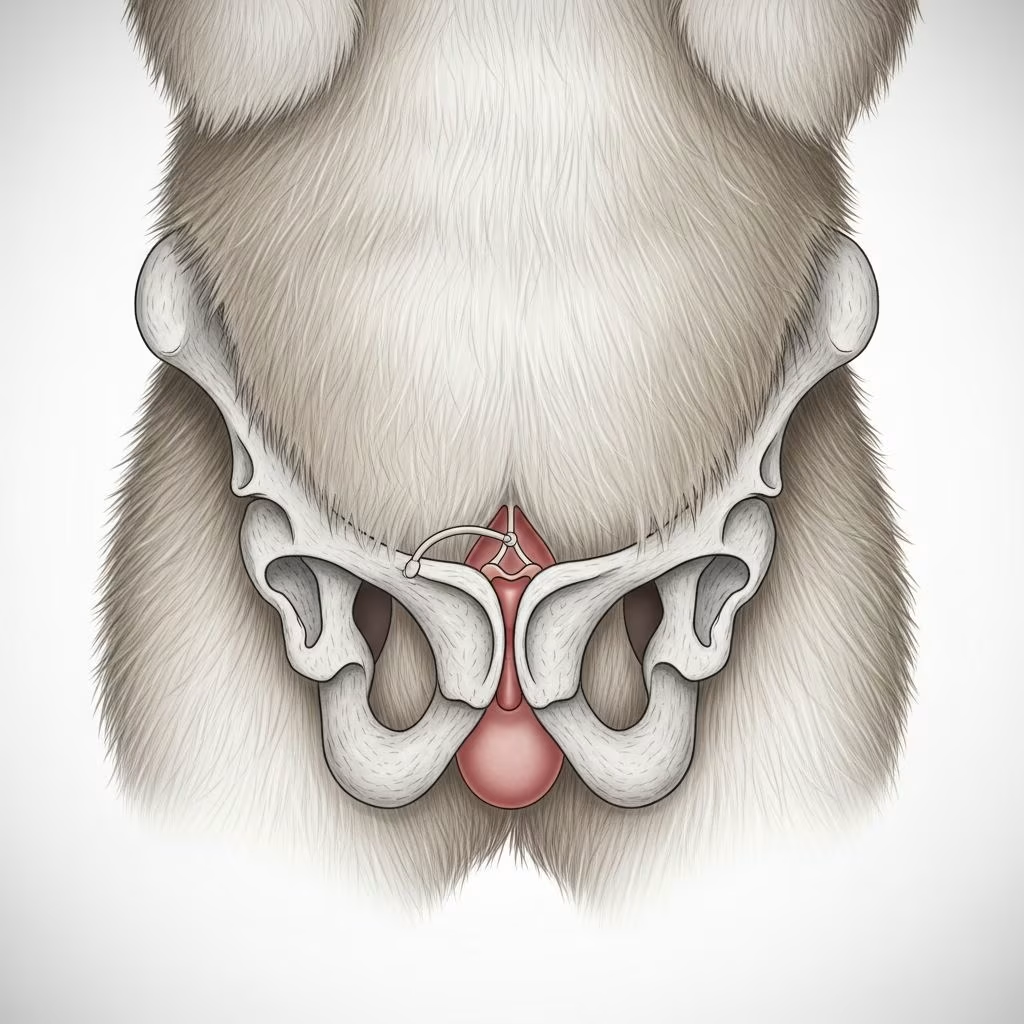
Female cats, known as queens, possess a clitoris as part of their reproductive anatomy, located just inside the vulva. Unlike in humans where the clitoris is primarily associated with sexual pleasure, its role in cats is less about pleasure and more integrated into the overall genital structure, with mating often appearing painful for the female.
This organ, present in all female mammals, consists of erectile tissue analogous to the penile tissue in males. Understanding this anatomy is crucial for cat owners, especially regarding spaying, health checks, and recognizing signs of estrus or disorders.
The Female Feline Reproductive Tract
The reproductive system of a female cat includes the ovaries, oviducts (fallopian tubes), uterus, cervix, vagina, vulva, and mammary glands, all located in the abdomen except the mammary glands which run along the underside from chest to groin. These organs work together for egg production, fertilization, pregnancy, and birth.
Ovaries
The ovaries are paired organs situated just behind the kidneys, held by abdominal ligaments. They store unfertilized eggs in follicles and produce hormones like estrogen and progesterone. Cats are induced ovulators, meaning eggs are released only after mating stimulates the ovaries via luteinizing hormone.
- Ovaries release eggs post-mating, unlike spontaneous ovulators like humans.
- Follicles mature under follicle-stimulating hormone, leading to estrogen production for estrus behaviors.
- Post-ovulation, corpora lutea form, secreting progesterone to prepare the uterus.
Oviducts (Fallopian Tubes)
These small tubes connect the ovaries to the uterus, transporting eggs via ciliated epithelium that aids movement and provides nutrients for eggs and sperm. Fertilization typically occurs here, creating a nurturing environment for early embryos.
The oviducts ensure eggs travel safely to the uterus, with secretions supporting fertilization and initial embryonic development.
Uterus
Cats have a Y-shaped uterus with long horns extending from each ovary, joining into a shorter body. Fetuses develop in the horns, lined by endometrium (inner vascular layer) and myometrium (smooth muscle for contractions during birth).
- Horns accommodate multiple kittens in litters.
- Endometrium thickens under progesterone for implantation.
- Myometrium contracts to expel kittens.
Cervix
The cervix, at the uterus base, is a muscular sphincter of connective tissue that remains mostly closed to block infections, opening during birth or mating. It separates the uterus from the vagina, dilating for kitten passage.
Vagina
This muscular tube extends from the cervix through the pelvis to the vulva, featuring folds for expansion during birth and protecting the urethral opening. Sperm is deposited here during mating, and it serves as the birth canal.
The vaginal walls include mucosa, smooth muscle, and connective tissue, allowing significant stretching.
Vulva and Clitoris
The vulva is the external opening in the perineum, ventral to the anus, consisting of two labia with a cleft. The clitoris lies just inside the ventral cleft in the clitoral fossa, made of cavernous erectile tissue equivalent to the male penis.
In estrus, the vulva may swell slightly, less prominently than in dogs. The clitoris can enlarge due to irritation or intersex conditions.
- Clitoris location: Ventral aspect of caudal vestibule.
- Innervated by mechano-sensitive fibers in the pudendal nerve, responding to pressure with neural firing.
- Not prominently visible externally in cats.
Mammary Glands
Female cats typically have eight mammary glands (four pairs) along the abdomen, producing milk post-pregnancy. Composed of glandular tissue, ducts, blood vessels, and connective tissue, they support kitten nursing.
Do Cats Have a Clitoris? Vet-Reviewed Facts
Yes, all female mammals, including cats, have a clitoris. In felines, it is a small structure inside the vulva, richly innervated with afferent neurons in S1-S2 dorsal root ganglia (average 433 cells per side).
Studies show clitoral stimulation elicits bursts of neural activity (170-255 Hz initially, sustaining at 40 Hz), indicating sensitivity but not necessarily pleasure. Scientists caution against anthropomorphizing; cat mating involves barbed penile spines causing pain, evident by queens’ cries and aggression.
| Aspect | Human Clitoris | Cat Clitoris |
|---|---|---|
| Location | External hood | Inside vulva, ventral fossa |
| Primary Association | Sexual pleasure | Anatomical/reproductive sensitivity |
| Mating Experience | Pleasurable | Often painful due to barbs |
| Innervation | High density | Mechano-sensitive myelinated fibers |
Feline Reproduction and the Clitoris’s Role
Cats are seasonally polyestrous, entering estrus multiple times yearly without pregnancy. Mating induces ovulation within 24-48 hours. The clitoris may play a sensory role during coitus, but pleasure is unproven.
Queens exhibit lordosis (raised hindquarters) in heat, vocalizing and rubbing. Post-mating, progesterone sustains pregnancy if fertilized.
Common Reproductive Health Concerns
Understanding anatomy aids in spotting issues:
- Pyometra: Uterine infection, common in unspayed cats; requires emergency spaying.
- Intersex Conditions: Enlarged clitoris or ambiguous genitalia.
- Clitoral Irritation: From infections or trauma, causing enlargement.
- Mammary Tumors: Risk higher in unspayed cats; early detection vital.
Regular vet check-ups and spaying prevent most issues, eliminating ovarian/uterine cancers and pyometra.
Spaying and Its Impact on Anatomy
Spaying (ovariohysterectomy) removes ovaries and uterus, halting estrus and hormone cycles. The vulva shrinks, clitoris unaffected structurally but unused. Benefits include cancer prevention and behavior stabilization.
Frequently Asked Questions (FAQs)
Do all female cats have a clitoris?
Yes, every queen has a clitoris, located inside the vulva.
Is the cat clitoris visible?
No, it’s internal, just inside the vulvar labia, not externally prominent.
Does the clitoris serve the same purpose in cats as in humans?
Not primarily; while sensitive, cat mating is painful, unlike pleasurable human experiences.
Can you see the clitoris during grooming or exams?
Vets may identify it during exams; owners should avoid probing to prevent injury.
Does spaying remove the clitoris?
No, spaying targets ovaries/uterus; clitoris and vulva remain.
What if my cat’s vulva area looks swollen or unusual?
Consult a vet; could indicate estrus, infection, or hypertrophy.
Conclusion
Female cats do have a clitoris, integral to their genital tract alongside ovaries, uterus, and vulva. While homologous to human anatomy, functions differ due to induced ovulation and painful mating. Knowledge empowers owners for better health management and spaying decisions.
References
- Do Cats Have a Clitoris? Vet-Reviewed Reproductive Anatomy — Hepper. 2023. https://articles.hepper.com/do-cats-have-a-clitoris/
- Structure and Function of the Female Feline Reproductive Tract — PetPlace. 2024. https://www.petplace.com/article/cats/pet-health/structure-and-function-of-the-female-feline-reproductive-tract
- The Gonads and Genital Tract of Cats — Merck Veterinary Manual. 2025-01-01. https://www.merckvetmanual.com/cat-owners/reproductive-disorders-of-cats/the-gonads-and-genital-tract-of-cats
- Animal clitoris – Domestic cats — Wikipedia (citing primary study). 2024. https://en.wikipedia.org/wiki/Animal_clitoris
- Normal feline reproduction: The queen — PMC – NIH. 2024. https://pmc.ncbi.nlm.nih.gov/articles/PMC10845401/
- Reproductive system of the dog and cat Part 1 — BVNA. 2010. https://bvna.org.uk/blog/reproductive-system-of-the-dog-and-cat-part-1-the-female-system-by-victoria-aspinall/



