

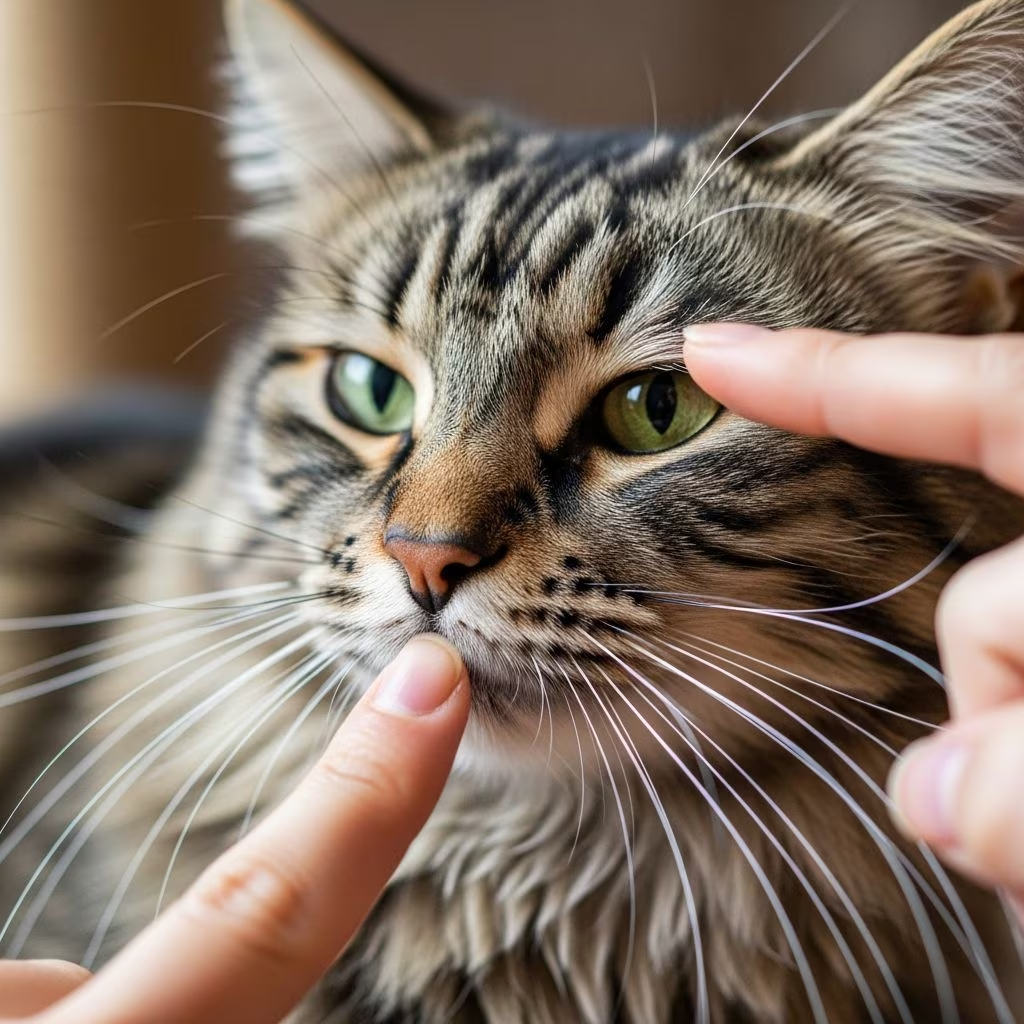
Cat whiskers, or vibrissae, are specialized sensory hairs deeply rooted in hair follicles surrounded by nerves, making them highly sensitive to touch and air movements. Cats often react strongly—blinking, pulling away, or twitching—when whiskers are touched because these structures act like radar, transmitting environmental data directly to the brain.
This sensitivity is normal, but understanding it helps owners interact better without causing discomfort. We’ll dive into whisker anatomy, functions, reactions to touch, whisker fatigue, and care tips.
What Are Cat Whiskers?
Whiskers are thicker, stiffer tactile hairs than regular fur, embedded deeply in the skin with rich nerve endings and blood vessels at their base. Known scientifically as vibrissae, they form follicle-sinus complexes for somatosensory functions.
Located on the muzzle, above eyes, chin, and front legs, whiskers are longer on wider cats for spatial mapping. Unlike normal hairs, they don’t grow from typical follicles but specialized ones acting as motion sensors.
- Mystacial whiskers: Main ones on cheeks, up to 4 rows, primary for navigation.
- Superciliary whiskers: Above eyes, protect from debris.
- Genal whiskers: On cheeks, shorter for close-range sensing.
- Mandibular whiskers: On chin, aid in object manipulation.
These positions allow comprehensive environmental scanning, far beyond mere ‘feelers’.
Why Are Cat Whiskers So Sensitive?
Each whisker connects to hundreds of nerves, detecting minute pressure changes, vibrations, and air currents—equivalent to a cat’s sixth sense. Even slight touches overload these receptors, causing reflexive blinks or head withdrawal.
In darkness, whiskers protract to sense obstacles via airflow changes, preventing collisions. This hypersensitivity aids survival: domestic cats retain predatory instincts where whiskers pinpoint prey movements too subtle for vision.
Whiskers also contribute to balance via proprioception, relaying body position data. Touching them disrupts this constant input stream, akin to tickling a human nerve.
The Functions of Cat Whiskers
Whiskers serve multiple critical roles:
- Navigation: Detect air current shifts around objects, allowing tight-space passage without vision. Cats gauge aperture widths via whisker contact in milliseconds.
- Hunting: Forward-facing whiskers sense prey vibrations or movements when close, improving strike accuracy.
- Protection: Eye whiskers trigger blinks against threats; all alert to dangers.
- Communication: Position signals mood—relaxed (neutral), curious/hunting (forward), aggressive/fearful (backwards). Combine with ears/tail for full read.
- Spatial Awareness: Measure object sizes/shapes/speeds for precise movement.
Without whiskers, cats become clumsy, bumping into walls or misjudging jumps.
Do Cats Hate When You Touch Their Whiskers?
Most cats dislike whisker touching due to overwhelming sensory input, not ‘hate’ per se—it’s a protective reflex. Gentle petting might be tolerated if the cat is relaxed, but sudden or repeated contact causes aversion.
Observe body language: flattened ears or tail swishing alongside withdrawal signals true discomfort. Some cats enjoy light nuzzling if bonded, but respect boundaries.
Avoid stroking whiskers like fur; they’re not for petting. Focus on cheeks or chin instead.
What Is Whisker Fatigue (or Whisker Stress)?
Whisker fatigue theory posits constant whisker stimulation—especially from deep/narrow bowls—overloads nerves, causing stress, messy eating, or paw-dipping.
Symptoms include avoiding bowls, eating floor food, finickiness, or agitation near dishes. Not a disease, but sensory overload from repeated side-brushing.
Debate exists: A study found no significant eating differences between whisker-friendly and standard bowls, though some cats preferred wide ones. No strong evidence for ‘fatigue,’ but shallow bowls reduce contact.
| Symptom | Possible Cause | Solution |
|---|---|---|
| Messy eating, food on floor | Whiskers brushing bowl sides | Use wide, shallow plates |
| Paw in water bowl | Narrow bowl overload | Wide ceramic/glass bowls |
| Avoids food/water | Sensory stress | Switch to whisker-friendly designs |
Signs Your Cat May Have Whisker Stress
- Sudden bowl avoidance or floor eating.
- Pawing food/water out repeatedly.
- Increased agitation or hiding near mealtimes.
- Finicky appetite without diet changes.
- Overall irritability post-meals.
Not all cases indicate stress; rule out dental issues or illness first.
How to Help a Cat with Sensitive Whiskers
Minimize overload:
- Bowl choice: Opt for wide, flat bowls (e.g., ceramic plates) so whiskers don’t touch sides.
- Grooming: Never trim whiskers—they regrow unevenly, disorienting cats for weeks.
- Environment: Avoid narrow spaces stressing whiskers; provide open paths.
- Touching: Skip whiskers; pet safe zones like back or chin.
- Monitor health: Check for follicle irritation, swelling, or eating/drinking pain—vet if persistent.
Test bowl changes: Offer old and new simultaneously; preference indicates relief.
Can You Trim Cat Whiskers?
No—trimming impairs navigation, hunting, and balance severely. Whiskers fall out naturally and regrow; forced cutting causes months of vulnerability.
Only vets trim in medical cases (e.g., surgery), and even then, minimally. Owners risk injuring follicles.
When to See a Vet for Whisker Sensitivity
Normal reactions are fine, but consult if:
- New/excessive twitching, head shaking, or avoidance.
- Redness, swelling, discharge around follicles.
- Behavioral shifts: irritability, appetite loss, lethargy.
- Drinking/eating avoidance suggesting pain.
Could indicate infection, injury, or neurological issues.
Frequently Asked Questions (FAQs)
Why do cats react when their whiskers are touched?
Cats’ whiskers connect to hypersensitive nerves detecting touch/airflow; contact triggers reflexes like blinking to protect the sensors.
Should I avoid touching my cat’s whiskers completely?
Yes, generally—it’s uncomfortable for most. Respect cues; pet other areas.
Is whisker fatigue real?
Theory suggests yes from bowl overload, but studies show minimal eating impacts. Wide bowls help anyway.
What if my cat’s whiskers fall out?
Normal shedding/regrowth cycle. If patchy/excessive, check nutrition, stress, or allergies with vet.
Do all cats have the same whisker sensitivity?
Sensitivity varies by individual, breed, age; some tolerate more, but all rely on them heavily.
References
- Do cats feel uncomfortable when you touch their whiskers — Dial A Vet. 2023-05-15. https://www.dialavet.com/vet-answers/post/cats-whiskers-sensitivity-reaction-51171
- Cat Whiskers 101: The Remarkable Sensory Organs of Felines — McGehee Clinic. 2024-02-10. https://mcgeheeclinic.com/blog/cat-whiskers/
- Your Cat’s Whiskers — Cat Behavior Associates. 2023-11-20. https://catbehaviorassociates.com/your-cats-whiskers/
- Cat Whiskers: The Hidden Sixth Sense — Pet Barn. 2024-08-05. https://petbarnkw.com/cat-whiskers-the-hidden-sixth-sense-and-their-vital-role-in-a-cats-life/
- Whisker Fatigue in Cats: What It Is and How To Help — PetMD. 2024-06-12. https://www.petmd.com/general-health/whisker-fatigue-cats-what-it-and-how-help
- Evaluation of whisker stress in cats — PMC – NIH (Peer-reviewed). 2024-01-15. https://pmc.ncbi.nlm.nih.gov/articles/PMC10812207/



