

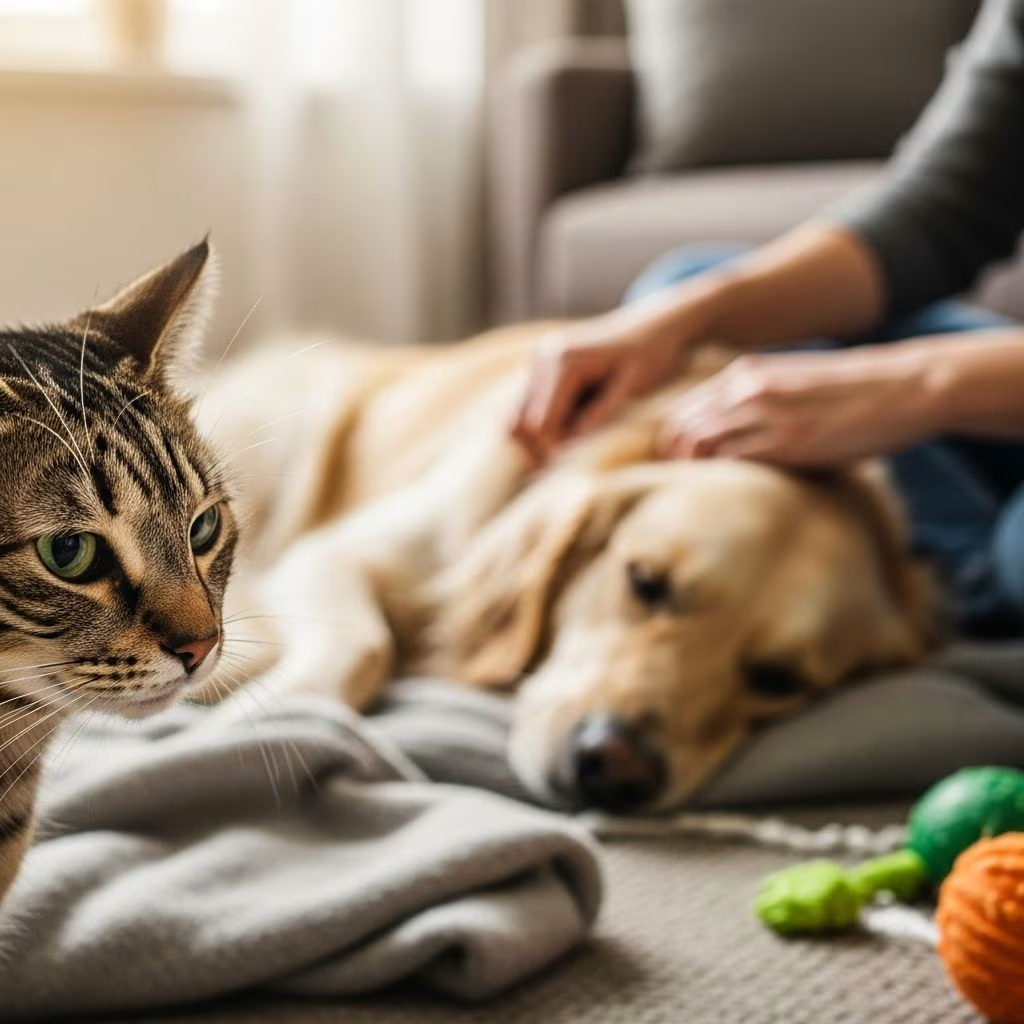
Cats are often perceived as independent creatures, yet many multi-pet owners observe behaviors that resemble jealousy when a dog enters the home. While scientific evidence for true jealousy in cats remains limited compared to dogs, cats exhibit territorial, possessive, and insecure responses that mimic human jealousy, particularly toward outgoing dogs that invade their space or attention.
Table of Contents
- Introduction
- Signs Your Cat Is Jealous of the Dog
- The Science Behind Cat Jealousy
- Why Do Cats Get Jealous of Dogs?
- How to Prevent Cat Jealousy
- How to Manage Cat Jealousy
- Frequently Asked Questions
Introduction
In multi-pet households, introducing a dog to a resident cat can spark tension. Owners frequently report their cats acting out—hissing at the newcomer, avoiding litter boxes, or seeking excessive attention—prompting questions about feline jealousy. Experts suggest cats don’t experience jealousy exactly like humans or dogs; instead, their reactions stem from territorial instincts, possessiveness, and insecurity when a dog’s energetic presence disrupts their routine. A study found 66% of cat owners perceive jealousy in their pets, often attributing it to competition for resources or affection. This article delves into the signs, science, causes, and solutions for cat-dog dynamics.
Dogs, evolved alongside humans for about 20,000 years, show stronger attachment and jealousy-like behaviors in experiments, such as protesting when owners interact with rival dogs. Cats, with less domestication dependency, display subtler responses, but household pets react more intensely to perceived rivals like owner-petted soft toys. Understanding these nuances helps foster peaceful coexistence.
Signs Your Cat Is Jealous of the Dog
Recognizing jealousy in cats requires observing changes in behavior post-dog introduction. Unlike dogs, whose jealousy is backed by infant-like experimental paradigms, cats’ signs are inferred from stress responses. Common indicators include:
- Unusual aggression: Directed at the dog, family members, or objects, such as swatting or biting.
- Hissing, growling, and puffed-up fur: Defensive postures signaling discomfort with the dog’s presence.
- Depression-like symptoms: Lethargy, withdrawal, and reduced appetite, as cats retreat from family interactions.
- Litter box accidents: Urinating or defecating outside the box to mark territory against the intruder.
- Excessive attention-seeking: Meowing loudly or rubbing against legs to reclaim human focus.
- Destructive behaviors: Scratching furniture or knocking items over in frustration.
- Unusual vocalizations: Yowling or chattering, more intense than typical meows.
These behaviors peak when dogs exhibit “annoyingly outgoing” traits, like roaming freely or hogging prime spots, exacerbating the cat’s sense of invasion. Owners note dogs express more secondary emotions frequently than cats, influencing perceptions of canine jealousy.
The Science Behind Cat Jealousy
Research on animal jealousy draws from infant studies, where babies protest maternal attention to rivals. Dogs replicate this in experiments: a 2014 UCSD study showed dogs approaching owners more when interacting with fake dogs versus books, with real-dog rivals confirming jealousy-like behaviors in neutral settings. A 2018 Hungarian study ruled out dominance or territoriality by using unfamiliar locations and varied rivals.
For cats, evidence is sparser. A Japanese study with 52 cats (household and café) observed reactions to owners petting a soft-toy cat versus a cushion. Household cats reacted more intensely to the “rival” toy petted by owners, suggesting primitive jealousy tied to valued relationships, though lacking full infant/dog jealousy markers like proximity-seeking or gaze aversion. No neural imaging confirms cat jealousy, unlike dogs showing amygdala activation (linked to negative emotions) when viewing owners reward fake dogs.
Owners believe dogs feel more emotions than cats, reporting jealousy more in dogs due to attachment differences. Cats may possess cognitive bases for jealousy, influenced by environment—household cats show stronger owner bonds. While dogs’ 20,000-year human evolution fosters jealousy proneness, cats warrant caution in attribution.
Why Do Cats Get Jealous of Dogs?
Several factors explain cat-dog tensions:
Invasion of Territory
Cats are territorial; a dog’s confident roaming—eating from bowls, using litter areas, or claiming couches—triggers protests. This possessiveness translates to jealousy when dogs occupy favored spots.
Feeling Neglected
Cats accustomed to undivided attention resent shared time. Routine changes stress them, linking displeasure to the dog, fostering possessiveness.
Poor Socialization
Kittens’ 2-7 week socialization window is critical. Poor exposure leads to lifelong discomfort; unsocialized cats view dogs as threats, prolonging jealousy.
Dog’s Outgoing Nature
Dogs’ exuberance draws human focus, amplifying cats’ insecurity. Inanimate objects or people can trigger similar reactions, but dogs are particularly provocative.
These differ from human resentment; cats prioritize security over envy. Breed and attachment variations may modulate responses, with more attached pets showing stronger reactions.
How to Prevent Cat Jealousy
Proactive steps minimize issues:
- Slow introductions: Keep separate for weeks, swapping scents via blankets.
- Resource duplication: Provide multiple litter boxes, bowls, and beds to avoid competition.
- Early socialization: Expose kittens to dogs during prime weeks for confidence.
- Maintain routines: Ensure cat gets daily play and affection first.
- Vertical space: Install shelves for cat-only zones.
Gradual exposure prevents territorial stress, mirroring successful dog studies’ controlled settings.
How to Manage Cat Jealousy
If signs appear:
- Supervised interactions: Never force proximity; use leashes initially.
- Positive reinforcement: Reward calm behaviors with treats.
- Enrichment: Puzzle toys and scratching posts redirect energy.
- Vet check: Rule out medical issues mimicking stress.
- Pheromone diffusers: Feliway calms territorial anxiety.
- Professional help: Behaviorists for persistent cases.
Patience yields harmony; most cats adapt, reducing “jealousy” over months.
Frequently Asked Questions
Do cats get jealous of dogs?
Cats exhibit territorial and possessive behaviors resembling jealousy, especially toward dogs invading space or attention, though not identical to human emotion.
How long does cat jealousy last?
Weeks to months with proper management; poor socialization prolongs it.
Can cats be jealous of other things?
Yes, of people, objects, or new pets triggering insecurity.
Are some cats more prone to jealousy?
Household pets with strong owner bonds and poor socialization show intense reactions.
Is cat jealousy dangerous?
It can lead to aggression or health issues from stress; early intervention prevents escalation.
References
- Do dogs and cats actually get jealous, or are we just projecting? — Aeon Essays. 2023-10-12. https://aeon.co/essays/do-dogs-and-cats-actually-get-jealous-or-are-we-just-projecting
- Do Cats Get Jealous of Dogs? — Cats.com. 2024-05-15. https://cats.com/do-cats-get-jealous-of-dogs
- Domestic cats’ reactions to their owner and an unknown individual interacting with a soft-toy cat and a cushion — Journal of Pet Sciences. 2023-11-20. https://journals.uco.es/index.php/pet/article/view/12176
- Owners’ Beliefs regarding the Emotional Capabilities of Their Dogs and Cats — PMC (Peer-reviewed). 2023-02-28. https://pmc.ncbi.nlm.nih.gov/articles/PMC10000035/
- Do Cats Get Jealous? — Psychology Today. 2022-02-14. https://www.psychologytoday.com/us/blog/the-modern-heart/202202/do-cats-get-jealous



