

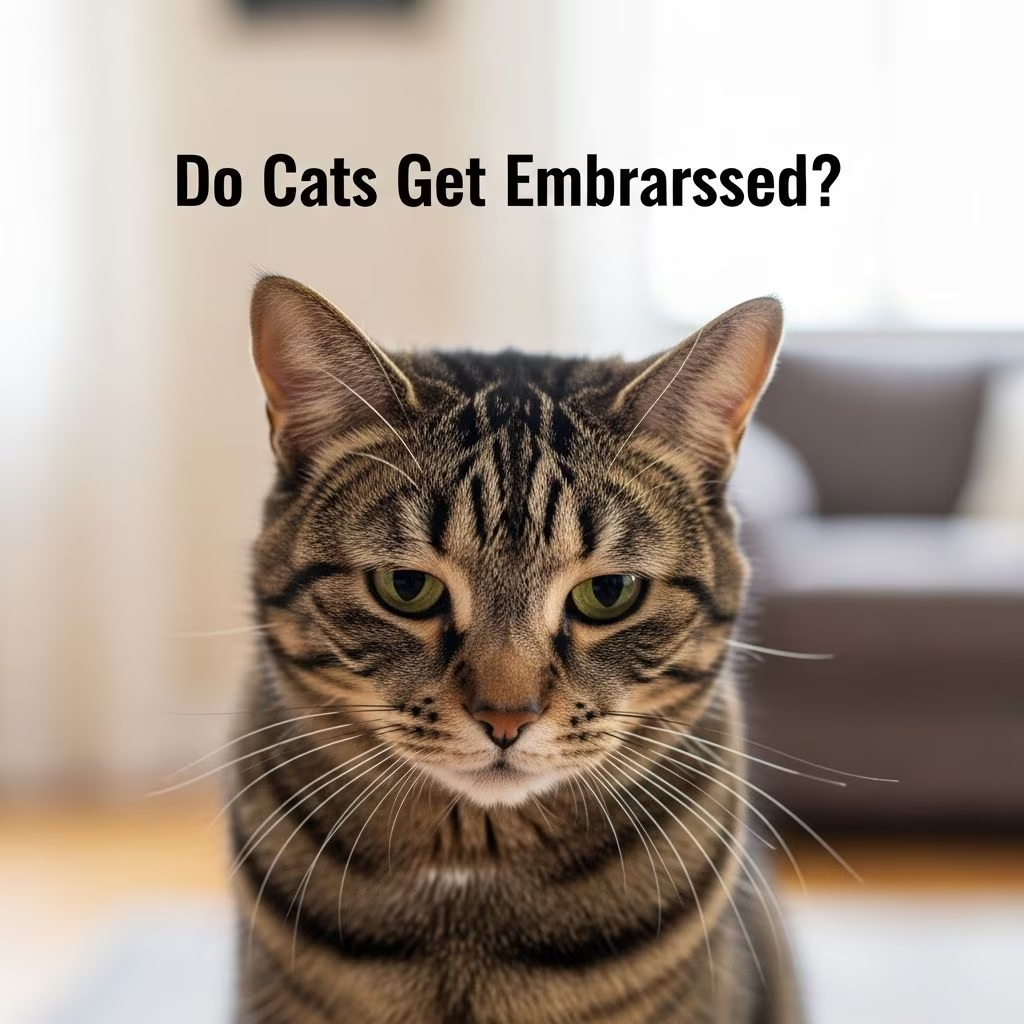
Cats often display behaviors that mimic human embarrassment, such as hiding after knocking over a vase or avoiding eye contact post-mishap, but scientific consensus leans toward these being instinctual responses to stress, fear, or social cues rather than true self-aware shame.
Understanding whether cats experience **embarrassment** requires examining their emotional capacity, body language, and responses to social situations. While cats possess a sophisticated limbic system for processing emotions, complex feelings like embarrassment—tied to self-awareness and perceived judgment—remain debated among experts. This article breaks down the signs, triggers, scientific views, and practical tips for cat owners, drawing from behavioral studies and veterinary insights.
What Does Embarrassment Mean for Cats?
Embarrassment in humans arises from self-awareness in social contexts, where we anticipate judgment for mistakes. For cats, a solitary species by nature, this emotion may not translate directly. Instead, what appears as embarrassment is often discomfort, anxiety, or avoidance learned from owner reactions.
Cats’ limbic systems, responsible for emotions like fear and pleasure, are well-developed, but their social structures differ from pack animals like dogs. Research indicates cats respond to social cues from humans and other felines, potentially showing stress akin to awkwardness after errors. For instance, a cat slipping off a counter might slink away, not from shame, but anticipating scolding based on past experiences.
Distinguishing this from true embarrassment is key: cats lack the mirror self-recognition typical of higher self-awareness in primates. Behavioral experiments suggest they learn from social mistakes, hinting at rudimentary awareness, yet experts emphasize context—stress or confusion often explains these reactions better than anthropomorphism.
Cat owners benefit from empathy here; misinterpreting stress as embarrassment can lead to punishment, worsening anxiety. Recognizing emotions differently fosters better bonding and welfare.
Common Signs That Suggest Cats Feel Embarrassed
Cats communicate via **body language**, and post-mishap behaviors can resemble embarrassment. Key indicators include:
- Avoiding eye contact or turning away: Signals shyness or discomfort, especially after being ‘caught’.
- Flattened ears and tucked tail: Indicates vulnerability, often after clumsy moments.
- Sudden excessive grooming: A self-soothing ritual to regain composure, like after playful interruption.
- Hiding or retreating: Seeking safety post-incident, avoiding interaction temporarily.
- Strange expressions or freezing: After vomiting or falling, cats may look puzzled, seeking reassurance.
These signs cluster after awkward events, but alternatives like fear or illness must be ruled out. Observe patterns: consistent avoidance post-error suggests sensitivity to your reactions. Video your cat’s responses for vets to assess underlying issues.
Why Cats Might Feel Embarrassed in Certain Situations
Cats thrive on routine; disruptions trigger unease mimicking embarrassment. Common triggers:
- Clumsy accidents: Slipping or knocking items draws attention, prompting evasion to avoid perceived annoyance.
- Grooming interruptions: Cats feel exposed mid-lick, leading to evasive maneuvers.
- Social faux pas: Unexpected interactions with cats or humans cause withdrawal or submissive postures.
- New environments: Overwhelm from strangers or changes manifests as hiding, often misread as shame.
- Post-vomit or fall: Cats check surroundings for threats, not self-judgment.
Preventing these builds confidence. Maintain predictability, use positive reinforcement, and provide safe spaces. Sensitivity to changes underscores cats’ need for stable homes.
How Embarrassment Affects Cat Behavior and Bonding
Perceived embarrassment impacts interactions: cats may shun play or affection temporarily, needing space to recover. This withdrawal signals a bid for calm, not sulking.
To strengthen bonds:
- Offer non-judgmental reassurance—gentle pets without fuss.
- Use positive reinforcement to rebuild confidence post-mishap.
- Respect boundaries, avoiding forced interaction.
Empathy deepens trust; punished ’embarrassed’ cats develop fear-based behaviors. A supportive environment enhances emotional resilience and attachment. Studies on feline grooming show restricted self-care (e.g., e-collars) heightens stress, underscoring comfort’s role in well-being.
Scientific Perspectives on Feline Emotions and Embarrassment
Research evolves on cat emotions, with brain imaging revealing human-like processing areas, yet self-awareness lags. A PMC study notes gaps in recognizing negative emotions at home, urging behavioral observation. Recent work deciphers facial expressions and purring, affirming cats’ emotional depth.
| Perspective | Key Finding | Source |
|————|————-|——–|
| Limbic System | Processes stress akin to complex emotions | Zoorithm |
| Self-Awareness | Limited; no mirror test pass | Cats.com |
| Behavioral Learning | Adjusts from social errors | Zoorithm |
| E-Collar Impact | Increases stress via grooming block | Discover Magazine |
| Facial Coding | New tools reveal nuanced feelings | Salon |
Experts concur: cats feel discomfort, not human-style shame. Veterinary guides stress instinct over emotion. Ongoing studies promise deeper insights.
Frequently Asked Questions (FAQs)
Q: Can cats really feel embarrassment like humans?
A: No, cats likely experience stress or fear instead; true embarrassment requires advanced self-awareness they lack.
Q: What behaviors show a cat might be embarrassed?
A: Hiding, avoiding eyes, grooming spikes, ear flattening—often post-mishap, but check for anxiety.
Q: Are cats embarrassed when they fall?
A: They scan for threats, not shame; it’s predator vigilance.
Q: Do cats get embarrassed after throwing up?
A: They seek quiet or reassurance due to unwellness, not embarrassment.
Q: How should I respond if my cat seems embarrassed?
A: Give space, offer calm reassurance, avoid punishment to build trust.
Q: Can the cone of shame embarrass cats?
A: It frustrates via grooming prevention, spiking stress—not humiliation.
These FAQs address owner concerns, promoting science-based care.
References
- Can Cats Feel Embarrassed? Understanding Feline Emotions — Zoorithm. 2023. https://www.zoorithm.com/cats/can-cats-feel-embarrassed
- Do Cats Feel Embarrassment? — Cats.com. 2023. https://cats.com/do-cats-feel-embarrassment
- Yes, the Cone of Shame Most Likely Makes Pets and Their Owners Sad — Discover Magazine. 2020-10-01. https://www.discovermagazine.com/yes-the-cone-of-shame-most-likely-makes-pets-and-their-owners-sad-45821
- Vet 2025 Guide: Do Cats Feel Embarrassed? — AskAVet. 2025. https://askavet.com/blogs/news/vet-2025-guide-do-cats-feel-embarrassed-understanding-feline-reactions-vet-led-support-%F0%9F%90%B1%F0%9F%99%88
- Recognising and assessing feline emotions during the consultation — PMC (NCBI). 2024. https://pmc.ncbi.nlm.nih.gov/articles/PMC11395287/
- New research is changing our understanding of cat emotions — Salon. 2023-11-03. https://www.salon.com/2023/11/03/new-research-is-changing-our-understanding-of-cat-emotions-from-purring-to-their-facial-expressions/



