

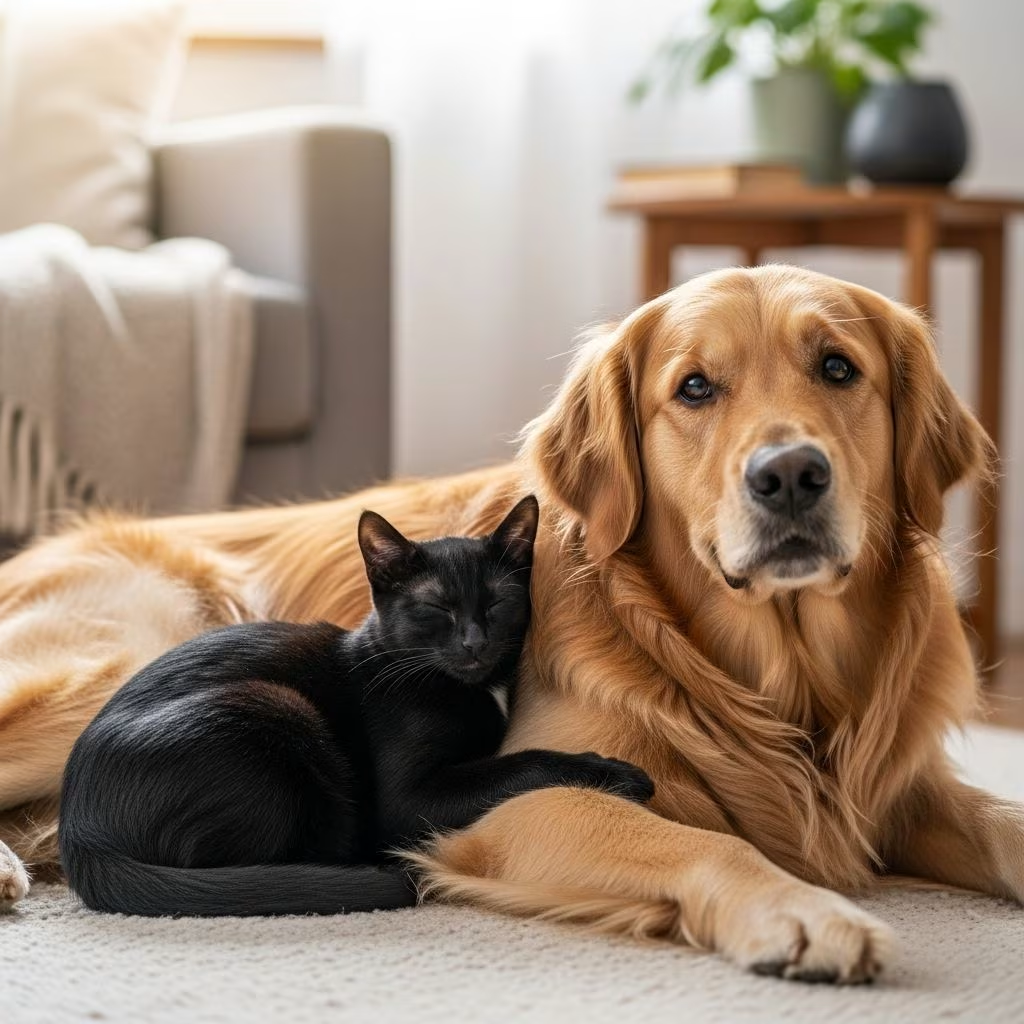
The notion that cats and dogs are natural enemies is a persistent stereotype perpetuated by cartoons, movies, and anecdotal tales of hissing cats chasing dogs or territorial skirmishes. But does science support this idea? Research indicates that while dogs and cats have distinct communication styles and social tendencies, they do not inherently “hate” each other. Instead, their interactions are heavily influenced by socialization, familiarity, and environment. A study published in PLOS ONE found that most dogs and cats living together engage in playful behaviors, with 76.2% showing sociability toward familiar humans, though dogs tend to be more outgoing with strangers and conspecifics than cats.
This article delves into the science behind cat-dog dynamics, debunking myths, exploring behavioral differences, and providing actionable advice for introducing these pets successfully. Drawing from peer-reviewed research, we’ll examine why cohabitation often works better than expected and how owners can foster positive relationships.
Why Do Cats and Dogs Seem to Hate Each Other?
The perception of enmity stems from fundamental differences in their evolutionary histories and communication. Dogs, descendants of pack-hunting wolves, are highly social and attuned to hierarchical structures, often approaching new animals actively—either playfully or aggressively. Cats, solitary hunters by nature, prefer independence and may respond to canine advances with avoidance, hissing, or swatting, which humans interpret as hatred.
Dogs use broad body language like wagging tails and play bows, while cats rely on subtle cues such as ear positions and tail flicks. A mismatch in these signals can lead to misunderstandings: a dog’s friendly tail wag might seem threatening to a cat, prompting defensive reactions. However, the PLOS ONE study reveals that when living together, cats and dogs adapt, with cohabiting pairs often sleeping and playing together, showing few aggressive interactions.
- Evolutionary roots: Dogs’ pack mentality vs. cats’ solitary lifestyle leads to different social approaches.
- Communication gaps: Dogs’ overt signals vs. cats’ nuanced postures cause misinterpretations.
- Owner bias: Media and stories amplify rare conflicts, ignoring harmonious homes.
The Science Behind Cat-Dog Interactions
Empirical data challenges the hate narrative. In a comprehensive survey of owners with both pets, researchers found dogs more sociable and protective, while cats were perceived as more neurotic, yet interspecies bonds formed through familiarity. Cats displayed affiliative behaviors like ‘tail up’ postures, which dogs interpreted positively, leading to friendly responses.
Another study in Frontiers in Veterinary Science notes that while cat owners may perceive less control over their pets compared to dog owners, this doesn’t preclude strong bonds; cats simply exhibit more autonomy. Dogs form secure attachments using owners as a ‘secure base,’ but cats show independence even in unfamiliar settings, vocalizing out of frustration rather than separation anxiety.
Key findings from research:
- 76.2% of cohabiting dogs and cats are playful with humans; dogs are friendlier to strangers.
- Cats ignore or flee dogs initially, but familiarity promotes play and proximity.
- Both species understand cross-species cues: cat ‘tail up’ elicits dog friendliness.
- Cats’ independence: They don’t seek owners for security like dogs do.
Do Cats and Dogs Get Along? Real-World Evidence
Yes, many do—far more than media suggests. The PLOS ONE study confirmed that household dogs and cats develop social bonds, retaining species traits but engaging in mutual play. Owners reported low aggression, with cats approaching dogs amicably via tail signals and dogs responding in kind.
A CABI study on multi-pet homes found that early exposure is crucial; cats and dogs introduced young form amicable ties, modulated by personality—dogs as sociable, cats more reserved. In Mexico-based research, cat-owner bonds scored higher overall due to lower perceived costs (less responsibility), though emotional closeness was stronger with dogs.
| Factor | Dogs | Cats |
|---|---|---|
| Sociability | High (active approach) | Moderate (selective) |
| Attachment to Owner | Secure base, high closeness | Independent, lower cost |
| Response to Other Species | Sociable/aggressive | Ignore/escape |
| Cohabitation Success | Playful with familiarity | Bonds via proximity |
This table summarizes behavioral contrasts, highlighting compatibility potential.
How to Introduce Cats and Dogs Successfully
Success hinges on gradual, supervised introductions. Start with scent swapping—rub a cloth on one pet and let the other sniff it. Use baby gates for visual acclimation without contact. Reward calm behaviors with treats.
- Prepare spaces: Provide separate food, water, litter, and beds to reduce resource guarding.
- Timing matters: Introduce puppies/kittens to adults for better acceptance; reverse for adults.
- Supervise always: Watch body language—relaxed ears/tail good; stiff postures signal stress.
- Training: Teach dogs ‘leave it’ and cats to use high perches for escape.
Research supports early socialization: Feuerstein and Terkel (via CABI) showed young exposure fosters lifelong amicability. Patience yields results; most pairs adapt within weeks.
Understanding Cat and Dog Body Language
Decoding signals prevents escalation. Dogs’ play bows and loose wags invite fun; stiff tails mean tension. Cats’ slow blinks signal trust, puffed tails aggression.
Cross-species: Cat’s vertical ‘tail up’ is affiliative, prompting dog friendliness. Dog’s tail wag might alarm cats, eliciting hisses—owners must intervene.
- Dog friendly: Play bow, wagging tail low, soft eyes.
- Dog aggressive: Stiff body, high tail, intense stare.
- Cat friendly: Tail up, slow blink, upright posture.
- Cat defensive: Hissed, arched back, flattened ears.
Common Myths About Cats and Dogs
Myth 1: Cats always hate dogs. False—familiarity overrides instincts.
Myth 2: Dogs chase cats innately. Prey drive exists but socialization curbs it.
Myth 3: Once they fight, it’s over. Mediated reintroductions often succeed.
Myth 4: Cats are antisocial. Studies show selective sociability, stronger in multi-pet homes.
When to Seek Professional Help
If aggression persists—snarling, swatting, chasing—consult a veterinary behaviorist. Signs include resource guarding or fear-based attacks. Tools like pheromone diffusers (Feliway for cats, Adaptil for dogs) aid calming. Never force interactions; safety first.
Frequently Asked Questions (FAQs)
Do cats and dogs naturally hate each other?
No, research shows they can form bonds with proper introduction; initial wariness is instinctual, not hatred.
Can adult cats and dogs get along?
Yes, though slower than with young pets; gradual exposure works.
Why do cats hiss at dogs?
Hissing signals discomfort from mismatched body language or invasion of space.
How long for cats and dogs to adjust?
Weeks to months; monitor progress daily.
Are some breeds better with cats?
Yes, retrievers and labs often tolerate cats; terriers may have higher prey drive.
Conclusion
Cats and dogs don’t hate each other—their ‘rivalry’ is a myth dispelled by science. With understanding, patience, and science-backed strategies, multi-pet homes thrive, enriching lives for pets and owners alike.
References
- Best friends or deadly enemies? What the owners of cats and dogs living together think of their interspecific relationship. — Menchetti L et al. PLOS ONE. 2020-08-26. https://journals.plos.org/plosone/article?id=10.1371/journal.pone.0237822
- Pet–Human Relationships: Dogs versus Cats. — González-Ramírez MT et al. PMC – NIH. 2021-09-22. https://pmc.ncbi.nlm.nih.gov/articles/PMC8470704/
- New research shows why cats are more independent than dogs. — University of Lincoln. Phys.org. 2015-09-10. https://phys.org/news/2015-09-cats-independent-dogs.html
- Do people really care less about their cats than about their dogs? — Frontiers in Veterinary Science. 2023-10-12. https://www.frontiersin.org/journals/veterinary-science/articles/10.3389/fvets.2023.1237547/full
- A Study on the Attachment to Pets Among Owners of Cats and Dogs. — PMC – NIH. 2024 (approx.). https://pmc.ncbi.nlm.nih.gov/articles/PMC11718770/
- Exploring the impact of dogs on the human-cat relationship. — CABI Digital Library. 2024. https://www.cabidigitallibrary.org/doi/10.1079/hai.2024.0007



