

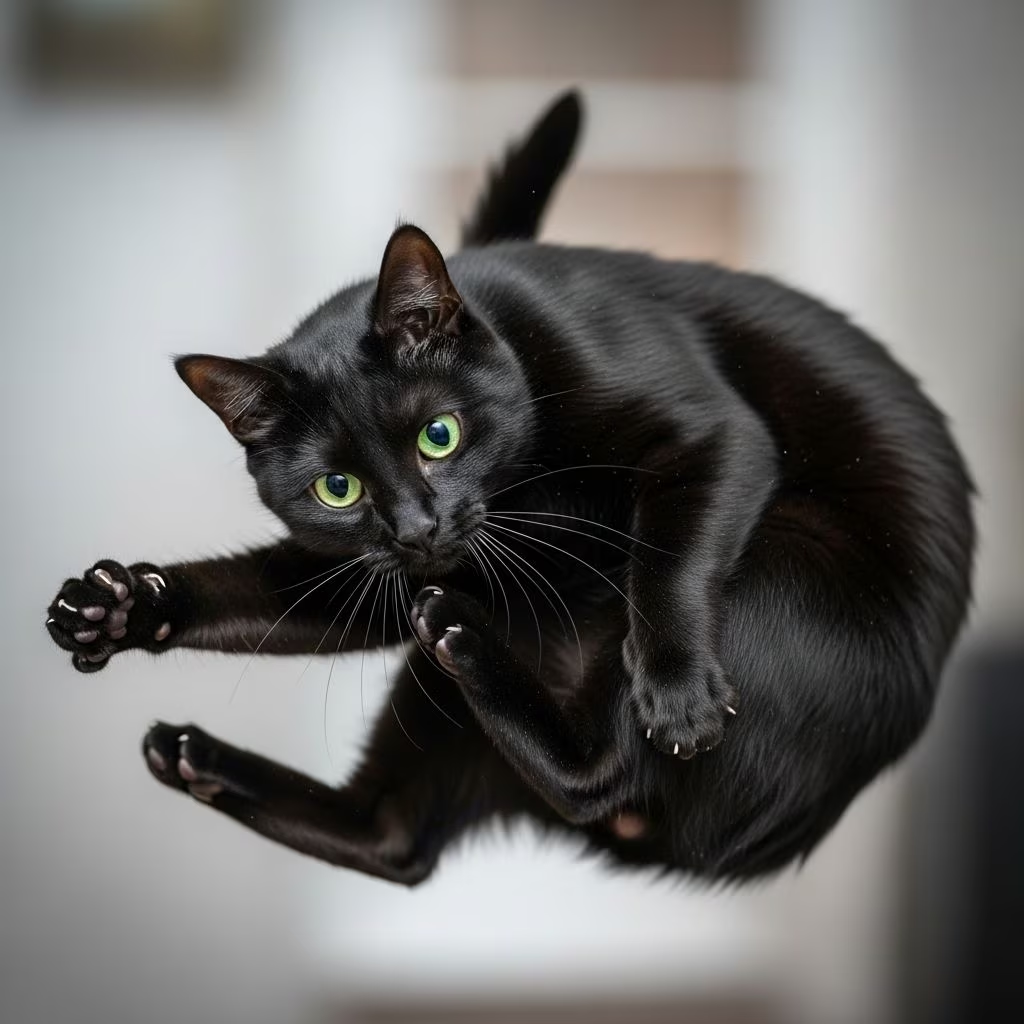
Do Cats Always Land on Their Feet? Understanding the Righting Reflex
One of the most remarkable abilities in the animal kingdom is a cat’s seemingly superhuman capacity to land gracefully on its feet, even when falling from seemingly impossible heights. This phenomenon has captivated scientists, pet owners, and animal enthusiasts for centuries. But is it truly an absolute guarantee, or is there more to the story than meets the eye? The answer lies in understanding the extraordinary biological and physical mechanisms that cats employ during a fall—a phenomenon known as the cat righting reflex.
The cat righting reflex is an innate and automatic ability that allows felines to reorient their bodies mid-air during a fall to land safely on their feet. This incredible skill is the result of millions of years of evolutionary refinement, combining exceptional flexibility, advanced sensory systems, and intuitive physics. Understanding this ability not only reveals the remarkable engineering of the feline body but also highlights why cats are considered one of nature’s most agile creatures.
What Is the Cat Righting Reflex?
The cat righting reflex is fundamentally a cat’s innate ability to sense its orientation in space and then adjust its body position to land safely during a fall. Unlike humans, who would find themselves helpless when tumbling through the air, cats possess an automatic response system that kicks in the moment they sense they are falling. This reflex isn’t learned—it’s hardwired into a cat’s neurobiology from birth.
The development of this reflex follows a predictable timeline in kittens. The righting reflex begins to appear at approximately 3 to 4 weeks of age, when kittens are still quite young and relatively immobile. However, the reflex continues to develop and strengthen over the following weeks. By the time kittens reach 6 to 9 weeks of age, they have typically mastered this ability completely and can execute the maneuver with impressive consistency.
This developmental timeline is crucial for understanding feline behavior. Kittens born in the wild or to outdoor cats need this skill relatively early in their lives, as they begin exploring their environments and climbing at increasingly greater heights. The rapid maturation of this reflex ensures that young cats can handle the inevitable tumbles that come with their natural climbing and exploring behaviors.
The Anatomy Behind the Magic
The cat righting reflex isn’t magic—it’s the result of exceptional anatomical features that cats possess. Understanding these physical characteristics is essential to appreciating how cats accomplish this feat of agility and control.
Flexible Spine
Perhaps the most critical anatomical feature enabling the righting reflex is the cat’s extraordinarily flexible spine. Unlike humans, who have 33 vertebrae, cats have approximately 30 vertebrae that are arranged in a way that allows for exceptional mobility and flexibility. These vertebrae are connected by highly flexible ligaments and discs that permit rotation, bending, and twisting movements that would be impossible for humans. The cat’s spine can bend, arch, compress, and twist with remarkable ease, allowing the front and rear halves of the body to move almost independently of each other.
This flexibility is absolutely fundamental to the righting reflex. Without such an adaptable spine, cats would not have the range of motion necessary to rotate their bodies mid-air to correct their orientation before landing.
Lack of a Functional Collarbone
Another crucial anatomical feature that distinguishes cats from many other mammals is the absence of a functional collarbone, or clavicle. While cats do have a clavicle, it is extremely small and not connected to other bones in the way that human collarbones are. This structural difference allows cats to rotate their front legs and shoulders with far greater freedom than other animals. The lack of a rigid collarbone connection enables cats to compress their front legs tightly against their body and move them through a much wider range of motion, contributing significantly to their ability to reorient during a fall.
The Vestibular Apparatus
Working in concert with the physical structures of the spine and skeleton is an advanced sensory system located in the cat’s inner ear. The vestibular apparatus is a fluid-filled system within the inner ear that functions as a sophisticated balance and orientation detection mechanism. This system allows cats to determine which way is up and down, even when they are rotating rapidly through the air. The vestibular apparatus contains specialized cells that detect movement and changes in head position, providing cats with real-time information about their spatial orientation.
When a cat begins to fall, the vestibular apparatus immediately signals to the cat’s brain which direction is toward the ground. This sensory information is absolutely essential—without it, the cat would have no way of knowing how to orient its body to land safely. Cats with vestibular disorders may experience difficulty maintaining balance and executing the righting reflex properly, highlighting just how important this sensory system is.
How Does the Righting Reflex Work? The Physics Explained
The actual mechanics of how cats execute the righting reflex involve a sophisticated combination of anatomy, physics, and instinctive motor control. Researchers have spent decades studying this phenomenon, and while they still debate some details, the basic sequence of movements is now well understood.
The Bend-and-Twist Method
The most widely accepted explanation for how cats right themselves during a fall is known as the “bend-and-twist” model. This approach relies on a principle from physics called conservation of angular momentum, which states that the total angular momentum of a system remains constant unless an external force acts upon it.
Here’s how the bend-and-twist method works in practice. When a cat senses it is falling, it first uses its vestibular apparatus to determine which way is up. Once the cat has this directional information, it bends its flexible spine at the waist, effectively creating two separate axes of rotation within its body—one for the front half and one for the rear half.
The cat then rotates these two body halves in opposite directions. To accomplish this rotation effectively, the cat employs a clever strategy involving its limbs. It tucks its front legs in close to its body to reduce the moment of inertia of the front half, allowing that section to rotate more dramatically. Simultaneously, the cat extends its back legs outward, increasing the moment of inertia of the rear half, which causes it to rotate less.
Through this mechanism, the cat can rotate its front half by as much as 90 degrees while the rear half rotates in the opposite direction by only about 10 degrees. The result is that the front half of the body turns to face downward even though the cat started the maneuver upside down.
The Second Phase of Rotation
Once the front half is facing downward, the cat reverses the process. It extends its front legs outward and tucks its back legs in toward the body. This reversal of the leg positions causes a reversal in the direction and amount of rotation. Now the rear half rotates more while the front half rotates less. This allows the back legs to catch up with the front legs and align with them.
Depending on the cat’s flexibility and how much angular momentum it had initially, the cat may need to repeat these steps multiple times to achieve a complete 180-degree rotation. However, all of this happens incredibly quickly—typically within just a few seconds—making it appear almost instantaneous to observers.
The Landing Position
As the cat approaches the ground, it shifts from rotation mode to landing mode. The sequence includes the cat twisting its head to spot the ground, aligning its front legs while twisting its upper body, bringing its rear legs into alignment with the front legs, and finally arching its back and spreading its legs to slow its descent. This spread-leg position increases air resistance and drag, which helps slow the cat’s rate of fall and reduces the impact force when it strikes the ground.
Does the Tail Play a Role?
Popular belief holds that the cat’s tail is essential to the righting reflex, and while the tail does seem to help, it is not absolutely necessary for the maneuver to succeed. Cats without tails—whether due to breed (such as Manx cats), injury, or congenital conditions—are still able to right themselves and land on their feet. The primary mechanism relies on the spine, vertebrae, and limb positioning rather than the tail.
That said, the tail does appear to assist in the righting process by helping with balance and fine-tuning the rotation. The tail can serve as a counterbalance during the rotation sequence, helping the cat achieve the precise angular momentum necessary for successful landing.
The Evolutionary Advantages
The cat righting reflex did not develop by chance—it evolved because it provided survival advantages in the wild. Cats are natural climbers and hunters that often scale trees, buildings, and other elevated structures in search of prey or safety. In these environments, falling is a genuine risk that early feline ancestors faced regularly. The ability to land on their feet and potentially escape injury increased the likelihood of survival and reproduction, so the trait became increasingly common in the feline lineage.
Beyond mere survival, the righting reflex also protects vital organs. By landing on their feet with their legs spread to absorb impact, cats distribute the force of landing throughout their body more evenly rather than concentrating it on vulnerable organs like the head or spine. This reduces the likelihood of fatal or catastrophic injuries from falls that might otherwise prove deadly.
Important Limitations to Understand
While the cat righting reflex is extraordinary, it is crucial to understand that it is not an absolute guarantee of safety in all situations. Several important limitations exist.
Height Requirements
First, the cat needs sufficient height to complete the righting maneuver. Falls from very low heights—such as falling from a chair or couch—may not give the cat enough time to rotate and position itself properly. Research suggests cats need approximately 12 to 24 inches of fall distance to reliably execute the complete righting sequence. Paradoxically, this means that very short falls can sometimes result in injuries, while longer falls may result in fewer injuries because the cat has adequate time to complete the maneuver and reach terminal velocity.
Terminal Velocity and High-Rise Syndrome
A fascinating study on feline high-rise syndrome found that cats falling from extreme heights—up to 32 stories—often had better survival rates than those falling from intermediate heights. The research suggested that after falling approximately five stories, cats reached terminal velocity (the maximum speed at which they fall), at which point they relaxed and spread their bodies to increase air resistance. This spread-body position acts like a parachute, significantly reducing the impact force when they finally land.
However, this finding has been subject to legitimate criticism. Critics point out that the study may suffer from survivorship bias—that is, only cats that survived their falls were brought to veterinarians and included in the study data, while cats that died from their falls were not recorded. This makes it difficult to draw definitive conclusions about injury rates at different heights.
Other Factors Affecting Success
Several other factors can influence whether a cat successfully lands on its feet:
- Age: Very young kittens (under 3 weeks) and elderly cats may have difficulty executing the reflex effectively.
- Health and Injury: Cats with vestibular disorders, spinal injuries, or other health conditions may struggle with the righting reflex.
- Stress and Panic: A cat that is panicked or extremely frightened may not execute the maneuver optimally.
- Initial Orientation: The position from which the cat falls can affect its ability to right itself.
- Surface Below: The type of surface a cat lands on significantly impacts injury severity. Landing on hard concrete is far more dangerous than landing on grass or soil.
What Science Says About Cat Righting
The physics of the cat righting reflex has been the subject of serious scientific study for well over a century. Early researchers were puzzled by how cats could land on their feet without any apparent external force providing the initial angular momentum needed for rotation. The “bend-and-twist” model solved this conceptual problem by showing how cats could use their body flexibility to achieve rotation without an external force, relying solely on conservation of angular momentum.
Modern research continues to reveal additional nuances about how cats execute this maneuver. Studies have shown that cats rely on working memory to help them navigate and avoid obstacles. Once their front legs have cleared an obstacle during a jump, their working memory helps position their hind legs to avoid it as well, demonstrating that feline movement involves more cognitive processing than previously realized.
Frequently Asked Questions About Cat Righting
Q: Do all cats have the righting reflex?
A: Most healthy adult cats possess the righting reflex. Kittens develop it gradually between 3 to 9 weeks of age. However, cats with certain health conditions, vestibular disorders, or injuries may experience difficulty executing the reflex.
Q: Is it safe to drop a cat to test the righting reflex?
A: No. Never intentionally drop a cat to test the righting reflex. Even with this remarkable ability, cats can suffer serious injuries from falls. It’s better to prevent falls through environmental safety measures.
Q: Can cats always land on their feet from any height?
A: No. While cats have an impressive ability to land on their feet, they need sufficient height (typically 12 to 24 inches minimum) to complete the rotation. Very short falls and falls from extreme heights both carry increased injury risks.
Q: What happens if a cat loses its tail?
A: Cats can still right themselves and land on their feet even without a tail. The tail assists the process but isn’t essential to the righting reflex mechanism.
Q: Should I be concerned about my cat jumping from high places?
A: Yes. While cats have excellent righting reflexes, falls from significant heights can still cause serious injury or death. Prevent access to high, dangerous areas and provide safe climbing structures designed for cats.
Q: At what age do kittens develop the righting reflex?
A: The righting reflex begins to appear at 3 to 4 weeks of age and is fully developed and mastered by 6 to 9 weeks of age.
Keeping Your Cat Safe
Understanding the cat righting reflex is fascinating, but it’s important to remember that this ability should never be used as justification for allowing cats unsupervised access to dangerous heights. While the righting reflex is remarkable, it is not foolproof, and accidents can happen. Responsible pet ownership involves creating a safe environment for your feline companion by securing windows and screens, providing appropriate climbing structures, and preventing access to dangerous ledges or balconies.
The cat righting reflex represents one of nature’s most elegant solutions to a practical problem—how to survive falls from height in an arboreal environment. By combining exceptional flexibility, sophisticated sensory systems, and intuitive physics, cats have evolved one of the animal kingdom’s most remarkable abilities. However, this ability should inspire wonder and appreciation rather than complacency about feline safety.
References
- Cat righting reflex — Wikipedia. Retrieved from https://en.wikipedia.org/wiki/Cat_righting_reflex
- Do Cats Always Land on Their Feet? What is a Cat’s Righting Reflex? — Kinship. Retrieved from https://www.kinship.com/uk/cat-behaviour/cat-righting-reflex
- Righting Reflex: Exploring the Claim That Cats Always Land on Their Feet — Rover. Retrieved from https://www.rover.com/blog/how-do-cats-land-on-their-feet/
- Amazing Fact About Cats: The Righting Reflex Explained — PetsCare. Retrieved from https://www.petscare.com/news/faq/what-is-an-amazing-fact-about-cats
- Learn the Riveting Physics Behind the “Cat-Righting” Reflex — A-Z Animals. Retrieved from https://a-z-animals.com/articles/how-do-cats-maneuver-so-gracefully/
- Feline Physics: How The Righting Reflex Helps Cats Stick A Landing — Fear Free Happy Homes. Retrieved from https://www.fearfreehappyhomes.com/feline-physics-how-the-righting-reflex-helps-cats-stick-a-landing/
- The enduring puzzle of why cats always land on their feet — Science Focus. Retrieved from https://www.sciencefocus.com/science/the-enduring-puzzle-of-why-cats-always-land-on-their-feet



