

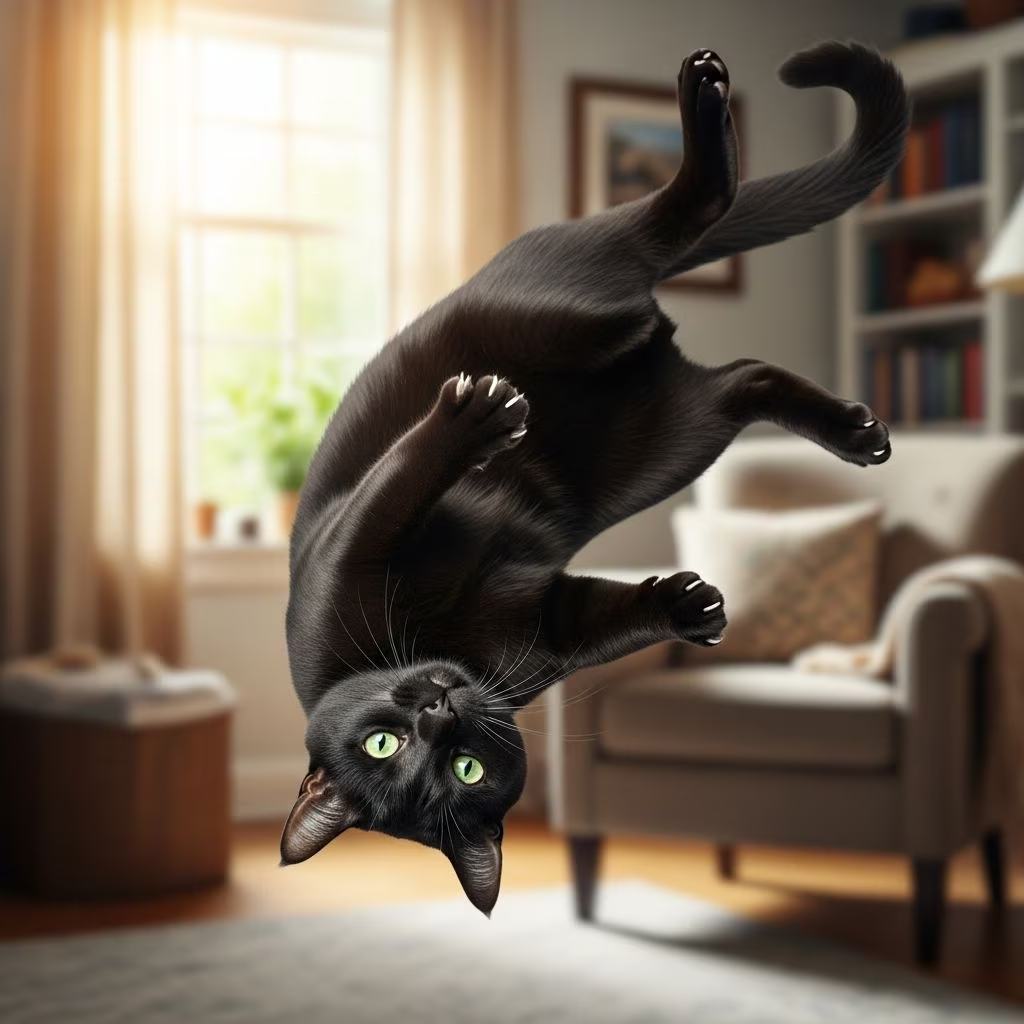
Do Cats Always Land on Their Feet?
The image of a cat gracefully twisting mid-air and landing perfectly on all four paws has captivated pet owners and scientists alike for centuries. But do cats truly always land on their feet, or is this just a popular myth? The answer is nuanced: most healthy cats can rotate in midair and land on their feet thanks to an automatic response called the righting reflex, but this ability is not absolute and comes with important limitations.
Understanding the Righting Reflex
The cat righting reflex is a complex physiological response that allows felines to orient their bodies during a fall. This nearly automatic ability has fascinated researchers for centuries because it seemed to defy the laws of physics. The reflex is powered by a sophisticated combination of biological systems: a balance system in the inner ear, a spine made of approximately 30 flexible vertebrae, and shoulders that are not locked in place by a collarbone, allowing the front and back halves of the body to twist independently during a fall.
Kittens typically begin demonstrating this flip at around three weeks old and have mostly mastered it by about seven weeks, which is impressively early for such a complex maneuver. However, the development of this reflex depends on more than just age. Research has shown that the righting reflex is primarily a vestibular-controlled reaction, meaning it relies heavily on the inner ear’s balance systems rather than vision alone.
How the Righting Reflex Actually Works
Step 1: Sensing Which Way Is Up
When a cat slips or misjudges a jump, fluid-filled structures in the inner ear detect that the body is no longer upright and send rapid signals to the brain about which way “down” is. This balance hardware, called the vestibular apparatus, includes semicircular canals and tiny dense structures that sense acceleration, helping the cat realize it is falling even before your own brain reacts. The vestibular system is so sensitive that it can detect the slightest change in position, allowing the cat’s muscles to begin responding almost instantaneously.
Step 2: Twisting Without Breaking the Laws of Physics
For a long time, scientists were baffled by how cats could rotate in midair without anything to push against, which appeared to violate the principle of conservation of angular momentum. The eventual solution revealed that cats are not rigid cylinders. Instead, they employ a sophisticated technique where they bend in the middle and rotate the front and back halves in opposite directions, similar to twisting a pepper grinder.
The process involves two primary phases:
- Bend and Twist Phase: The cat arches its spine, turns the front half one way and the back half the other, and starts to align the head and chest toward the ground.
- Tuck and Turn Phase: The cat tucks some legs and stretches others, changing how mass is distributed, much like a figure skater pulling in their arms to spin faster or extending them to slow down.
This ingenious method was first detailed by researcher Rudolf Magnus, who conducted extensive studies on cat behavior. Through cinematographic recordings and serial photography, Magnus demonstrated that the reaction is induced by a turning of the head, followed by the neck positioning reflex, which causes the body to follow the head, first with the thorax, then with the pelvis.
Step 3: The Perfect Landing
The landing itself is another engineering marvel. Biomechanics research with force plates and motion capture found that when cats jump down from about 3.3 to 6.6 feet, their front legs hit first and the elbow joints do most of the energy absorption, while the hips dominate the work in the hind legs. The forelimb “buffering” phase only lasts around 0.05 seconds, but in that instant the joints bend and muscles act like springs to turn a violent impact into a smooth crouch. Long, angled legs and flexible joints mean the bones do not take the shock in a straight vertical line, further reducing the risk of injury on impact.
The Biology Behind the Ability
Several anatomical features work together to enable cats’ remarkable landing ability:
- Flexible Spine: With approximately 30 vertebrae (compared to 33 in humans), cats possess extraordinary spinal flexibility that allows them to contort their bodies mid-air.
- No Collarbone: Unlike many other animals, cats have no collarbone locking their shoulders in place, allowing independent rotation of their front and back halves.
- Vestibular System: The inner ear’s balance system continuously monitors the cat’s position and orientation relative to gravity.
- Sensitive Reflexes: Rapid neural responses throughout the body allow for coordinated twisting and repositioning in milliseconds.
When Does the Righting Reflex Develop?
The righting reflex does not emerge immediately at birth. Kittens typically show signs of the flip at around three weeks of age, with the ability becoming largely refined by seven weeks old. Interestingly, a 1984 study on kittens blinded since birth demonstrated that the development in blind kittens progresses the same as in normal kittens with vision, with the skill becoming mature by 33 days. This finding confirms that vision is not essential for developing the righting reflex; the vestibular system is the primary control mechanism.
Additionally, experiments in the mid-1900s showed that adult cats could still perform a version of this righting maneuver in brief zero-gravity flights, while very young kittens could not. This observation reinforces that the reflex depends on the maturation of inner-ear structures as well as experience moving through space.
What the Righting Reflex Can and Cannot Do
| What It Helps With | What It Does Not Prevent |
|---|---|
| Rotating the body so the feet point down during falls from around 2.5–3 feet or higher, reducing the chance of a head-first impact | Serious injury or death from high falls, especially without prompt veterinary care after landing |
| Spreading impact forces across all four limbs and allowing elbows, hips, and other joints to absorb much of the landing energy | Damage to lungs, internal organs, teeth, or spine from high-rise syndrome, even when the landing looked “clean” |
| Improving survival odds in accidental falls from multi-story buildings when combined with emergency veterinary treatment | Problems caused by obesity, arthritis, or vestibular disease that slow the reflex or make the landing awkward |
The Myth vs. Reality
While the righting reflex is indeed a remarkable ability, the phrase “cats always land on their feet” is not entirely accurate. Several factors can compromise the effectiveness of this reflex:
- Fall Height: Falls from very short distances (less than 2-3 feet) may not provide enough time for the reflex to work properly.
- Health Conditions: Obesity, arthritis, or vestibular disease can slow or impair the reflex.
- Age and Development: Very young kittens and elderly cats may have compromised righting abilities.
- High-Rise Syndrome: Falls from extreme heights can result in fatal injuries despite successful body rotation, as the impact forces exceed what even perfectly positioned limbs can absorb.
- Tail Loss: Some cats leverage their tails during the righting process, though tailless cats can still turn themselves successfully.
High-Rise Syndrome: When the Reflex Isn’t Enough
One of the most important realities to understand is that while cats can land on their feet, this ability does not protect them from serious injury or death in high falls. High-rise syndrome refers to injuries sustained by cats falling from multi-story buildings. Even when a cat successfully lands on all four paws, the impact forces from heights above six stories can cause devastating internal injuries, broken bones, lung damage, and organ failure. Veterinary intervention is critical for survival and recovery in these cases.
The Role of Working Memory
Beyond the automatic righting reflex, cats also employ working memory to help them navigate and avoid obstacles during falls. Once their forelegs have stepped over an obstacle, their working memory helps them position their hindlegs to avoid it as well. Scientists suggest that the motor commands used for the forelegs combine with their visual information about the size and location of the obstacle, establishing a memory of the obstacle in relation to the cat’s body that they utilize while still in motion. This cognitive component adds another layer of sophistication to feline agility.
Frequently Asked Questions
Q: Do all cats have the righting reflex?
A: Most healthy adult cats possess a functional righting reflex. However, very young kittens, elderly cats, and those with health conditions affecting the vestibular system may have impaired or underdeveloped reflexes.
Q: Can cats without tails still land on their feet?
A: Yes. While some cats use their tails to help with balance and rotation during falls, cats without tails can still successfully execute the righting reflex and land on their feet.
Q: At what age do kittens master the righting reflex?
A: Kittens typically begin showing signs of the reflex at around three weeks of age and have mostly mastered it by approximately seven weeks old.
Q: Is vision necessary for the righting reflex to work?
A: No. Studies of blind kittens have shown that the vestibular system (inner ear balance) is the primary control mechanism, and vision is not essential for the reflex to develop normally.
Q: Can falls from any height be survived if a cat lands on its feet?
A: No. While the righting reflex helps reduce injury risk in falls from moderate heights, extremely high falls can cause fatal injuries despite successful body rotation. Heights above six stories significantly increase the risk of death.
Q: How long does the righting reflex take?
A: The entire righting reflex happens in milliseconds. The forelimb buffering phase during landing lasts approximately 0.05 seconds, but the initial rotation begins almost instantaneously once the cat detects it is falling.
References
- Cat Turning: The Righting Reflex — Mouritz, Specialist Publisher on the Alexander Technique. https://mouritz.org/companion/article/cat-turning
- Why Cats Land on Their Feet: The Righting Reflex — Meowant. https://meowant.com/blogs/comprehensive-guides/why-cats-land-on-their-feet
- Righting Reflex: Exploring the Claim That Cats Always Land on Their Feet — Rover. https://www.rover.com/blog/how-do-cats-land-on-their-feet/
- Learn the Riveting Physics Behind the “Cat-Righting” Reflex — A-Z Animals. https://a-z-animals.com/articles/how-do-cats-maneuver-so-gracefully/
- The Enduring Puzzle of Why Cats Always Land on Their Feet — BBC Science Focus. https://www.sciencefocus.com/science/the-enduring-puzzle-of-why-cats-always-land-on-their-feet
- How Do Cats Land on Their Feet? — Live Science. https://www.livescience.com/animals/cats/how-do-cats-land-on-their-feet



