

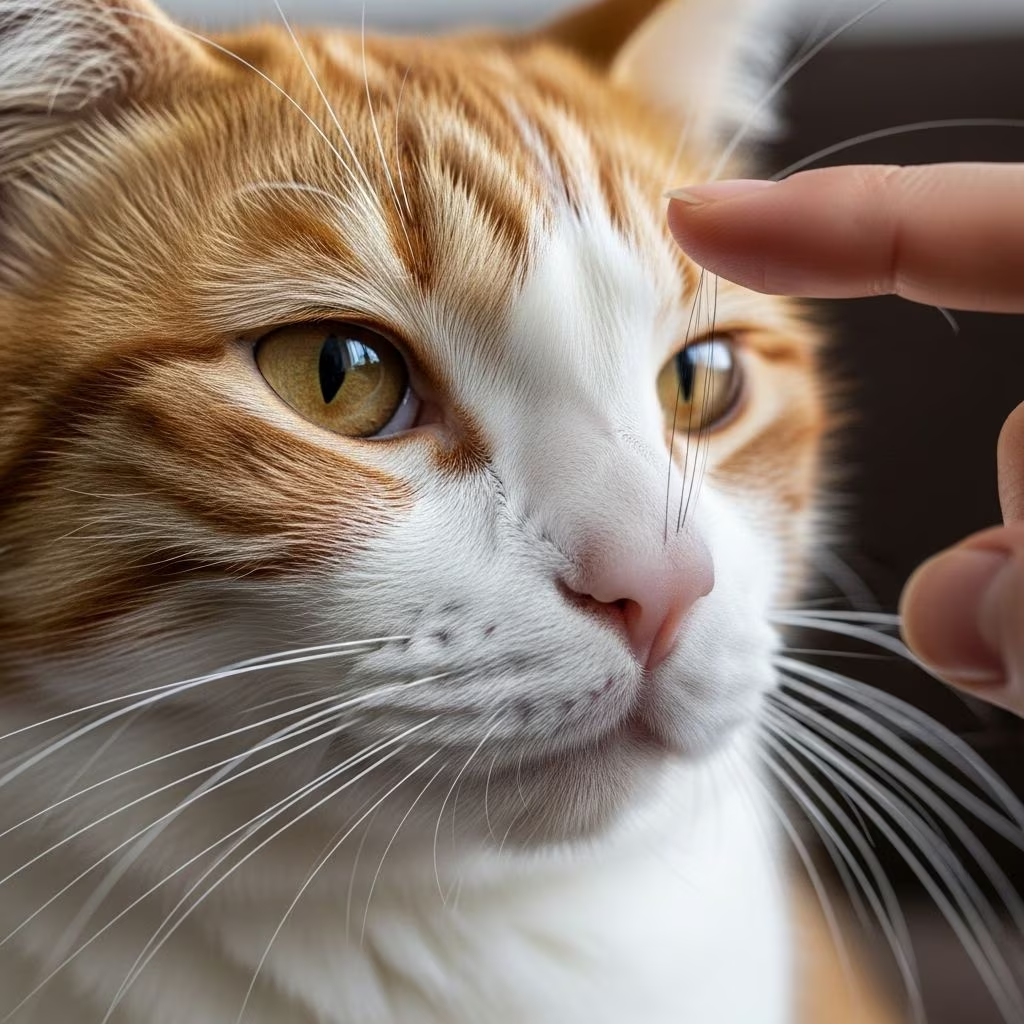
Cat whiskers, or vibrissae, serve as essential sensory organs that help felines navigate their world with precision. While the whisker shaft itself lacks nerve endings, the follicle at its base is packed with nerves and blood vessels, making rough handling or pulling painful for cats. Gentle touching typically causes no pain, but overstimulation or damage can lead to discomfort or stress.
The Anatomy and Role of Feline Whiskers
Whiskers are specialized hairs embedded deeply in hair follicles surrounded by a dense network of sensory nerves. These nerves detect even the slightest air currents, vibrations, or touches, transmitting signals directly to the brain. This setup allows cats to gauge distances, detect obstacles in the dark, and maintain balance through proprioceptors at whisker tips.
Located on the muzzle, above the eyes, on cheeks, and even the forelegs, whiskers act like radar systems. They help cats judge tight spaces, hunt prey by sensing movements, and communicate emotions through positioning. Forward-pointing whiskers signal curiosity, while flattened ones indicate fear or aggression.
Key Functions of Whiskers
- Navigation: Whiskers measure spatial width, preventing cats from entering spaces too narrow for their bodies.
- Balance and Proprioception: Proprioceptors relay body position data to the brain, aiding agility and right-side-up landings.
- Hunting and Sensing: Vibrations from air or prey movement provide environmental intel.
- Communication: Whisker position reveals mood, crucial for veterinary pain assessments.
Can Cats Feel Pain Directly in Their Whiskers?
The whisker hair does not contain pain receptors along its length, so trimming the tips does not hurt. However, the root is highly vascularized and innervated, so plucking, pulling, or bending whiskers forcefully causes significant pain similar to pulling a human hair.
Rough touching can irritate the sensitive follicle, leading to discomfort. Cats may react by pulling away, flattening ears, or swatting if whiskers are mishandled. In pain assessments, whisker retraction or changes in position are scored as indicators of distress.
Whiskers in Pain Detection: The Feline Grimace Scale
Veterinarians use the Feline Grimace Scale (FGS) to evaluate acute pain through facial cues, including whisker position. The scale assesses ear position, orbital tightening, muzzle tension, head position, and whisker retraction. Whisker changes, caused by contraction of the levator nasolabialis muscle, signal pain but have lower specificity than other features.
A study confirmed FGS unidimensionality, with strong inter-rater reliability. Whiskers and muzzle tension were less discriminative, yet overall, FGS enables timely analgesia, improving outcomes.
| FGS Feature | Pain Indicator | Sensitivity/Specificity Notes |
|---|---|---|
| Whisker Position | Retracted or forward | Specificity below 70%; detects muscle contraction |
| Ear Position | Flattened backward | High sensitivity |
| Muzzle Tension | Tightened | Sensitivity below 70% |
| Orbital Tightening | Narrowed eyes | Highly reliable |
Whisker Stress vs. True Pain: Debunking Myths
Whisker fatigue, or stress, refers to sensory overload from repeated whisker contact, like brushing deep bowls. While anecdotal, scientific evidence is limited. A study with 40 cats found no significant increase in food intake or reduced mess with “whisker-friendly” bowls, though slight preference was noted.
Another trial with 38 cats showed 24 preferring wide bowls, spending more time eating, but results don’t confirm pain—merely preference. Whisker stress likely causes aversion rather than outright pain, as nerves signal irritation overload, not injury.
Signs of Whisker-Related Discomfort
- Avoiding food/water bowls or pawing at food.
- Head shaking or pawing at face.
- Altered whisker positions persisting outside feeding.
- General stress behaviors like hiding or aggression.
To mitigate, use shallow, wide bowls spaced from walls. Monitor for changes, as persistent issues may indicate dental pain or illness, not just whiskers.
Recognizing and Managing Feline Pain Beyond Whiskers
Cats mask pain evolutionarily, complicating detection. Acute pain from trauma or surgery is sharp and protective; chronic pain from arthritis or cancer leads to maladaptive health changes.
Tools like the Colorado Feline Acute Pain Scale combine behavior, appearance, and palpation response. FGS adds facial analysis for objective scoring.
Pain Management Strategies
Veterinary care prioritizes multimodal therapy:
- NSAIDs: Veterinary-specific for inflammation; monitor kidneys/liver long-term. Human versions toxic.
- Opioids: For severe cases like post-surgery or cancer.
- Environmental: Low-stress handling, soft bedding, pheromone diffusers.
- Monitoring: Regular FGS/FAP checks for adjustments.
Caring for Your Cat’s Whiskers: Practical Tips
Preserve whisker health to avoid disorientation or stress:
- Never Trim or Pluck: Regrowth takes weeks; causes confusion and pain.
- Gentle Handling: Stroke lightly; respect if cat recoils.
- Bowl Selection: Opt for wide, flat designs to minimize contact.
- Health Checks: Wavy whiskers may link to FeLV; consult vet.
- Enrichment: Provide spaces matching whisker width for confidence.
Regular vet exams catch issues early, using pain scales for subtle signs.
Common Questions About Cat Whiskers and Pain
Is trimming cat whiskers painful?
No, the shaft has no nerves, but avoid unless necessary—disrupts function.
Do deep bowls hurt cat whiskers?
Not painful, but may cause stress from overload; wide bowls preferred by some.
How do vets know if a cat is in pain?
Via FGS, behavioral scales, and exams; whiskers factor in facial scoring.
Can damaged whiskers regrow normally?
Yes, but full sensitivity returns in 2-3 months; protect during regrowth.
Why do cats pull away when whiskers are touched?
Follicle sensitivity; rough touch irritates nerves.
Understanding whisker sensitivity enhances cat welfare. These tools not only aid navigation but reveal hidden pain, guiding better care.
References
- Worried Whiskers—Feline Pain Management — Just Cats Clinic. 2023. https://justcatsclinic.com/worried-whiskers-feline-pain-management/
- How facial expressions reveal acute pain in domestic animals — Frontiers in Veterinary Science. 2025. https://www.frontiersin.org/journals/veterinary-science/articles/10.3389/fvets.2025.1546719/pdf
- Whisker Fatigue in Cats: What It Is and How To Help — PetMD. 2023. https://www.petmd.com/general-health/whisker-fatigue-cats-what-it-and-how-help
- Why Do Cats Have Whiskers — Cats.com. 2023. https://cats.com/why-do-cats-have-whiskers
- Ask a Vet: What is Whisker Stress in Cats? — WagWalking. 2023. https://wagwalking.com/wellness/ask-a-vet-what-is-whisker-stress-in-cats
- Cat Whiskers Help Them Navigate and Can Tell Us How They’re Feeling — Discover Magazine. 2023. https://www.discovermagazine.com/cat-whiskers-help-them-navigate-and-can-tell-us-how-theyre-feeling-46214
- Understanding the Feline Grimace Scale: a study of dimensional… — PubMed. 2025. https://pubmed.ncbi.nlm.nih.gov/40998152/



