

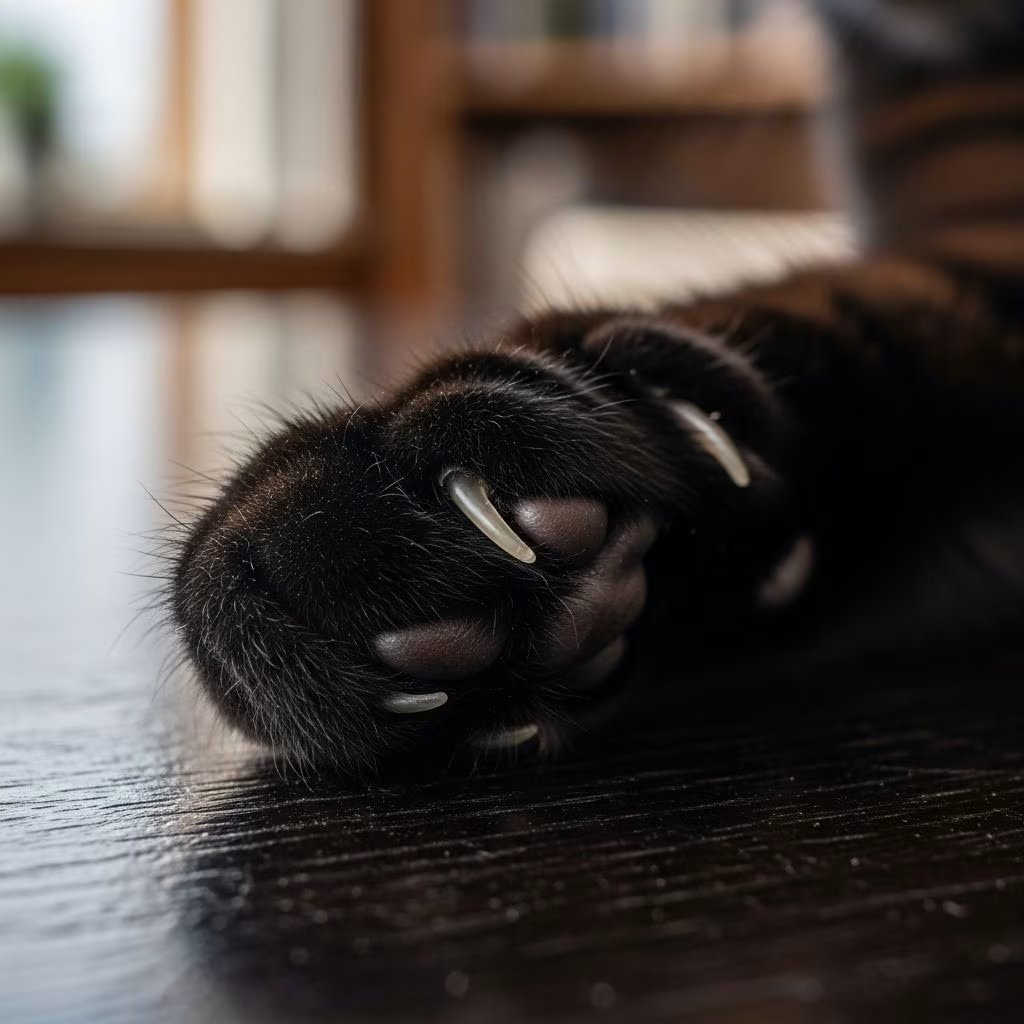
Retractable claws are one of the most remarkable adaptations in the feline world, enabling cats to stalk prey silently, climb with precision, and defend themselves effectively. While nearly all domestic cats possess this feature, subtle variations exist across breeds and individual health conditions. This comprehensive guide delves into the mechanics of cat claw retraction, its biological advantages, exceptions to the rule, and practical advice for owners to maintain healthy paws.
The Ingenious Anatomy Behind Feline Claw Retraction
At the heart of a cat’s paw lies a sophisticated system of bones, tendons, ligaments, and muscles that allow claws to extend and retract on demand. Each claw is composed of layers of keratin surrounding a sensitive quick—a vascular core attached to the distal phalanx, the final bone in the toe. Unlike human nails, which grow flat, cat claws curve and grow over this quick, forming a tapered, razor-sharp point.
The retraction mechanism relies on two key tendons: the superficial flexor tendon on top and the deep digital flexor tendon below. These connect to the claw via the distal phalanx. When a cat contracts its foreleg flexor and extensor muscles, the digital flexor tightens, pulling the toe bone forward and protracting the claw. Relaxation allows an elastic dorsal ligament to pivot the bone back, sheathing the claw into a protective skin fold.
This setup ensures claws remain hidden in the paw’s furred recesses during rest or casual movement, preventing wear and noise. The claws do not fully vanish into the paw but nestle securely, ready for instant deployment—like a switchblade.
How Cats Control Their Claws: Extension and Retraction in Action
Extension occurs through coordinated muscle action. The deep digital flexor pulls the distal phalanx downward, forcing the claw outward. Co-contraction of forearm flexors and extensors stabilizes this motion, providing the force needed for grip or strike. Retraction is passive: muscles relax, and the elastic ligaments snap the claw back, conserving energy.
Not all cats achieve perfect retraction. Overgrown claws or phalangeal deformities can leave tips protruding, mimicking non-retractable states. Healthy claws shed outer keratin sheaths periodically—often found near scratchers—revealing fresh, sharp edges beneath.
| Claw State | Mechanism | Muscles/Tendons Involved |
|---|---|---|
| Extended | Tightens digital flexor, pulls distal phalanx forward | Foreleg flexors/extensors, deep digital flexor tendon |
| Retracted | Relaxes muscles, elastic ligament pivots bone back | Dorsal elastic ligaments |
Evolutionary Advantages of Retractable Claws in Cats
Retractability evolved in felids to optimize survival. Silent stalking is paramount: retracted claws prevent clicking on hard surfaces, allowing cats to creep undetected before pouncing. Once engaged, sharp claws secure prey, grapple during fights, or provide traction for climbing.
Protection is another boon. Sheathed claws avoid dulling on rough terrain, cracking, or snagging—risks that could impair hunting or lead to infection. The keratin structure, while tough, is brittle; constant exposure would render it useless quickly. Retraction also minimizes self-injury during grooming or play.
- Hunting Efficiency: Muffled paws for stealthy approaches.
- Climbing Prowess: Precise grip on bark or fabric without slippage.
- Defense: Instant weapon deployment for threats.
- Durability: Shields claws from environmental wear.
Do Exceptions Exist? Breeds and Conditions Affecting Retraction
The vast majority of domestic cats (Felis catus) have fully retractable claws, a trait shared with all wild felids. However, certain breeds exhibit partial or absent retraction due to genetics or pathology.
Cheetahs, the outlier among big cats, possess semi-retractable claws resembling dog nails for superior traction during high-speed chases. Among domestics, breeds like American Polydactyls or those with dewclaws may show variations, but front paws universally retract. Health issues—arthritis, nerve damage, or overgrown nails—can impair function, leaving claws extended.
Kittens are born with retractable claws, honing control as they play-fight and explore. Senior cats might lose some retraction due to muscle atrophy, necessitating vigilant trimming.
Comparing Cat Claws to Other Animals
Cats’ claws differ starkly from dogs’, which are non-retractable for constant traction in running and digging. Bears and some primates have semi-retractable versions, but felids’ mechanism is uniquely ligament-driven.
| Animal | Claw Type | Primary Function |
|---|---|---|
| Cat | Fully retractable | Hunting, climbing, silence |
| Dog | Non-retractable | Traction, digging |
| Cheetah | Semi-retractable | High-speed grip |
Recognizing and Addressing Claw Problems in Cats
Observe your cat’s paws regularly. Signs of trouble include constantly extended claws, limping, reluctance to use litter, or bloodied sheaths. Causes range from nail overgrowth to infections or injuries.
Trimming mimics natural shedding: use cat-specific clippers to snip only the opaque tip, avoiding the pink quick. Provide varied scratchers—sisal posts, cardboard—to encourage shedding and mark territory.
Essential Claw Care Tips for Cat Owners
Maintaining retractable claws ensures your cat’s comfort and home harmony.
- Invest in multi-texture scratchers to satisfy instincts.
- Trim every 2-4 weeks, rewarding cooperation with treats.
- Monitor for ingrown nails or swelling; consult a vet promptly.
- Soft paw caps offer temporary protection for furniture.
- Encourage play-hunting to naturally wear claws.
Declawing—surgical amputation—is outdated and painful; focus on positive alternatives.
Claw Functions Beyond Retraction: Daily Roles in Feline Life
Claws aid grooming by removing debris, kneading stimulates milk flow in kittens (and relieves stress in adults), and scratching deposits pheromones from glands at the base. These behaviors reinforce well-being.
Frequently Asked Questions (FAQs)
Can all domestic cats retract their claws fully?
Yes, all healthy domestic cats have retractable claws on front and hind paws, though hind claws retract less completely.
Why do some cats’ claws stick out?
Overgrowth, injury, or age-related weakness prevents full retraction. Regular trimming helps.
How often do cat claws grow and shed?
Claws grow continuously, shedding sheaths every 2-3 months to stay sharp.
Are big cats’ claws retractable too?
Most are, except cheetahs, whose semi-retractable claws aid sprinting.
Is claw trimming safe at home?
Yes, with proper tools and caution to avoid the quick. Vets demonstrate techniques.
References
- How Do Cat Claws Work? How They Come Out & Retract — Catster. 2023-10-15. https://www.catster.com/ask-the-vet/how-do-cat-claws-work/
- Understanding Cat and Dog Claw Anatomy and Their Essential Uses — Pet Nation Omaha. 2024-10-15. https://www.petnationomaha.com/blog/understanding-cat-and-dog-claw-anatomy-and-their-essential-uses-20241015
- The form and function of retractile claws in the Felidae — PubMed (Journal of Anatomy). 1975-03. https://pubmed.ncbi.nlm.nih.gov/1127699/
- Retracting Cat’s Claw — Engineering4Kids. 2019-02-08. https://engineering4kids.org/2019/02/08/retracting-cats-claw/
- How Does a Cat Use Their Claws & Why Are They So Sharp? — YouTube (Video Transcript). 2023. https://www.youtube.com/watch?v=kOHHKmo9ph8



