

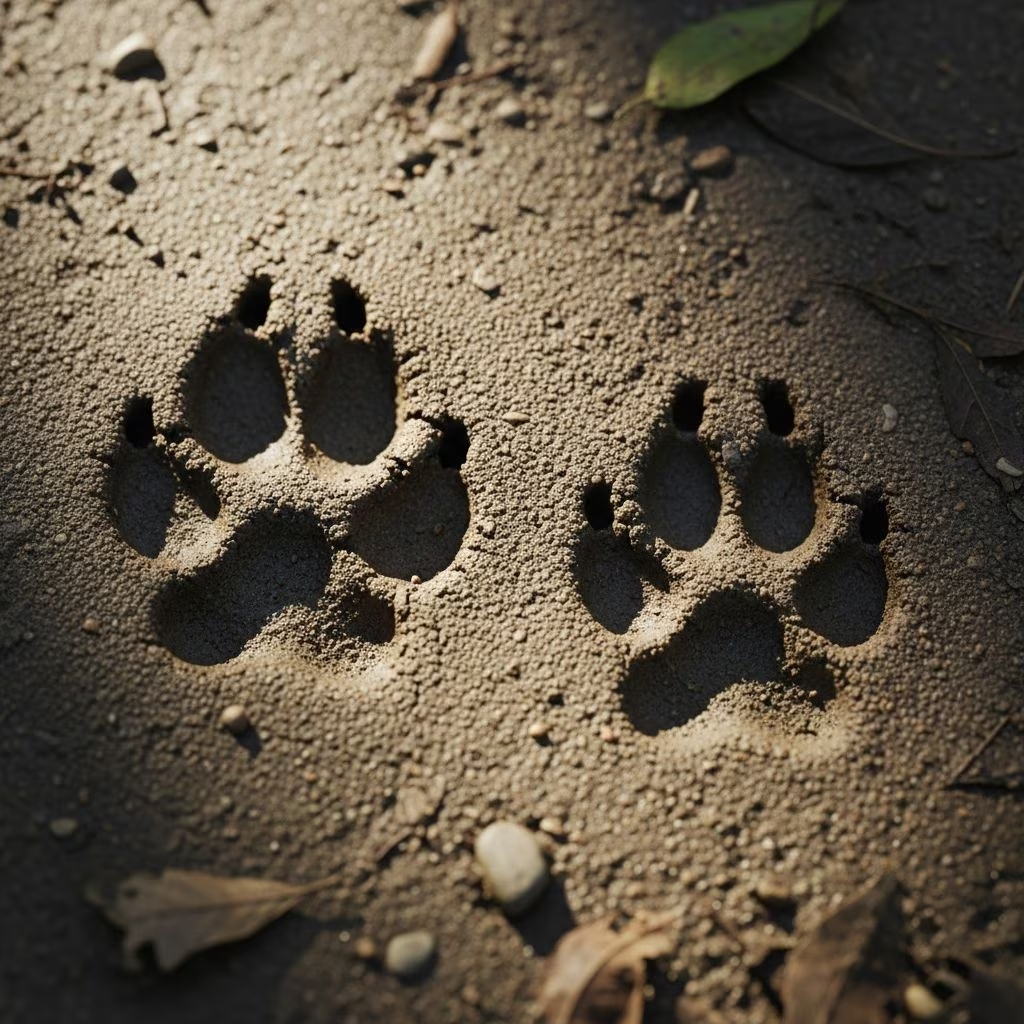
Identifying animal tracks in nature enhances our connection to the wild, but telling apart domestic dog prints from those of coyotes can be challenging. These two canines share similarities due to their family ties, yet distinct features in footprint morphology, gait patterns, and associated signs reveal their identities. This guide breaks down the essential traits, drawing from expert tracking observations to equip you with reliable identification skills.
Understanding Canine Foot Anatomy Basics
All canines, including dogs and coyotes, exhibit a standard foot structure with four toes on front paws and hind paws, a central palm pad, and often visible claw impressions. The front paws typically measure larger than the rear ones, a trait consistent across species. However, subtle variations in pad proportions, toe alignment, and claw prominence set wild coyotes apart from domesticated dogs.
Coyote feet are adapted for endurance travel over varied terrains, resulting in compact, efficient designs. Domestic dogs, bred for diverse purposes, show greater variability, often with looser structures from less rigorous lifestyles.
Key Morphological Differences in Tracks
The most reliable distinctions lie in the overall shape, pad configurations, and claw details. Coyote tracks present as narrow ovals or egg-shapes, emphasizing streamlined efficiency, while dog tracks tend toward rounder, more splayed outlines.
- Overall Shape: Coyote prints are elongated and symmetrical, with toes tightly grouped and pointing forward. Dog prints appear broader, with outer toes frequently fanning outward.
- Middle Pad Size: In coyotes, the central pad is proportionally smaller relative to the track’s total size, creating a more open appearance. Dogs feature larger, more dominant central pads.
- Toe Spacing: Coyote toes cluster closely with minimal negative space between them and the pad. Dog toes spread wider, especially the inner and outer ones, due to muscle tone differences.
These features hold even under imperfect conditions, though soft substrates can cause minor spreading in coyotes for traction.
Claw Marks: A Telling Indicator
Claw impressions provide strong clues. Coyote claws register as fine, sharply pointed marks, often limited to ahead of the leading toes or faintly on others. Their constant activity wears nails to precise tips, unlike the blunt, robust claws of many dogs.
- Coyote claws: Delicate, non-connected to toe pads, pointing forward.
- Dog claws: Thicker, more prominent across all toes, sometimes splayed sideways.
In galloping coyotes, claws may deepen and spread slightly, but retain sharpness and compactness compared to dogs.
Front vs. Rear Paw Comparisons
Front paws in both species are larger, but coyotes maintain oval uniformity. Rear paws are smaller and slimmer. Dogs often show rounder rears with conspicuous pads and widespread claws.
| Feature | Coyote Front | Coyote Rear | Dog Front | Dog Rear |
|---|---|---|---|---|
| Shape | Oval, compact | Oval, smaller | Rounded, splayed | Round/slim, splayed |
| Middle Pad | Small relative | Small relative | Large relative | Conspicuous |
| Claws | Fine, selective | Faint/minimal | Robust, all toes | Robust, all toes |
This table highlights proportional differences, aiding quick field assessments.
Influences of Terrain and Movement on Track Appearance
Environmental factors alter tracks. On soft sand or snow, coyote toes may spread for grip, mimicking dogs superficially. However, the small middle pad and pointed claws persist as identifiers. High-speed gaits like galloping elongate prints, deepening claws in coyotes while retaining symmetry.
Dogs, less consistent travelers, leave messier trails with variable splay. Active dogs narrow the gap, but rarely match coyote precision.
Trail Patterns and Behavioral Context
Beyond single prints, examine track sequences. Coyotes travel purposefully in straight lines or slight curves while hunting/foraging, with direct register (rear overlapping front). Dogs meander, crisscross, or loop during play/walks.
- Coyote trails: Linear, purposeful, minimal overlap variation.
- Dog trails: Wandering, erratic, wider straddle.
Straddle width (distance between left/right tracks) is narrower in coyotes, reflecting leaner builds.
Size Considerations and Overlaps
Absolute size varies; medium dogs match coyote dimensions (2.5-3.5 inches front). Ignore size alone—focus on proportions. Small coyotes or large dogs demand multi-feature analysis.
Supplementary Signs: Scat and Other Clues
Tracks rarely appear isolated. Coyote scat, tapered and filled with fur, bones, or seeds, contrasts smooth, uniform dog feces. Scat placement along trails favors coyotes.
Fur marks in shaggy dog breeds or absence of clawless cat-like prints (e.g., bobcats) further differentiate.
Comparing with Other Canines: Foxes and Wolves
Red foxes leave rounder, smaller tracks with a unique middle pad chevron. Wolves scale larger with similar coyote traits but bulkier pads. Direct side-by-side reveals coyote ovality vs. fox roundness.
Field Identification Techniques
Practice systematic checks:
- Measure overall shape and symmetry.
- Assess pad-to-toe ratios.
- Examine claw style and position.
- Review trail directionality.
- Seek corroborating signs like scat.
Use references like coins for scale in photos.
Why Accurate Identification Matters
Distinguishing these tracks promotes safety—coyotes signal wild presence near human areas. It aids conservation by tracking populations accurately and enriches recreational pursuits like hiking.
Frequently Asked Questions
Can dog tracks ever look exactly like coyote tracks?
Rarely, due to variability, but combined features like toe splay and claw bluntness usually betray dogs.
What if tracks are in snow or mud?
Soft media exaggerate spreads, but coyote compactness endures. Look for multiple prints.
How do I tell coyote from wolf tracks?
Wolves are larger (4+ inches) with broader pads; proportions similar otherwise.
Are claw marks always visible in coyote tracks?
Often faint, especially rear paws, but sharper than dogs when present.
Does breed affect dog track identification?
Yes—athletic breeds closer to coyotes, but pad dominance persists.
Advanced Tips for Trackers
Photograph sequences with scale objects. Study in varied conditions. Join tracking workshops for hands-on practice. Apps with overlays aid beginners.
References
- Knowing Coyote Tracks — Linda J. Spielman. 2022-06-20. https://lindajspielman.com/2022/06/20/knowing-coyote-tracks/
- How can you tell the difference between dog and coyote tracks — Christine DeMerchant. N/A. https://www.christinedemerchant.com/coyote-or-dog-tracks.html
- Canine Tracks — PEI Untamed. N/A. https://www.pei-untamed.com/post/canine-tracks
- Coyote Tracks — Wildlife Illinois. N/A. https://wildlifeillinois.org/discover-animal-signs/coyote-tracks/
- Tracking: Coyote vs. Dog Tracks — YouTube (Video Transcript). N/A. https://www.youtube.com/watch?v=g_wvyNtidNs



