

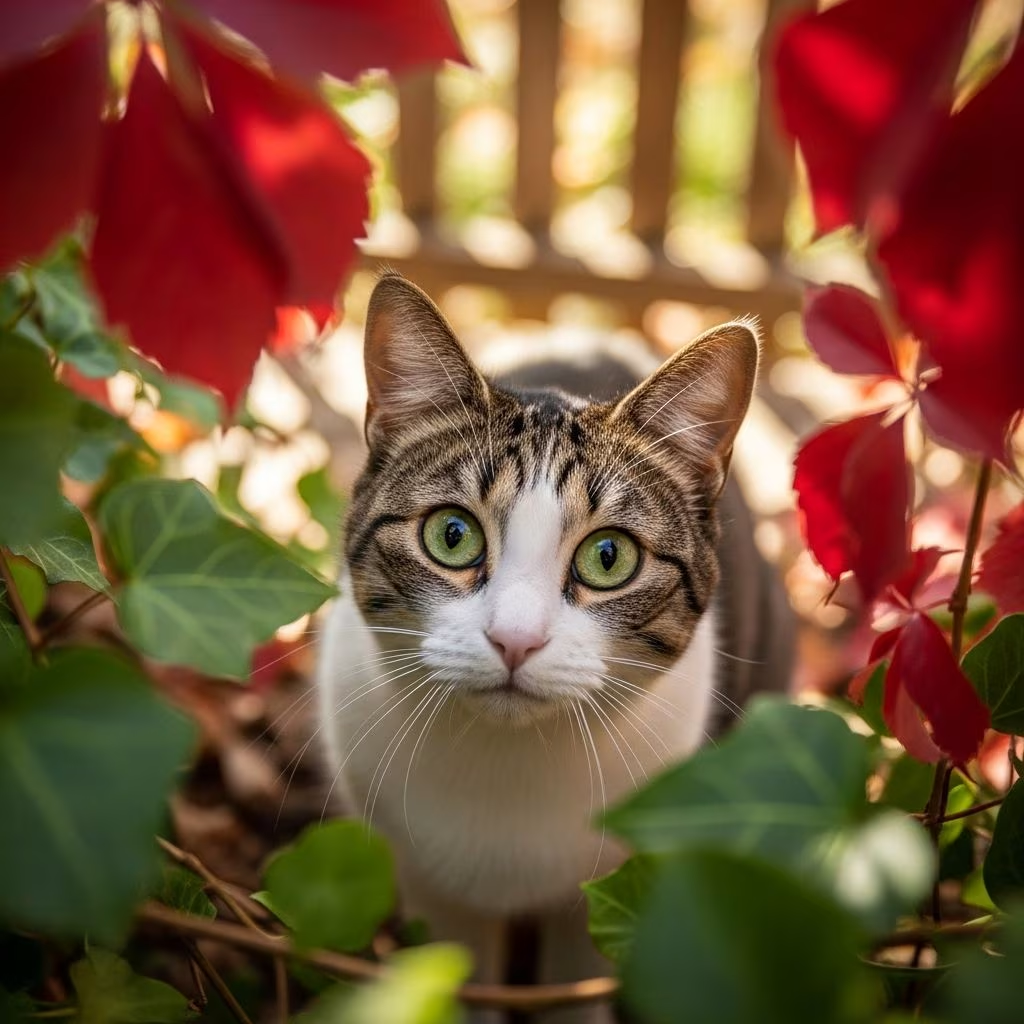
Understanding the Dilemma of the Friendly Outdoor Cat
When we encounter a friendly cat wandering the streets of our neighborhood, our first instinct is often to help. Many well-meaning people believe the right action is to capture the cat and bring it to a local animal shelter, assuming this will lead to adoption and a safe home. However, the reality is far more complex. Behind every friendly cat sauntering down the street is someone who cares about them—often more than one person. According to a 2019-2020 American Pet Products Association survey of 15,000 consumers, roughly a third of households allow their cats some outdoor access, while an additional 14% actively care for free-roaming cats in their communities. These bonds between people and outdoor cats are real and meaningful, and dismissing them simply because they don’t fit the traditional model of indoor pet ownership misses a crucial point about modern cat welfare and community care.
The relationship between humans and outdoor cats has evolved significantly. Many animal welfare professionals and shelter operators now recognize that the traditional approach of immediately sheltering every friendly stray cat may not serve the cat’s best interests. This shift in perspective represents a fundamental change in how we think about community cats and their role in our neighborhoods.
The Statistics Behind Outdoor Cat Care
Understanding who cares for outdoor cats reveals the depth of community involvement in feline welfare. Among the 14% of surveyed households that care for free-roaming cats, the level of support varies considerably:
- 95% provide food and water
- 43% provide shelter
- 20% arrange spaying or neutering services
- 13% provide additional medical care
These statistics demonstrate that outdoor cat caretakers are making genuine commitments to the welfare of these animals. Don Riser, animal services manager for City of Hesperia Animal Services, acknowledges this reality: “Those cats do belong someplace and it’s certainly not in our shelter. Plus, I find in talking to people that they want their friendly stray back and they just appreciate the spay/neuter resources.” This recognition from shelter professionals highlights a growing understanding that community-based care may be more beneficial than institutionalizing friendly outdoor cats.
The Benefits of Keeping Strays Out of Shelters
Shelters face significant practical and ethical reasons for preferring not to take in every friendly, adoptable-appearing cat found on the street. The shelter environment itself poses considerable challenges for feline health and behavior.
Disease and Stress in Shelter Settings
Cats are notoriously susceptible to stress and illness in shelter environments. Upper respiratory infections and other contagious diseases can spread through an entire facility with alarming speed. Even the friendliest cat may exhibit terrified or aggressive behavior when confined to a cage, substantially reducing the likelihood of successful adoption. This behavioral change isn’t reflective of the cat’s true temperament in their natural community setting, where they thrive and interact confidently with their human caregivers.
Resource Allocation and Animal Welfare Priorities
When shelters remove friendly cats from neighborhoods, they divert critical resources away from animals most at risk: owner surrenders, neonatal kittens, and cats who are sick, injured, or victims of cruelty. These animals require intensive care and intervention that shelters are better positioned to provide. By allowing friendly, self-sufficient cats to remain in their communities where they are cared for by established networks of caretakers, shelters can focus their limited resources on animals with more pressing needs.
Paradigm Shift in Shelter Messaging
This represents a major shift in shelter practices that can initially confuse the public. Leah from Best Friends Animal Society explains: “We’ve drilled into them that if they find a stray animal, they should bring it to the shelter. Now we are changing the messaging and that catches people by surprise. However, most people understand once we have a conversation and point out that the cat might already be home.” This educational effort is essential in helping the community understand that leaving a friendly outdoor cat where it is can sometimes be the most compassionate choice.
Addressing Common Arguments Against Returning Friendly Cats to Their Communities
Several persistent misconceptions drive the belief that all outdoor cats should be sheltered. However, when examined closely, these arguments often don’t hold up to scrutiny.
Reunion Success Rates
One of the most compelling reasons to leave friendly cats in their communities is their dramatically higher success rate for reunification with families or caretakers. Research shows that cats are 13 times more likely to be reunited with their families through means other than a shelter visit. The most common methods by which lost cats return home are either through their own navigation back to familiar territory or through searches conducted by concerned neighbors and community members in the area where the cat went missing. This statistic alone suggests that the presence of a cat in a community where it has established connections is often the best indicator that it has someone looking for it.
Safety Risks: Comparing Outdoor Dangers to Shelter Reality
A frequent argument against keeping cats outdoors concerns the risks inherent in outdoor life—cars, predators, and diseases all pose genuine threats. However, this argument fails to acknowledge that shelters themselves are not entirely safe places for cats, particularly regarding disease exposure. While outdoor risks are real, the controlled environment of a shelter does not guarantee safety or improved outcomes. In fact, the stress-induced illnesses that develop in shelter settings can be just as life-threatening as outdoor hazards.
Health Outcomes in Outdoor Cat Programs
The claim that outdoor cats are inherently unhealthy and likely to succumb to various illnesses has not withstood scientific examination. One peer-reviewed study examining large-scale Return to Field (RTF) and Trap-Neuter-Return (TNVR) programs found that only 0.5% of participating cats required euthanasia due to serious health issues. This remarkably low figure suggests that the majority of outdoor cats, when provided with basic care and community support, maintain adequate health and quality of life without requiring shelter intervention.
Social Bonds and Protective Relationships
While cats have traditionally been viewed as solitary creatures, contemporary understanding recognizes that they do form meaningful relationships with both one another and with people. Confident, friendly cats have been documented offering protection and support to other cats within their social group. These social structures, which develop naturally in community settings, contribute to the overall welfare of outdoor cats in ways that cannot be replicated in shelter environments.
Facing Realistic Choices for Cats
While many animal welfare advocates believe that every cat deserves an indoor home with a warm lap and regular meals, the reality reflects diverse human perspectives and living situations. In the United Kingdom, only about 10% of pet cats are kept exclusively indoors, and survey data from the United States indicates that many people believe cats benefit from at least some outdoor enrichment. These varying philosophies about appropriate cat care are deeply held and influenced by cultural, practical, and personal factors.
Adoption Contracts and Real-World Behavior
Animal shelter professionals may include clauses in adoption contracts requiring that cats be kept indoors exclusively. However, people make decisions about outdoor access based on what works for their individual circumstances, regardless of what they pledge on paper. In many cases, allowing a cat with behavioral issues—such as spraying—some outdoor time is the only intervention preventing that cat from being relinquished to a shelter entirely. This pragmatic reality means that forcing adherence to ideal indoor-only policies may paradoxically result in worse outcomes for cats, including their surrender to shelters where their fate becomes uncertain.
The Cycle of Behavior and Shelter Risk
This dynamic creates a circular problem: a friendly cat with behavioral challenges remains in a home where some outdoor access is permitted, maintaining its life and community connections. Conversely, if forced to be strictly indoor-only, the same cat may be relinquished to a shelter, where the behavioral issues persist alongside the additional trauma of institutional confinement, substantially reducing the likelihood of a positive outcome.
Personal Perspective: Living with Community Cats
The reality of community cat care is illustrated through lived experience. Many people in neighborhoods work alongside neighbors to feed and care for several cats in the area, including numerous friendly individuals who remain in the community for years. Some of these cats are so comfortable with their human supporters that they occasionally venture indoors for a nap on the couch. However, this regular care and close relationship does not translate into a felt need to “rescue” these cats. This perspective—caring for cats without viewing them as victims requiring institutional intervention—represents a mature, realistic approach to community animal welfare.
Understanding Community Cats
The terminology surrounding outdoor cats often creates confusion. The terms “stray,” “feral,” and “free-roaming” are frequently used interchangeably by the general public, yet they carry different implications. Best Friends Animal Society advocates for the term “community cats” because it accurately reflects the reality that these cats are valued members of our communities and are actively cared for by community members. This linguistic shift represents a fundamental reframing of how we view outdoor cats—not as problems to be solved but as members of our neighborhoods with existing support systems.
TNVR: The Humane Solution for Managing Community Cats
Trap-Neuter-Return (TNVR) programs represent the most fiscally sound and humane option for managing outdoor cat populations. Traditional eradication methods employ horrendous techniques with costs exceeding $100,000 per square mile. Such approaches are simply not viable in the United States. TNVR, by contrast, focuses on humanely reducing the outdoor cat population through spaying and neutering while allowing cats to remain in their communities. Arguments about the limitations of TNVR’s effectiveness or its alleged impact on the environment largely miss the central point: in the vast majority of instances, TNVR is simply the best available option for humane population management and addressing any related nuisance complaints.
Public support for TNVR is robust and consistent. Roughly 7 in 10 Americans agree that TNVR is the best way to manage community cats. A 2006 survey commissioned by Alley Cat Allies found that 81% of respondents believed “leaving a cat where it is outside” was more humane than “having the cat caught and then put down.” Even when respondents were told to assume a cat would die two years later after being hit by a car, support for leaving the cat in place remained strong at 72%. These consistent survey results across multiple studies indicate that the public understands the ethical complexity of this issue and supports community-based solutions.
The Ethics of Respectful Engagement
Peter Wolf and colleagues, discussing a Conservation Biology journal article titled “A Moral Panic Over Cats,” highlight the importance of ethical and scientific scrutiny when addressing outdoor cats. William Lynn and co-authors challenge common misconceptions about outdoor cats posing risks to biodiversity and public health, advocating for putting such risks into proper perspective. They emphasize that “the harming of sentient, sapient, and social individuals, such as cats … requires strict ethical and scientific scrutiny.”
This perspective calls for “respectful engagement” as the best opportunity for resolving the complex issues surrounding free-ranging cats. Even among those who disagree about outdoor cat management, there is significant common ground: both animal welfare advocates and conservation professionals are interested in reducing the number of unowned, free-roaming cats, and both care about protecting wildlife and public health. Starting from this shared foundation of concern allows for more productive dialogue.
FAQ: Understanding Friendly Outdoor Cats
Q: If I find a friendly outdoor cat, should I always bring it to a shelter?
A: Not necessarily. A friendly outdoor cat may already have a home and caretaker in the neighborhood. Before taking action, observe whether the cat appears well-fed and healthy, check for identification, and ask neighbors if they know the cat. Cats are 13 times more likely to be reunited with their families through community searches than through shelter intake.
Q: What is the difference between a stray cat and a community cat?
A: The term “community cat” reflects the reality that outdoor cats are often cared for and valued by multiple people in their neighborhood. “Stray” can imply the cat is lost or abandoned, while “community cat” acknowledges the existing relationships and support systems that have developed around the cat.
Q: Are outdoor cats really healthier or safer in shelters?
A: Shelters pose significant health risks to cats, including stress-related illnesses and contagious diseases that spread rapidly in confined environments. Peer-reviewed studies show that cats in large-scale outdoor care programs have excellent health outcomes, with only 0.5% requiring euthanasia due to serious health issues.
Q: What is TNVR and why do most people support it?
A: Trap-Neuter-Return (TNVR) involves humanely capturing outdoor cats, spaying or neutering them, and returning them to their community. Approximately 70% of Americans support TNVR as the best method for managing community cats because it is humane, cost-effective, and preserves the cats’ connections to their neighborhoods and caregivers.
Q: Should I stop caring for outdoor cats in my neighborhood?
A: No. Providing food, water, and shelter for community cats is a valuable form of animal welfare. Many outdoor cats thrive under community care for years. Supporting TNVR programs and connecting with other neighborhood caregivers amplifies the positive impact you can have on these cats’ lives.
References
- The Dilemma of the Friendly Outdoor Cat — Best Friends Animal Society. 2025. https://bestfriends.org/network/blog/dilemma-friendly-outdoor-cat
- Shelter Staff and Community Cats — Best Friends Animal Society. 2025. https://bestfriends.org/pet-care-resources/what-shelter-and-field-services-staff-should-know-about-community-cats
- What to Know About Community Cats — Best Friends Animal Society. 2025. https://bestfriends.org/pet-care-resources/what-everybody-should-know-about-community-cats
- The Ongoing Debate Over Outdoor Cats — Best Friends Animal Society. 2025. https://bestfriends.org/stories/julie-castle-blog/ongoing-debate-over-outdoor-cats-call-respectful-engagement
- What Every Advocate Should Know About Community Cats — Best Friends Animal Society. 2025. https://bestfriends.org/pet-care-resources/what-every-advocate-should-know-about-community-cats



