

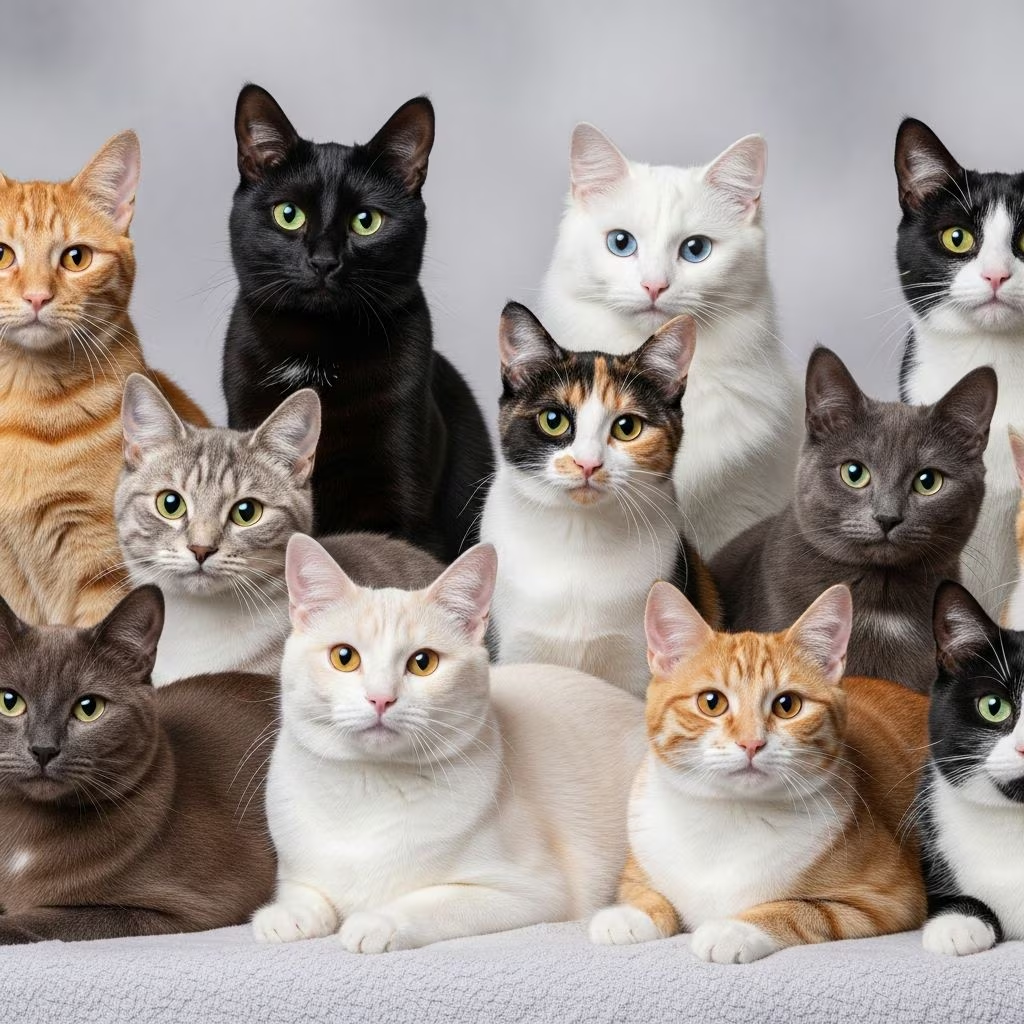
Cats display an incredible array of coat colors and patterns, all stemming from complex genetics involving just a few key pigments: black (eumelanin) and red/orange (pheomelanin). These variations result from genes at specific loci that control pigment production, distribution, dilution, and patterning. Understanding cat colors enhances appreciation for breeds and individual felines.
How Cat Colors Are Determined
Cat coat colors originate from two primary pigments: eumelanin (black or brown) and pheomelanin (red or orange). The primary gene for coat color at the B locus codes for eumelanin, where dominant B produces black, recessive b chocolate, and b1 cinnamon. The orange gene (O/o) on the X chromosome determines red tones; O blocks black pigment, allowing only pheomelanin. Females (XX) can be tortoiseshell (O/o), while males (XY) are typically solid orange or non-orange.
Additional genes modify these bases: the dilute gene (D/d) lightens colors (e.g., black to blue/gray, red to cream), requiring homozygous recessive dd. The agouti gene (A locus) creates banded hairs for tabby patterns when dominant. White spotting (S locus) and dominant white (W) suppress pigment in patches or entirely. Colorpoint (C locus) restricts pigment to cooler body areas like ears and tail.
Basic Cat Colors
Core colors build from black and red bases, modified by genes like brown (B), dilute (D), and others.
- Black: Dominant eumelanin (B-), dense pigment (D-). True jet black with a glossy sheen.
- Blue/Gray: Dilute black (bb dd), appearing smoky gray.
- Red/Orange/Ginger: Dominant orange (O), pheomelanin only. All reds carry agouti, showing tabby markings—no solid red exists. Males predominate (80% ginger cats).
- Cream/Buff: Dilute red (O dd), pale yellowish.
- Chocolate: Recessive brown (b/b), warm medium brown.
- Lilac/Lavender: Dilute chocolate (b/b d/d), soft dove-gray.
- Cinnamon: Recessive (b’/b’), light reddish-brown.
- Fawn: Dilute cinnamon (b’/b’ d/d), pale beige.
Dilute-modifier (Dm) further lightens dilutes: blue to caramel, lilac to caramel-on-lilac.
Solid Colored Cats
Solid cats lack tabby patterns due to recessive non-agouti (a/a), showing uniform color without banding. Common in breeds like Persians and British Shorthairs. Examples include solid black, white, blue, red, and chocolate. White solids mask underlying colors via W or epistatic white. True solids require a/a to suppress tabby.
Tabby Cats
The most common pattern, tabbies exhibit banded hairs (agouti A-) with markings from the tabby gene (Ta). Four types:
- Mackerel Tabby: Narrow stripes, ‘fishbone’ on sides, classic ‘M’ on forehead. Dominant pattern.
- Classic/Blotched Tabby: Bold swirls, marbled bullseyes on flanks.
- Spotted Tabby: Round spots instead of stripes, seen in Bengals, Ocicats.
- Ticked Tabby: Even ticking, no stripes/spots, like Abyssinian. Bands along hair shaft.
Tabbies come in all base colors: brown, blue, red, cream, chocolate, lilac, etc. Silver tabbies (I-) inhibit yellow pigment for smoky effect.
Tortoiseshell and Calico Cats
Tortoiseshell (tortie) cats blend black/brown and red patches due to X-inactivation in females (O/o). Males are rare (XXY Klinefelter syndrome).
- Tortoiseshell: Intermingled black and red, no white.
- Calico: Tortie with white spotting (S), large white areas with color patches. Almost exclusively female.
- Tortie-and-White (Tortie Tabby): Tortie with white feet or bib.
Dilutes yield blue-cream torties or calicos. Patterns vary from fine (brindle) to bold patches.
Bi-Color Cats
Bi-colors have white (S locus) with any single color, like black-and-white or red-and-white. Piebald patterns range from minimal white (van) to 50/50. Dominant white (W/W) produces full white, masking other colors and risking deafness.
Colorpoint Cats
Colorpoint (cs/cs at C locus) restricts pigment to extremities (face, ears, paws, tail) due to temperature-sensitive enzyme. Siamese hallmark: seal, chocolate, blue, lilac points.
- Tonkinese: cb/cs, mink points (medium contrast).
- Burmese: cb/cb, sable (even warm brown).
- Mocha/Bangkok: New Burmese variant, apricot points.
Combined with red (e.g., red point Siamese) or tabby (lynx points).
Shaded, Smoke and Silver Cats
Inhibitor gene (I-) blocks pigment in hair root, leaving silver undercoat.
- Smoke: Non-agouti base with I, white roots tipped color (blue-smoke, black-smoke).
- Shaded Silver/Gold: Tipped (1/3 colored), undercoat silver/gold.
- Chinchilla/Shell: Lightly tipped (1/8), shimmering.
Gold uses wide-band (Wb) for yellow undercoat.
White Cats
White arises from:
- Dominant White (W): Epistatic, hides all color; blue eyes common, deafness risk.
- High White Spotting (S/S): Piebald with mostly white.
- Albino (c/c): Rare, no pigment, pink eyes (undesirable in breeding).
Other Cat Colors
Fever Coat: Kittens born pale/silver due to maternal stress (fever), darkens later.
Amber/Russet: e/e fades eumelanin to red tones; amber in Norwegian Forest Cats, russet in Burmese.
Sepia (cb/cb) and mink hybrids add to pointed variations.
Cat Color Genetics Table
| Gene Locus | Effect | Examples |
|---|---|---|
| B/b/b’ | Eumelanin type | B-black, b-chocolate, b’-cinnamon |
| O/o (X-linked) | Pheomelanin | O-red, o-black based |
| D/d | Dilution | d-dilute (blue, cream) |
| A/a | Agouti/tabby | A-banded tabby, a-solid |
| C/cs/cb | Colorpoint | cs-pointed Siamese |
| I/i | Inhibitor/silver | I-silver undercoat |
| W/w | Dominant white | W-all white |
| S/s | Spotting | S-white patches |
Frequently Asked Questions (FAQs)
What determines a cat’s color?
Coat color comes from genes controlling eumelanin (black/brown) and pheomelanin (red), modified by dilution, agouti, and others.
Why are most orange cats male?
Orange is X-linked; males need one O from mother, females two.
Can two blue cats have black kittens?
No, dilute (dd) parents can’t produce dense (D-) colors.
Are calico cats always female?
Nearly always, due to two X chromosomes for O/o patching.
What causes colorpoint patterns?
Temperature-sensitive cs allele limits pigment to cooler areas.
Why do white cats go deaf?
Dominant white (W) disrupts melanocytes in ear, linked to blue eyes.
References
- Cat Genetics 2.0: Colours — Laboratoire de génétique vétérinaire. 2023. https://labgenvet.ca/en/cat-genetics-2-0-colours/
- Cat Coat Genetics and Science — Basepaws. 2023. https://basepaws.com/blog/cat-coat-genetics
- Cat Genetics: A Progressive Look at Coat Colors & Patterns — Liz’s Kitty Bootcamp. 2020-08-24. https://lizskittybootcamp.com/2020/08/24/cat-genetics-a-progressive-look-at-coat-colors-patterns/
- Cat Genetics: Fever Coats, Taste Buds & More — Litter-Robot. 2023. https://www.litter-robot.com/blog/cat-genetics-fever-coat/
- A Basic Guide to Cat Genetics — Animal Behavior College. 2023. https://www.animalbehaviorcollege.com/blog/lifestyle/a-basic-guide-to-cat-genetics/
- COLOUR AND PATTERN CHARTS — Messybeast. 2023. http://messybeast.com/colour-charts.htm



