
8 Key Differences Between Dogs and Wolves
Discover the fascinating physical, behavioral, and genetic differences that separate our beloved dogs from their wild wolf ancestors.
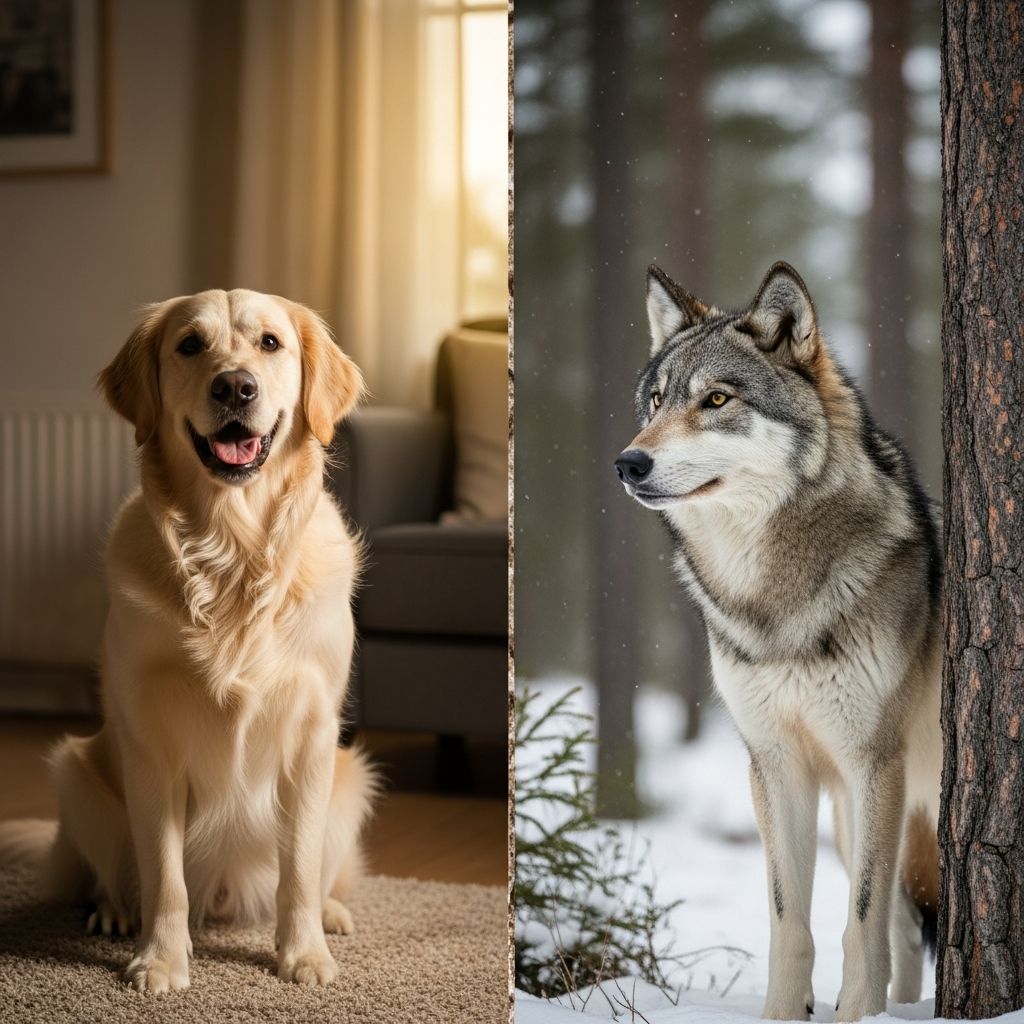
While dogs and wolves share a common ancestor and retain many similarities, thousands of years of domestication have created profound differences between these two canines. Understanding these distinctions helps pet owners appreciate how their furry companions have evolved and why they behave so differently from their wild relatives. This comprehensive guide explores eight major differences that separate our beloved dogs from wolves.
1. Physical Appearance and Body Structure
One of the most obvious differences between dogs and wolves lies in their physical appearance. Wolves generally have larger heads and feet, a narrower chest, longer legs, and a more pronounced muzzle than most dog breeds. Their robust build is perfectly adapted for survival in the wild, with stronger jaws and teeth designed for hunting and killing prey. Wolves also display less variation in their eye and coat colors, typically featuring shades of gray, brown, and black.
In stark contrast, domestic dogs come in an astounding variety of shapes and sizes, from the tiny Chihuahua weighing just a few pounds to the massive Great Dane standing over 30 inches tall. This incredible diversity in physical traits results directly from selective breeding by humans over centuries, emphasizing specific characteristics such as size, coat type, ear shape, and color. Whether a dog has floppy ears, a curled tail, or a specific coat pattern, these traits were intentionally selected by humans rather than occurring naturally.
Perhaps most enchanting is the development of the “puppy dog eyes” that have captured human hearts for generations. Wolves lack the specialized muscles around their eyes needed to create this heart-melting expression. Scientists believe that during the domestication process, dogs developed these unique facial muscles specifically to enhance their communication with people—a remarkable adaptation that demonstrates how closely dogs have evolved alongside humans.
2. Dietary Needs and Digestive Systems
The dietary differences between dogs and wolves reflect their divergent evolutionary paths. Wolves are strict carnivores whose digestive systems have evolved to efficiently process raw meat and extract maximum nutrition from prey. Their digestive tract is optimized for breaking down animal tissue, and they can survive on an entirely meat-based diet.
Dogs, however, have adapted significantly from their wolf ancestors. When humans began farming and settling in agricultural communities, early domesticated dogs were introduced to starches and plant-based foods alongside meat scraps from human meals. Over thousands of years, dogs have evolved the ability to digest and extract nutrition from a broader range of foods, making them true omnivores. Modern dogs can thrive on diets containing grains, vegetables, and other plant-based ingredients, alongside protein sources. This dietary flexibility has been crucial to dogs’ success as human companions, allowing them to survive on whatever food sources were available in human settlements.
3. Reproductive Cycles and Breeding Patterns
Reproductive behavior represents another significant area where dogs and wolves differ substantially. Wolves have a highly regulated breeding cycle tied to the seasons. They breed once per year, typically in late winter, with litters arriving in the spring. This strict breeding schedule ensures that wolf pups are born during seasons when prey is most abundant, maximizing their chances of survival. The entire wolf pack often assists in raising and protecting the young, demonstrating their cooperative nature.
Dogs, by contrast, have evolved away from seasonal breeding constraints. Female dogs typically go into heat twice per year, and male dogs produce sperm year-round once they reach sexual maturity at approximately six months of age. This continuous reproductive capability reflects dogs’ adaptation to human environments, where food availability is no longer seasonal and survival pressures differ dramatically from wild ecosystems. This difference has enabled humans to breed dogs on their own schedules rather than being bound by nature’s seasonal cycles.
4. Intelligence and Problem-Solving Abilities
When discussing canine intelligence, context becomes crucial. Dogs demonstrate remarkable trainability and eagerness to please their human handlers, successfully learning hundreds of commands and performing complex tasks. By these metrics, dogs often appear “smarter” than wolves. Dogs’ willingness to follow verbal instructions and their motivation to cooperate with humans are unparalleled in the animal kingdom.
However, when researchers examine problem-solving abilities in controlled settings, wolves consistently outperform dogs. Studies have shown that wolves solve puzzles at younger ages than dogs and tackle more complicated puzzles successfully. In one notable study, eight out of ten wolves succeeded at a simple puzzle task, while only two of eighteen dogs managed to solve it, ostensibly due to their fixation on human interaction. Wolves also excel at cooperative problem-solving, demonstrating superior skills when working together to overcome obstacles. This advantage stems from their need to cooperate as a pack for survival in the wild, where collaborative hunting and problem-solving are essential for success.
The distinction highlights how domestication has fundamentally altered canine intelligence. Dogs have traded independent problem-solving ability for enhanced social cooperation with humans, while wolves maintain their ancestral capacity for complex reasoning and collaborative strategies.
5. Social Structure and Hierarchy
Both dogs and wolves are inherently social animals that thrive in group environments, yet their social structures have evolved differently. Wolves in the wild maintain strict hierarchical pack structures with a dominant breeding pair and their offspring. This rigid hierarchy is essential for coordinating the complex behaviors required for survival—cooperative hunting, pup rearing, territory defense, and protection from predators. Each pack member understands their position within the hierarchy, and this structure minimizes dangerous conflicts over resources.
Domestic dogs have adapted to more flexible social roles within human families. Rather than rigid dominance hierarchies, dogs have developed the capacity to function in diverse social contexts. A dog living with a single person, multiple people, other dogs, and cats all manages to navigate these relationships with remarkable flexibility. This adaptability results from selective breeding combined with early socialization experiences. Dogs have essentially learned to coexist harmoniously with humans and other animals in ways that wolves, with their strict hierarchical needs, simply cannot replicate.
6. Communication Methods and Vocalizations
Dogs and wolves employ similar communication tools but utilize them differently. Both species use vocalizations including howling, growling, barking, and whining, along with body language to express emotions and intentions. However, the frequency and context of these sounds differ considerably between the species.
Wolves tend to howl more frequently as a means of coordinating pack members across distances and maintaining group cohesion. Dogs, having lived alongside humans for thousands of years, have developed barking as a primary vocalization—a behavior that is actually less common in wolves. This shift likely represents adaptation to human environments where rapid communication and attention-getting are valuable traits. Additionally, both species share charming nesting behaviors where they dig and circle in their resting spots, though wolves demonstrate this behavior when clearing ground of rocks and twigs to prepare safe den sites.
7. Prosocial Behavior and Cooperation
Research from the Wolf Science Center in Vienna has revealed fascinating differences in prosocial behavior—actions intended to benefit others. In studies using touchscreen-based tasks that allowed individual animals to provide food to fellow pack members, wolves behaved significantly more prosocially toward their companions than did pack dogs. Wolves demonstrated a clear motivation to help their pack members acquire food, while dogs showed no significant difference in their behavior whether pack members were nearby or not.
This counterintuitive finding challenges the common assumption that domestication selected for increased cooperativeness in dogs. Instead, it suggests that prosocial behaviors observed in pet dogs may actually trace back to ancestral wolf traits rather than being products of domestication. Dogs may have instead developed different forms of cooperation specifically oriented toward humans rather than toward other dogs. The willingness of dogs to cooperate with humans represents a fundamental shift in where their prosocial instincts are directed.
8. Human-Directed Behavior and Bonding
Perhaps the most significant difference lies in how dogs and wolves interact with humans. Dogs spend substantially more time in close proximity to human companions, gazing at them, and engaging in interactive behaviors like tail wagging compared to wolves. Even when socialized from birth and raised around humans, wolves maintain greater independence and emotional distance from people.
Studies examining greeting behavior reveal that dogs spent significantly more time in proximity with human partners than wolves, and both species showed stronger bonding with familiar human caregivers compared to unfamiliar individuals. Dogs exhibited more ear positions associated with submission and attentiveness toward humans, while wolves maintained more independent ear postures. This fundamental difference in human-directed behavior represents perhaps the most important adaptation dogs have undergone—they have evolved to be intensely focused on human social cues and emotional states in ways that wolves simply have not.
Genetic Similarities Despite Behavioral Differences
Despite these profound differences, dogs and wolves remain genetically remarkably similar. The two species share 99.9% of their DNA, and both possess 39 pairs of chromosomes, meaning they can interbreed and produce viable offspring. This genetic overlap explains why dogs retain many wolf behaviors including keen senses of smell, prey drive, and scent marking.
Recent genomic research has identified specific “domestication genes” responsible for behavioral differences. Rather than finding that all dogs carry these mutations while all wolves do not, scientists discovered a spectrum of variation. Some wolves possess these genetic variations to a lesser degree, while some dogs lack them entirely. This suggests that the transformation from wolf to dog represents a gradual magnification of pre-existing traits in wolves—as though “we’ve taken a friendly wolf and magnified it 10 times” to create a dog, and then magnified those traits further to produce specialized breeds like Labradors or German Shepherds.
Frequently Asked Questions
Q: Can dogs and wolves interbreed?
Yes, dogs and wolves can interbreed because they share 99.9% of their DNA and both have 39 pairs of chromosomes. However, wolf-dog hybrids can be unpredictable and are often illegal to own as pets.
Q: Are wolves smarter than dogs?
It depends on how intelligence is measured. Wolves excel at independent problem-solving and cooperative reasoning, while dogs are superior at understanding human commands and working with people. Dogs have essentially traded problem-solving ability for enhanced human social cooperation.
Q: Why do dogs have “puppy dog eyes” but wolves don’t?
Dogs developed specialized eye muscles during domestication to enhance communication with humans. Wolves lack these specific facial muscles because they never evolved pressure to communicate their emotions to people in this way.
Q: Can wolves be domesticated like dogs?
While individual wolves can be socialized to tolerate humans, they lack the genetic and behavioral predispositions that make dogs naturally domesticated. Domestication is a multi-generational process requiring selective breeding for tameness.
Q: What do wolves eat compared to dogs?
Wolves are strict carnivores and survive on raw meat and prey. Dogs are omnivores that have adapted to digest grains, vegetables, and various plant-based foods alongside protein sources due to thousands of years living alongside humans.
Q: How do wolf packs differ from dog packs?
Wild wolf packs maintain rigid hierarchies essential for coordinated survival, while domestic dogs have adapted to flexible social roles within human families. Dogs have evolved to tolerate diverse social structures that wolves would find incompatible with their survival needs.
References
- Dogs vs wolves: understanding differences and similarities — Wisdom Panel. 2024. https://www.wisdompanel.com/en-us/blog/dogs-vs-wolves
- Wolf. Dog. What’s the Difference? — Portland Monthly. October 2018. https://www.pdxmonthly.com/news-and-city-life/2018/10/wolf-dog-what-s-the-difference
- Wolves and Dogs–Same? Different? — Patricia McConnell, Certified Applied Animal Behaviorist. https://www.patriciamcconnell.com/theotherendoftheleash/wolves-and-dogs-same-different/
- Wolves vs. dogs: Prosocial behavior study — Cornell University College of Veterinary Medicine, Riney Canine Health Center. https://www.vet.cornell.edu/departments-centers-and-institutes/riney-canine-health-center/canine-health-information/wolves-vs-dogs-prosocial-behavior-study
- Differences in dogs’ and wolves’ human-directed greeting behaviour — National Center for Biotechnology Information (NCBI). 2024. https://pmc.ncbi.nlm.nih.gov/articles/PMC12226620/
Similar Articles








Read full bio of medha deb




