

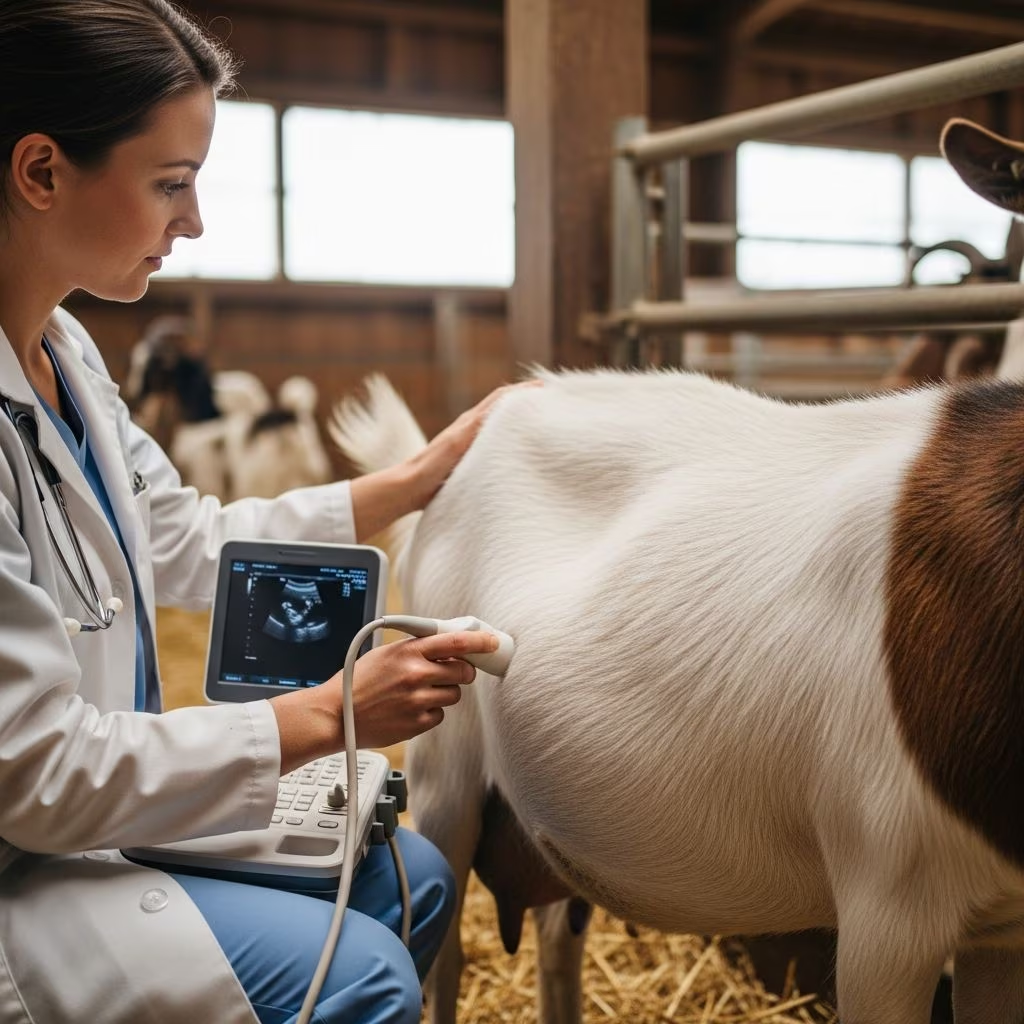
Confirming pregnancy in goats is vital for effective herd management, enabling farmers to plan nutrition, space, and kidding schedules while minimizing losses from conditions like hydrometra. Modern techniques offer high accuracy from as early as 20 days after breeding, surpassing older methods in reliability and speed.
Why Pregnancy Confirmation Matters for Goat Farmers
Accurate pregnancy diagnosis helps identify non-pregnant does early, allowing timely rebreeding or culling decisions. It also detects issues like pseudopregnancy, where fluid accumulation mimics gestation, potentially leading to unnecessary treatments or abortions if prostaglandins are administered to false negatives. In dairy operations, this prevents resource waste on non-productive animals. Overall, it supports better reproductive efficiency, with studies showing ultrasound and specific biomarkers achieving over 95% accuracy in commercial settings.
Timeline of Pregnancy Detection Methods
Goat gestation lasts about 145-155 days, and detection windows vary by technique. Early methods (20-30 days) focus on hormonal changes, while mid-to-late gestation relies on imaging for fetal viability and numbers.
| Method | Earliest Detection (Days Post-Breeding) | Accuracy | Pros | Cons |
|---|---|---|---|---|
| Transrectal Ultrasound | 20-25 | 95-100% | Visualizes embryo, heartbeat | Requires skilled operator |
| Blood PAG Assay | 24-26 | 98-100% | Lab-based, specific | Delay for results |
| Progesterone Test | 22 | 90-95% (pregnant detection) | Simple blood draw | Poor non-pregnant specificity |
| Transabdominal Ultrasound | 30-35 | 91-100% | Non-invasive | Later detection |
| Urine/Milk Tests | 28 | 70-85% | At-home option | Low accuracy, limited use |
This table summarizes key options, drawn from comparative studies on dairy goats.
Ultrasound Techniques: The Gold Standard
Real-time ultrasonography dominates due to its ability to visualize the uterus, fluid, fetuses, and heartbeats directly. Two main approaches exist: transrectal for early stages and transabdominal for later ones.
Transrectal Ultrasound for Early Detection
From 20 days, a linear-array probe (5 MHz) is inserted into the rectum after lubrication. Rotate slowly to image the pelvic area; the bladder aids orientation. Embryonic vesicles appear as black fluid pockets by day 25, with heartbeats detectable around day 28. Accuracy reaches 100% by days 24-26 in synchronized herds. This method excels at distinguishing true pregnancy from hydrometra, as no fetal structures appear in fluid-only cases.
Transabdominal Ultrasound for Mid-to-Late Gestation
After 35 days, clip hair on the right flank and apply gel. A 3.5-5 MHz curvilinear probe images the gravid uterus. Fetuses show as hypoechoic masses with placentomes (cotyledons) visible by day 45. Count kids between 45-90 days by scanning both sides patiently—multiple profiles in one view confirm twins. It’s ideal for viability checks in toxemia risks, spotting dead fetuses via scale subsidence.
Differences from Older Ultrasound Types
- A-Mode: Detects fluid only; unreliable due to false positives from pyometra.
- Doppler: Hears fetal heart (pounding), movements, or uterine artery flow; transrectal best early, external later, but largely replaced by B-mode imaging.
- B-Mode: Provides 2D visuals; 91-100% accuracy with training.
Hormonal and Biomarker Tests
Blood, milk, or urine assays detect gestation-specific changes, offering alternatives when ultrasound isn’t feasible.
Pregnancy-Associated Glycoproteins (PAGs)
PAGs, produced by the trophoblast, rise from day 24 and persist through lactation. Plasma assays at days 24-26 yield near-perfect accuracy (98-100%), outperforming progesterone for non-pregnants. Radioimmunoassay or ELISA methods are used; commercial kits exist for goats.
Progesterone (P4) Assays
P4 levels above 1 ng/mL indicate luteal activity, accurate for pregnancy by day 22 but fails to flag all non-pregnants (e.g., persistent corpus luteum). Single samples suffice for positives; combine with PAG for full diagnosis.
Urine and Milk Tests
At-home urine kits (e.g., for PAG-like proteins) from day 28 have 70-85% accuracy; repeat testing advised. Milk tests suit lactating does from day 28 ($4-5/test), but useless for dry juniors.
Recognizing Developmental Stages via Imaging
Estimating age refines management:
- Days 20-25: Fluid-filled vesicles (10-20 mm).
- Days 28-35: Heartbeat, embryo proper.
- Days 45+: Fetal profiles, limbs, placentomes.
- Third Trimester: Probe ventrally for descended uterus.
Goat stages are less documented than sheep, but eye estimation improves with experience.
Challenges and Pitfalls in Diagnosis
Hydrometra (waterbelly) affects 10-20% of dairy goats, causing false positives in non-specific tests. Ultrasound differentiates by lacking embryos. Operator skill impacts results—train on 50+ scans for proficiency. Synchronization (e.g., FGA sponges) standardizes timing.
Fetal Number Estimation and Toxemia Monitoring
Ultrasound between 45-90 days counts multiples (common in goats), aiding nutrition for triplets+. In pregnancy toxemia, scan for live heartbeats; dead fetuses show hyperechoic scales.
Practical Tips for On-Farm Implementation
- Restrain does standing in stanchions.
- Use sedation rarely; most tolerate probes.
- Record breeding dates precisely.
- Combine methods: ultrasound + PAG for confirmation.
- Train staff via certified courses.
FAQs
How early can I confirm goat pregnancy?
Transrectal ultrasound or PAG blood tests from 20-26 days post-breeding.
What’s the best tool for counting kids?
Transabdominal B-mode ultrasound at 45-90 days, scanning bilaterally.
Can I use human pregnancy tests on goats?
No, they’re unreliable; use goat-specific PAG or progesterone assays.
How do I spot hydrometra?
Ultrasound shows fluid-filled uterus without fetuses or placentomes.
Is Doppler ultrasound still useful?
Less so; B-mode offers visuals over sounds.
Future Advances in Goat Reproductive Diagnostics
Portable high-res ultrasound and point-of-care PAG ELISA promise farm-level speed. AI-assisted imaging may automate age/fetal counting soon.
References
- A comparison of diagnosis of pregnancy in the goat via transrectal ultrasound scanning, progesterone, and pregnancy-associated glycoprotein assays — Theriogenology (PubMed). 2004-09-15. https://pubmed.ncbi.nlm.nih.gov/15289050/
- Pregnancy Diagnosis in Goats — Veterian Key. N/A. https://veteriankey.com/pregnancy-diagnosis-in-goats/
- Pregnancy diagnosis in small ruminants — AABP Proceedings (Texas A&M). N/A. https://bovine-ojs-tamu.tdl.org/aabp/article/view/8636/8392
- Goat Pregnancy Confirmation Methods — YouTube (Cumberland County 4-H). N/A. https://www.youtube.com/watch?v=XGxz9CwDfuA
- Pregnancy Diagnosis in Small Ruminants — E.I. Medical. N/A. https://www.eimedical.com/blog/pregnancy-diagnosis-in-small-ruminants
- Review PREGNANCY DIAGNOSIS TECHNIQUES IN GOATS — CABI Digital Library. N/A. https://www.cabidigitallibrary.org/doi/pdf/10.5555/20153275194



