

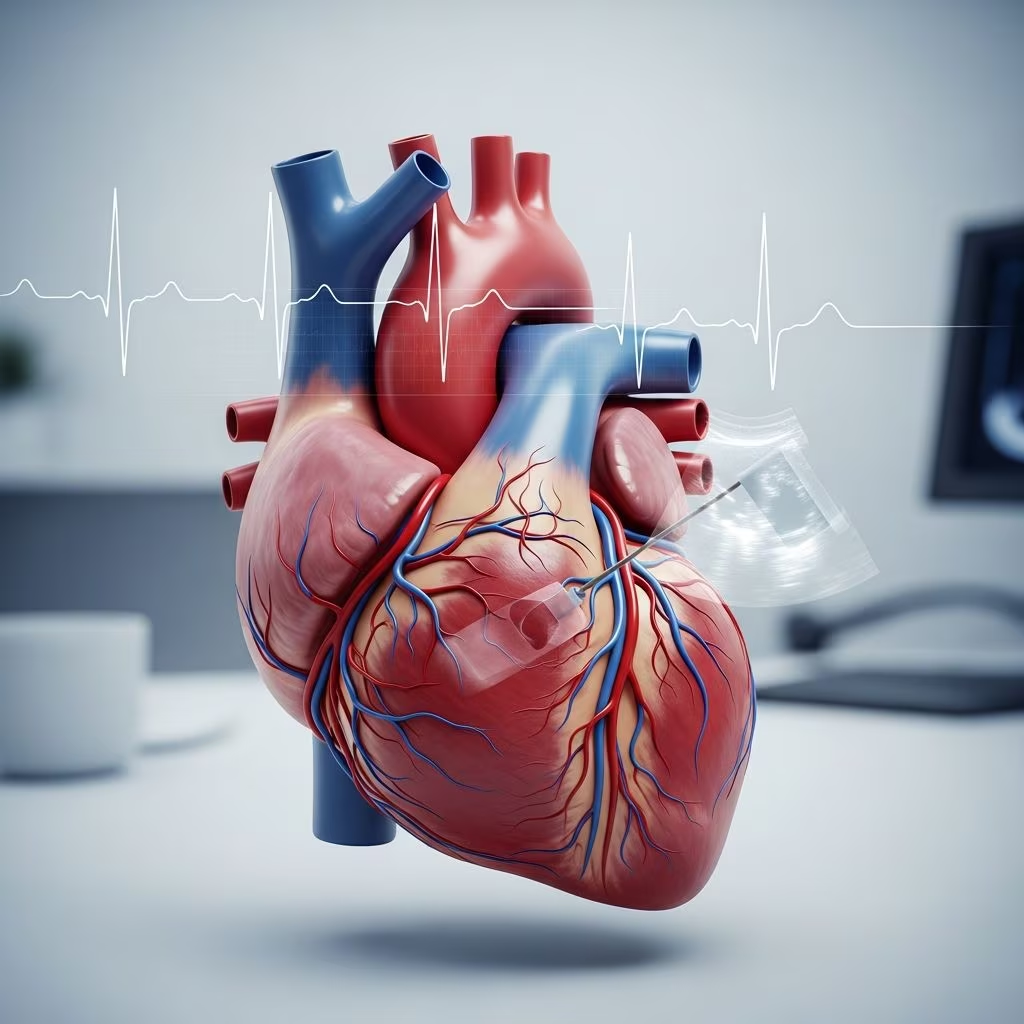
Heart disease affects many dogs, often silently until advanced stages. Early detection through systematic diagnostic approaches can significantly improve prognosis and quality of life. This article explores the step-by-step process veterinarians use, from initial observations to sophisticated imaging, empowering owners to recognize signs and support their pet’s care.
Recognizing Early Warning Signs
The journey to diagnosing canine heart issues begins with keen observation. Owners play a crucial role by noting subtle changes in behavior or appearance. Common indicators include persistent coughing, especially at night; reduced exercise tolerance, where a once-energetic dog tires quickly; rapid or labored breathing even at rest; fainting episodes (syncope); or swelling in the abdomen or limbs due to fluid buildup. These symptoms warrant immediate veterinary attention, as they may signal underlying cardiovascular problems like valve degeneration or congenital defects.
Breed predispositions heighten risk; small breeds such as Cavalier King Charles Spaniels and Dachshunds are prone to mitral valve disease, while larger breeds like Boxers may face dilated cardiomyopathy. Age matters too—geriatric dogs over 7 years often develop acquired conditions, whereas congenital issues appear in puppies. Tracking these signs helps vets prioritize targeted diagnostics.
Initial Veterinary Assessment
A thorough history and physical exam form the foundation of heart disease evaluation. Vets inquire about onset of symptoms, diet, activity levels, and family history of cardiac issues. Signalment—breed, age, and sex—guides suspicion; for instance, neutered males may show higher arrhythmia risks.
Physical exams emphasize auscultation, listening to heart and lung sounds with a stethoscope. Normal heartbeats produce ‘lub-dub’ rhythms at 60-160 beats per minute depending on size and excitement. Deviations like murmurs—abnormal whooshing sounds from turbulent blood flow—or irregular rhythms suggest pathology. Murmurs are graded 1-6 by intensity; grade 3 or higher often prompts further tests. Pulse quality checks femoral arteries for strength and synchronicity with heartbeats, weak pulses indicating poor output.
- Key exam findings: Harsh systolic murmurs over left apex (mitral regurgitation); soft diastolic murmurs (aortic issues).
- Lung crackles signal pulmonary edema from heart failure.
- Arrhythmias detected via brief ECG leads if gallop sounds (extra heart thumps) present.
Essential Imaging: Radiographs and Beyond
Thoracic radiographs provide a static snapshot of heart size, shape, and lung fields. Standard views—right lateral, left lateral, dorsoventral—reveal cardiomegaly (enlarged heart silhouette), pulmonary vein distension, or edema patterns confirming congestive failure. Vertebral heart score normalizes size assessment across breeds; scores over 10.5 suggest enlargement.
Radiographs differentiate cardiac from respiratory distress, spotting pleural effusion or masses. They’re cost-effective for staging disease progression in chronic cases like myxomatous mitral valve disease (MMVD).
Electrocardiography: Tracking Electrical Activity
Electrocardiograms (ECGs) record the heart’s electrical impulses via limb and chest leads. Primarily for detecting arrhythmias—irregular beats like atrial fibrillation or ventricular tachycardia—ECGs identify conduction blocks or enlargement patterns, though less reliable than echo for the latter.
A standard 6-lead ECG lasts minutes, noninvasive and painless. Indications include murmurs with weak pulses or syncope. Holter monitors offer 24-hour ambulatory recording for intermittent issues, crucial in breeds like Boxers prone to ventricular arrhythmias.
| Finding | Implication | Associated Conditions |
|---|---|---|
| Wide QRS complexes | Ventricular origin beats | Dilated cardiomyopathy |
| Atrial premature contractions | Early atrial beats | Early MMVD |
| ST elevation | Pericardial effusion | Neoplasia or infection |
Echocardiography: The Gold Standard
Echocardiography, or cardiac ultrasound, revolutionizes diagnosis by visualizing structure and function in real-time. Noninvasive probes from chest windows yield 2D images of chambers, valves, and vessels. M-mode slices time-motion data for precise measurements like wall thickness or ejection fraction.
Doppler variants enhance utility: Color Doppler maps flow direction and turbulence (red/blue hues), spectral Doppler quantifies velocities via Bernoulli equation (pressure gradient = 4v², v=velocity). Continuous-wave Doppler handles high speeds across stenotic valves; pulsed for low-velocity fills. Tissue Doppler assesses myocardial motion, aiding systolic function evaluation.
For congenital defects, echo confirms shunts like ventricular septal defects (VSDs) or patent ductus arteriosus (PDA). In MMVD, it measures regurgitation severity and left atrial:aortic ratios. 3D echo emerging for volumetric accuracy.
- Echo benefits: Detects pericardial effusion, thrombi, myocardial fibrosis.
- Stages heart failure per ACVIM: B1 (mild structural), C (symptomatic), D (refractory).
Advanced and Supportive Tests
Blood pressure via oscillometric cuffs detects hypertension, common in chronic kidney disease overlaps. NT-proBNP blood tests quantify heart stress; elevated levels (>1000 pmol/L) predict failure risk in MMVD, aiding respiratory vs. cardiac dyspnea differentiation.
Cardiac catheterization, rarely first-line, involves fluoroscopy-guided catheters measuring intracardiac pressures or injecting contrast for angiography. Reserved for surgical planning or elusive cases. Bloodwork screens for comorbidities like thyroid issues or infections mimicking cardiac signs.
Staging and Monitoring Heart Disease
ACVIM classifies canine heart disease into stages for tailored management:
- Stage A: High-risk dogs without structural changes (e.g., MMVD breeds).
- Stage B1/B2: Structural disease, no failure; B2 has severe enlargement.
- Stage C: Past/current failure signs, responsive to therapy.
- Stage D: Refractory failure needing advanced interventions.
Serial echoes track progression; NT-proBNP trends forecast worsening.
FAQs on Canine Heart Diagnostics
What if my dog has a heart murmur?
Grade it and pursue echo if >3/6 or symptomatic. Many innocent murmurs resolve in pups.
How often should diagnostics repeat?
Every 6-12 months for B2 stages; more if clinical changes.
Is anesthesia safe for heart testing?
Sedation minimized; echoes often unsedated.
Can diet affect diagnosis?
Yes, taurine deficiency mimics dilated cardiomyopathy; test levels.
What’s the cost range?
Exam/rads: $200-500; Echo/ECG: $500-1500; varies by location.
When to Seek Emergency Care
Rush to ER for collapse, blue gums, severe dyspnea, or abdominal distension. Stabilize with oxygen, diuretics before full diagnostics.
References
- Cardiac Disease | OFA — Orthopedic Foundation for Animals. 2023. https://ofa.org/diseases/cardiac-disease/
- ABCDs of Canine Cardiology — Cardiac Education Group. 2017-11-02. https://cardiaceducationgroup.org/wp-content/uploads/2015/09/CEG_ABCD_Brochure_110217.pdf
- Management of Cardiovascular Disease in the Household Dog — Veterinary Technician. 2012. https://vetmeds.org/wp-content/uploads/2015/03/2012-Sept.-Oct.-VT-Vol.-15-No.-5-Management-of-CVD-in-the-Household-Dog.pdf
- Diagnosis of Heart Disease in Animals — Merck Veterinary Manual. 2023. https://www.merckvetmanual.com/circulatory-system/diagnosis-of-heart-disease/diagnosis-of-heart-disease-in-animals
- ACVIM consensus guidelines for the diagnosis and treatment — PMC / Journal of Veterinary Internal Medicine. 2019. https://pmc.ncbi.nlm.nih.gov/articles/PMC6524084/
- Heart Disease in Dogs — PetMD. 2023. https://www.petmd.com/dog/conditions/cardiovascular/heart-disease-dogs
- Heart Disease Diagnosis — Cummings School of Veterinary Medicine at Tufts University. 2023. https://vet.tufts.edu/foster-hospital-small-animals/specialty-services/cardiology/heartsmart/heart-disease-diagnosis



