

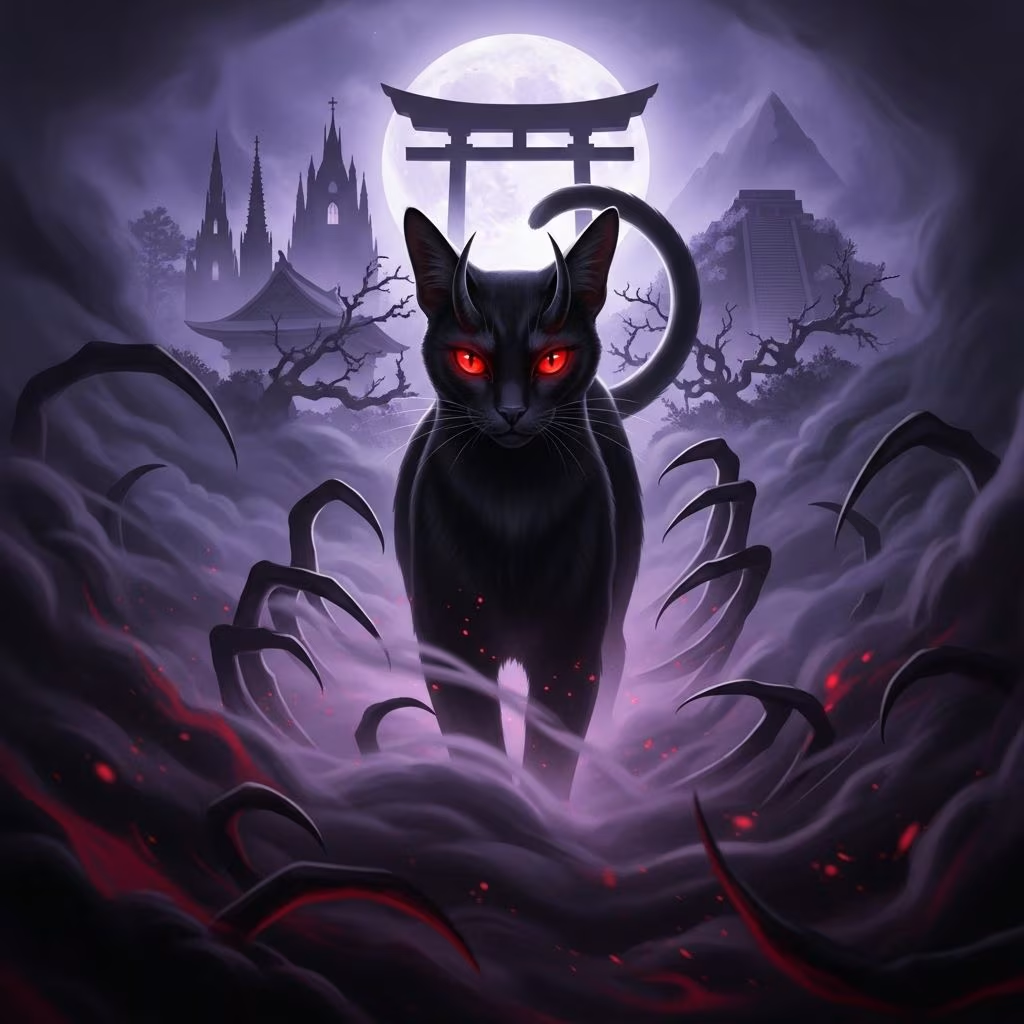
Throughout history and across civilizations, cats have held a uniquely ambiguous position in human consciousness—simultaneously revered as sacred guardians and feared as harbingers of dark forces. While modern society tends to view cats primarily as beloved household pets, the folklore and mythological traditions of cultures worldwide paint a far more complex and often unsettling portrait. These creatures have been cast as shape-shifters, soul-stealers, curse-bearers, and servants of supernatural realms, embodying humanity’s ancient anxieties about the unknown and the unknowable.
The transformation of cats into demonic entities within folklore reflects deeper cultural beliefs about the boundary between the natural and supernatural worlds. Unlike dogs, which typically appear as loyal companions or fierce guardians in mythology, cats occupy a liminal space—neither fully domesticated nor truly wild, neither completely trustworthy nor wholly malevolent. This fundamental ambiguity has made them ideal vehicles for exploring humanity’s relationship with mystery, power, and forces beyond human comprehension.
The Japanese Transformation Legends: Bakeneko and Nekomata
Japanese folklore presents one of the most elaborate and detailed systems for understanding demonic cats, distinguishing between various types of supernatural felines based on their origins and capabilities. The term “bakeneko” translates loosely as “changed cat,” referring to cats that have undergone a transformation into creatures of supernatural power, typically through extended existence or the accumulation of spiritual energy over time.
The mechanism of transformation in Japanese belief holds particular significance. Ancient texts suggest that cats raised by humans for extended periods—sometimes specified as three years or more—begin to absorb spiritual energy from their environment, particularly lunar radiation. This absorption of otherworldly power gradually alters the cat’s nature, eventually resulting in the development of demonic capabilities. White-tailed cats were considered especially susceptible to this process, leading to cultural prohibitions against keeping such animals.
A closely related but distinct entity in Japanese mythology is the Nekomata, distinguished from the ordinary bakeneko by specific physical characteristics. The Nekomata typically possesses a divided or split tail, often described as containing two or more distinct tail segments. This physical transformation marks the cat as having crossed a threshold into genuinely demonic territory, transforming it from a mischievous supernatural being into a truly dangerous entity.
The Nature of Bakeneko Manifestations
- Capability to adopt human form and infiltrate human society
- Tendency to engage in deceptive behavior and trickery
- Potential to curse families or individuals who mistreat them
- Ability to create poltergeist-like phenomena within homes
- Capacity to cause illness through supernatural means
One particularly striking account from Japanese folklore describes a samurai whose household suffered from unexplained supernatural disturbances that resisted all attempts at exorcism. Priests and monks proved unable to banish the entity through conventional spiritual means. The mystery resolved only when the samurai discovered his elderly house cat possessed two tails—a definitive marker of Nekomata status—and removed the creature from the home, whereupon all paranormal activity ceased immediately.
Another legendary narrative reveals a cat that consumed an elderly woman and subsequently assumed her physical form, inhabiting her position within the village. The creature initially maintained this deception successfully, but eventually experienced a change of heart regarding its transgression. The transformed cat subsequently became venerated as a deity—the Myōtaraten—suggesting that even demonic felines could achieve redemption or transcendence through altered intention.
The Kasha: Corpse-Consuming Demon of the Flames
While bakeneko and Nekomata represent transformations of living cats into supernatural beings, Japanese folklore also recognizes the Kasha, a distinct demon entity whose association with felines came somewhat accidentally through artistic reinterpretation. The original concept of Kasha—translatable as “fire chariot”—involved a flaming vehicle that descended from the heavens specifically to collect corpses during funeral processions.
The visual transformation of this concept from abstract phenomenon to concrete creature occurred through the artistic work of Toriyama Sekien, a renowned Japanese artist who portrayed the Kasha in illustrated form as a massive, flame-wreathed demon cat. Through the power of this influential artistic representation, the Kasha became permanently associated with feline form in popular imagination and subsequent folklore development.
Variations on the Kasha legend warn that extraordinarily aged cats can spontaneously transform into this corpse-devouring demon, particularly if left unattended near human remains. Some accounts suggest that the mere presence of a corpse can trigger transformation in vulnerable felines, potentially explaining historical observations of postmortem predation by cats on deceased humans.
Celtic and Western European Demonic Felines
Celtic and broader Western European traditions developed their own distinctive mythological frameworks for understanding supernatural cats, often depicting them as possessing far greater power and significance than ordinary animals. The Cat Sìth, emerging from Scottish and Irish folklore, represents a large black feline with a distinctive white spot on its chest, typically understood as either a fairy in animal form or a witch capable of shape-shifting.
Within Celtic belief systems, cats were understood as ambiguous entities—simultaneously dangerous and protective, mysterious and essential. Unlike the more straightforwardly malevolent demons of other traditions, Celtic cats occupied a complex middle ground, embodying forces that might prove beneficial or catastrophic depending on circumstance and human behavior.
The Palug Cat: Legendary Threat to Kingdoms
Welsh and French mythology preserved accounts of the Palug Cat, a creature of such formidable power that it earned the designation “one of the three plagues of the Isle of Mona”. This cat achieved legendary status through confrontations with King Arthur or his knight Cai, depending on textual variant. The creature proved sufficiently dangerous that Arthur himself took up arms against it, though he sustained wounds in the battle that contributed to his eventual death—or according to some tellings, withdrawal from the realm.
The prominence of the Palug Cat in Arthurian legend suggests that Celtic cultures recognized felines as possessing power approaching that of human rulers and champions. The cat was not a minor obstacle or symbolic threat, but a genuine military and supernatural concern warranting royal attention.
Cats as Shape-Shifters and Devil’s Agents
Celtic traditions held that cats could manifest as spirits, evil fairies, shape-shifting witches, demons, or even the devil himself in disguise. A thirteenth-century Irish woman named Alice Kytler was accused of maintaining relations with a succubus that frequently adopted feline form. Other witnesses to alleged witchcraft reported encountering cats of enormous size—three times their natural proportions—which witnesses interpreted as demonic manifestations rather than natural animals.
The connection between cats and witchcraft would deepen considerably during the European witch trials, when simple cat ownership became dangerous. People who kept cats risked suspicion of witchcraft and potential prosecution, as ecclesiastical authorities increasingly associated nocturnal animals with devil worship and supernatural malevolence.
Italian Traditions: Il Gatto Mammone
Italian folklore contributed its own distinctive demonic cat to the broader European canon through the figure of Il Gatto Mammone, a creature combining characteristics of massive size, regal authority, and demonic power. This entity ruled over other cats from its fortress castle, establishing a hierarchical supernatural kingdom that paralleled human political structures.
The Gatto Mammone embodies an interesting duality within Italian folklore—simultaneously portrayed in certain traditions as a powerful neutral entity enforcing a kind of chaotic fairylike justice, and in other accounts as a genuinely dangerous predatory demon that consumed livestock and posed direct threats to human prosperity. This flexibility in characterization allowed communities to employ the legend adaptively, explaining misfortunes to livestock or family members through reference to the creature’s supernatural malice.
Scholars have noted striking similarities between the Gatto Mammone and the cat demon Tevildo from J.R.R. Tolkien’s early literary works, particularly regarding massive size and the creature’s authority over a kingdom of subordinate cats. Whether Tolkien drew directly from Italian folklore or whether similarities arose independently remains a subject of scholarly debate, but the correspondences suggest deep archetypal patterns in human imagination regarding demonic felines.
Comparative Analysis: Demonic Cat Characteristics
| Tradition | Creature Name | Primary Ability | Origin | Cultural Function |
|---|---|---|---|---|
| Japanese | Bakeneko | Shape-shifting, household haunting | Natural cat transformation | Explaining mysterious phenomena |
| Japanese | Nekomata | Revenge, poltergeist activity | Abused or exceptionally aged cats | Justifying animal welfare |
| Japanese | Kasha | Corpse consumption | Autonomous demon entity | Explaining funeral disruptions |
| Celtic | Cat Sìth | Soul theft, supernatural authority | Fairy or shape-shifter | Warning about ritual observance |
| Celtic | Palug Cat | Martial combat capability | Ancient legendary creature | Establishing cat power equivalence |
| Italian | Gatto Mammone | Livestock predation, rule-enforcement | Demonic ruler entity | Explaining agricultural loss |
Historical Church Influence on Cat Demonization
While diverse cultures independently developed demonic cat mythologies, the intensification and proliferation of negative cat associations in medieval and early modern Europe resulted substantially from ecclesiastical influence. The Christian church, particularly under Pope Innocent, linked nocturnal creatures with devil worship and demonic activity, establishing theological frameworks that transformed cats from ambiguous supernatural entities into explicit agents of Satan.
Pre-Christian Celtic cultures, despite their complex relationship with felines, did not engage in systematic persecution of cats. The historical record indicates that Celtic peoples, primarily engaged in agricultural pursuits, maintained generally positive relationships with the animals. The shift toward demonization intensified with Christianization, suggesting that ecclesiastical authorities deliberately reframed pagan cat associations into explicitly demonic categories to consolidate religious authority.
This theological rebranding proved consequential for actual cats and for people—particularly women—accused of witchcraft. Cat ownership became evidence of demonic association, and black cats in particular faced systematic harm as symbols of devil worship. The cultural consequences of this theological shift persisted for centuries, influencing superstitions and practices that continue to influence some communities today.
Cross-Cultural Patterns in Demonic Feline Mythology
Despite emerging independently across geographically distant cultures, demonic cat legends share recurring characteristics that suggest deep patterns in human psychology and social organization. Most traditions recognize the transformational capacity of cats—their ability to transition from ordinary animals into supernatural beings through accumulation of age, spiritual energy, or traumatic experience.
Revenge and retribution emerge consistently as motivations for demonic cat behavior, particularly when animals experience abuse or mistreatment. This characteristic suggests that cat mythology served important social functions, reinforcing behavioral norms regarding animal treatment by attributing supernatural consequences to cruelty.
The liminality of cats—their position between civilization and wilderness, domestication and wildness—appears fundamental to their demonic significance. Unlike fully domesticated dogs or obviously dangerous wild predators, cats maintain perpetual ambiguity about their allegiance to human interests. This fundamental uncertainty likely made them ideal figures through which to explore anxieties about boundaries between human and nonhuman, controllable and chaotic, natural and supernatural.
Protective Counternarratives: When Cats Guard Rather Than Threaten
While demonic associations dominate many folkloric traditions, alternative narratives simultaneously portray cats as protective supernatural guardians. Ancient Egyptians worshiped Bastet, the cat-headed goddess of protection, fertility, and home life, understanding felines as guardians against evil spirits rather than sources of evil. Killing a cat in ancient Egypt, even accidentally, constituted a crime punishable by death—a severe penalty suggesting profound reverence rather than fear.
In various traditions, cats were believed to possess the ability to perceive spiritual presences invisible to humans, functioning essentially as supernatural sensors or gatekeepers. Some cultures positioned cats near vulnerable individuals—particularly newborns—as protective entities capable of warding off malevolent spirits through their mere presence and supernatural perception.
This protective dimension suggests that demonic cat legends should not be understood as wholly negative. Rather, cats in global mythology embody the fundamental ambiguity of supernatural power itself—dangerous yet necessary, threatening yet protective, requiring caution but capable of beneficial intervention.
Contemporary Resonance and Cultural Memory
Modern culture continues to echo these ancient associations, particularly during autumn and winter months when Halloween and darker cultural narratives gain prominence. Black cats continue to trigger superstitious responses in some populations, reflecting the persistence of medieval ecclesiastical categorizations established centuries ago.
Understanding demonic cat mythology historically rather than literally permits appreciation of how these traditions functioned within their original contexts—explaining natural phenomena, reinforcing behavioral norms, exploring anxieties about supernatural realms, and processing human relationships with animals that maintain irreducible mystery and independence.
Frequently Asked Questions
Can ordinary cats actually transform into demons?
Folkloric traditions describe transformation processes, but these represent mythological explanations for observed animal behavior rather than literal supernatural events. The legends likely emerged from observations of behavioral changes in elderly cats or explanations for predatory incidents involving felines.
Are black cats actually unlucky?
Black cat superstitions originated primarily from medieval Christian theology rather than ancient traditions. Pre-Christian cultures generally regarded cats of all colors neutrally or positively. Modern superstitions represent cultural inheritance rather than established fact.
Why do so many cultures independently develop demon cat mythology?
Cats’ fundamental ambiguity—their domestication without complete dependence, their nocturnal activity, their predatory nature combined with household presence—makes them ideal symbols for exploring anxieties about boundaries between civilization and wildness, safety and threat.
Do any traditions view cats as purely beneficial supernatural beings?
Yes, particularly ancient Egyptian traditions understood cats as protective deities, and various Asian traditions recognize cats as capable of spiritual perception and protective intervention despite their potential for demonic transformation.
References
- Il Gatto Mammone: The Italian Legend of the Cat King (Or Cat Demon?) — Folklore Thursday. 2024. https://folklorethursday.com/folktales/italian-legend-cat-king-cat-demon/
- Kasha the Japanese Cat Demon: History & Myth Explained — Catster. 2024. https://www.catster.com/lifestyle/kasha-japanese-cat-demon/
- The Cat in Celtic Lore: Demon, Witch, or Lover? — Living Library Blog. 2024. https://livinglibraryblog.com/the-cat-in-celtic-lore-demon-witch-or-lover/
- Cat Legends — Asheville Cat Weirdos. 2024. https://ashevillecatweirdos.org/cat-legends/
- Bakeneko — Wikipedia. 2024. https://en.wikipedia.org/wiki/Bakeneko



