
Undefined Degenerative Nerve Disorders In Animals: Guide
Exploring progressive peripheral neuropathies affecting animal mobility, breathing, and quality of life with insights into diagnosis and management.
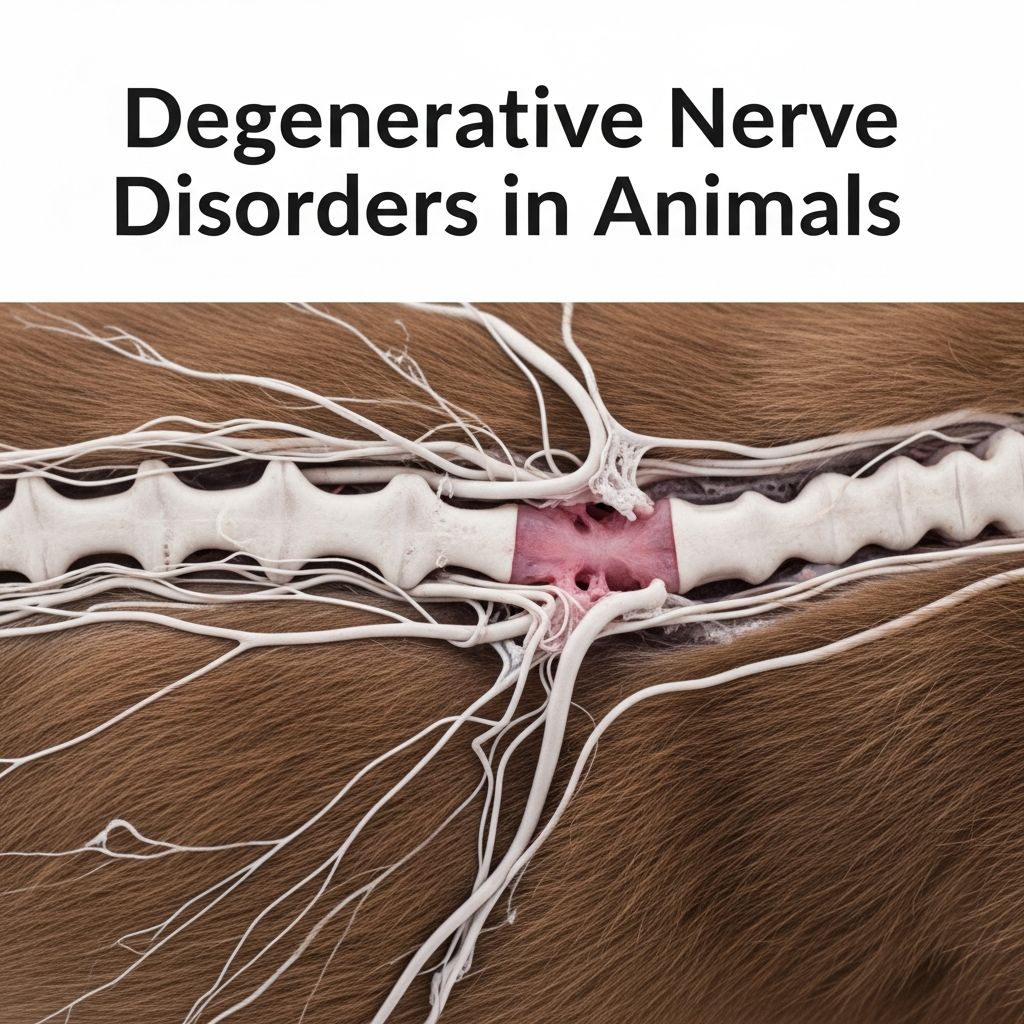
Progressive damage to peripheral nerves and neuromuscular junctions leads to significant mobility issues, respiratory challenges, and muscle wasting in various animal species, particularly dogs. These conditions, often termed degenerative neuropathies, involve the breakdown of nerve fibers or their protective coverings, disrupting signal transmission from the brain to muscles.
Understanding Peripheral Nerve Anatomy and Function
Peripheral nerves extend beyond the brain and spinal cord, forming a network that controls movement, sensation, and autonomic functions. Each nerve comprises axons—long projections of nerve cells—insulated by myelin sheaths produced by Schwann cells. In degenerative disorders, axons may degenerate (axonopathy) or myelin may break down (myelinopathy), impairing nerve conduction.
Animals rely on these nerves for coordinated gait, swallowing, and breathing. When degeneration occurs, signals weaken or fail, resulting in paresis (partial paralysis), ataxia (uncoordinated movement), and atrophy (muscle shrinkage). Length-dependent patterns are common, where longest nerves, like those to hind limbs or larynx, suffer first.
Common Clinical Manifestations Across Species
Symptoms typically emerge gradually, starting with subtle gait changes and progressing to severe disability. Key signs include:
- Hind limb weakness: Dragging feet, knuckling, or stumbling, often bilateral.
- Laryngeal dysfunction: Hoarse bark, stridor (noisy breathing), exercise intolerance, or collapse from airway obstruction.
- Generalized paresis: Affecting all limbs, with reduced reflexes and proprioceptive deficits.
- Muscle changes: Wasting in distal limbs, visible tremors, or fibrillation on palpation.
In advanced stages, animals may require assistance for mobility or face euthanasia due to welfare concerns. Respiratory compromise from laryngeal paralysis heightens risks of aspiration pneumonia or heat stress.
Breed-Specific Degenerative Neuropathies in Dogs
Certain breeds exhibit hereditary predispositions, highlighting genetic factors in disease onset.
| Breed | Condition | Age of Onset | Key Features |
|---|---|---|---|
| Labrador Retriever | Late-Onset Peripheral Neuropathy (LPN) | Middle-aged to older | Length-dependent axon loss; laryngeal paralysis (100%); pelvic paresis. |
| Rottweiler | Distal Polyneuropathy | 1-4 years | Asymmetric weakness progressing to all limbs; reduced reflexes; poor prognosis. |
| Alaskan Malamute | Progressive Axonal Demyelinating Polyneuropathy | Variable | Motor and sensory axon degeneration; likened to human CMT disease. |
LPN in Labradors exemplifies a spontaneous model for human age-related neuropathy, featuring reduced compound muscle action potential (CMAP) amplitudes and distal axon loss. Rottweiler cases show nerve conduction slowing and distal muscle denervation, unresponsive long-term to steroids.
Diagnostic Approaches: From Exam to Advanced Testing
Veterinary diagnosis combines history, neurology, and specialized tests. Initial exams reveal hyporeflexia, absent paw replacement, and respiratory noise.
Electrodiagnostic Techniques
Motor nerve conduction velocity (MNCV) and electromyography (EMG) pinpoint lesion sites. In axonopathies, CMAP amplitude drops without velocity changes, while EMG detects spontaneous activity in distal muscles like gastrocnemius.
- Nerve conduction studies: Measure latency, amplitude, and velocity in sciatic/ulnar nerves.
- EMG: Identifies fibrillation potentials, positive sharp waves in affected limbs.
Histopathology and Imaging
Nerve biopsies reveal axonal dropout, especially large-diameter fibers in distal segments, confirming length-dependency. Spinal cord sections rule out central involvement, distinguishing from degenerative myelopathy.
Pathophysiological Mechanisms
Degeneration stems from genetic mutations, aging, or metabolic insults. In LPN, heritable axonopathy targets motor nerves, sparing conduction speed initially. Demyelinating forms thicken perineurium, compromising vascular supply and inducing ischemia.
Secondary effects include Wallerian degeneration—distal axon breakdown post-injury—and Schwann cell dysfunction. Unlike inflammatory neuropathies (e.g., acute polyradiculoneuritis post-raccoon exposure), degenerative types lack immune mediation.
Management Strategies and Supportive Care
No cures exist for most degenerative cases, but interventions mitigate symptoms.
- Surgical options: Unilateral arytenoid lateralization for laryngeal paralysis improves airflow.
- Pharmacology: Corticosteroids offer transient relief in some polyneuropathies.
- Rehabilitation: Physical therapy, slings, or carts enhance mobility and muscle tone.
- Monitoring: Regular EMG tracks progression; antioxidants or neurotrophics are experimental.
Prognosis varies: LPN allows functional life with management, while Rottweiler polyneuropathy often progresses fatally.
Research Models and Translational Potential
Canine LPN serves as a large-animal model for human peripheral neuropathies due to clinical, electrophysiologic, and histologic parallels. Studies quantify axon loss in recurrent laryngeal nerves, mirroring human length-dependent patterns.
Genetic loci like NDRG1 in Malamutes parallel Charcot-Marie-Tooth mutations, aiding gene therapy trials. Future work targets neuroprotection and regeneration.
FAQs on Animal Nerve Degeneration
What causes sudden breathing issues in older Labradors?
Laryngeal paralysis from axonopathy in recurrent laryngeal nerves, leading to vocal fold immobility.
Can diet or supplements slow progression?
Limited evidence; balanced nutrition supports nerve health, but consult vets for tailored plans.
Is this hereditary? Should I breed affected dogs?
Many are genetic (e.g., LPN); genetic testing and breeding avoidance recommended.
How do I differentiate from spinal cord disease?
Normal spinal reflexes and EMG focus on peripheral signs distinguish neuropathy.
What’s the lifespan impact?
Varies; managed cases live years, but respiratory crises shorten it without intervention.
Preventive Measures and Owner Education
Early detection via breed screening and prompt veterinary consults improves outcomes. Owners should monitor for gait changes, raspiness, or fatigue, avoiding high-heat exercise.
Genetic registries aid selective breeding. Research participation advances therapies.
References
- Pathologic Classification of a Late Onset Peripheral Neuropathy in a Labrador Retriever Model — PMC/NCBI. 2024. https://pmc.ncbi.nlm.nih.gov/articles/PMC10914337/
- Disorders of the Peripheral Nerves and Neuromuscular Junction in Dogs — MSD Veterinary Manual. 2023. https://www.msdvetmanual.com/dog-owners/brain-spinal-cord-and-nerve-disorders-of-dogs/disorders-of-the-peripheral-nerves-and-neuromuscular-junction-in-dogs
- Disorders of the Peripheral Nervous System: Mononeuropathies and Polyneuropathies — Veterian Key. 2022. https://veteriankey.com/disorders-of-the-peripheral-nervous-system-mononeuropathies-and-polyneuropathies/
- Nerve Disorder Affecting Multiple Nerves in Dogs — PetMD. 2023. https://www.petmd.com/dog/conditions/neurological/c_multi_peripheral_neuropathies
Similar Articles








Read full bio of medha deb


