

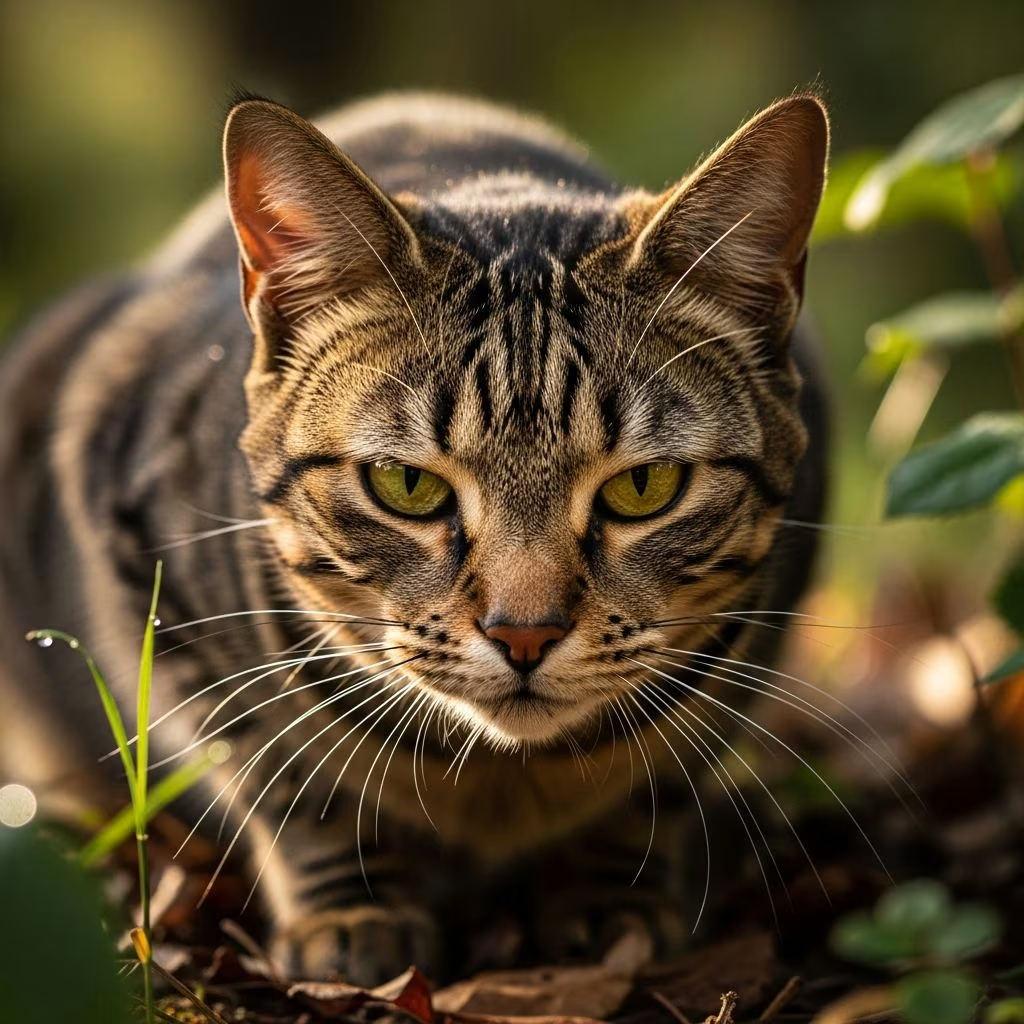
Cats retain powerful hunting instincts from their wild ancestors, driving them to stalk, chase, and pounce even when well-fed. This behavior stems from deep-seated neurological rewards rather than mere hunger, making it essential for owners to understand and redirect these impulses constructively.
The Evolutionary Roots of Cat Hunting
Domestic cats descend from solitary hunters like the African wildcat, where survival hinged on efficient predation. Unlike pack animals, cats evolved to hunt alone, relying on stealth and precision to capture small, fast prey such as rodents and birds. This solitary strategy shaped their behavior: they scan environments, stalk silently, then explode into action with a pounce.
Archaeological evidence suggests early human-cat bonds formed around 9,000 years ago, when felines controlled rodents near grain stores. Domestication preserved these traits, as cats self-selected for proximity to humans without losing their predatory edge. Today, even pampered house cats exhibit these patterns, triggered by movement or sound, proving the instinct endures across millennia.
Breaking Down the Hunting Sequence
Feline predation unfolds in distinct phases, each fulfilling specific physical and mental needs. Here’s a step-by-step overview:
- Search Phase: Cats methodically patrol territories, using heightened senses to detect prey cues like rustling leaves or scurrying feet. This exploratory stage activates their curiosity and orientation skills.
- Stalk and Approach: Once prey is spotted, the cat crouches low, moving with deliberate slowness to avoid detection. The head remains extended, muscles tensed for the impending burst.
- Chase and Pounce: Closing in, cats accelerate into a sprint, launching forward with front paws to strike. Success rates in the wild hover below 50%, honing their agility over repeated attempts.
- Capture and Manipulation: After securing prey, cats may bat it around, assessing safety before the kill. This isn’t cruelty but a risk-mitigation tactic against potential counterattacks.
- Kill and Consume: A precise neck bite severs the spine, followed by eating if hunger motivates. Well-fed cats often abandon kills, prioritizing the thrill over nutrition.
Each stage provides dopamine surges, particularly during the appetitive (pre-capture) elements, reinforcing the behavior intrinsically.
Why Well-Fed Cats Still Hunt
Hunger plays a minor role; hunting’s primary driver is pleasure and mental stimulation. Neurological studies reveal dopamine release during stalking and chasing, independent of outcomes. This ‘internal reward loop’ explains why satiated cats pursue laser dots or toys with fervor—it’s not about eating but the exhilarating process.
Indoor confinement amplifies this: without natural outlets, cats redirect energy toward household items, leading to shredded curtains or ambushed ankles. Neutering doesn’t suppress it either, as the drive isn’t hormonal but hardwired for survival practice.
| Hunting Trigger | Indoor Manifestation | Neurological Benefit |
|---|---|---|
| Movement/Sound | Chasing shadows or feet | Dopamine boost from chase |
| Curiosity | Stalking toys | Mental engagement |
| Energy Surplus | Pouncing on objects | Stress reduction |
This table illustrates common triggers and their domesticated parallels, highlighting play’s role in mimicking wild scenarios.
The Science of Play as Prey Simulation
Interactive toys replicate hunting phases, offering fulfillment without wildlife impact. Feather wands emulate birds, balls mimic rodents, and puzzle feeders simulate consumption. Research confirms cats engage longer with prey-resembling items, especially when hungry, blurring lines between play and predation.
Play reduces stress hormones, sharpens reflexes, and prevents obesity by burning calories equivalent to short hunts. Timing matters: sessions before meals recreate the hunt-eat cycle, enhancing satisfaction. Allow ‘captures’ by letting toys succumb, completing the sequence psychologically.
Individual Variations in Hunting Styles
Not all cats hunt identically; personality influences tendencies. Some are patient ambushers, lying in wait for hours; others are bold chasers, favoring high-speed pursuits. French studies link bolder, more active cats to higher hunting frequencies, modulated by environment and care.
- Ambush Predators: Prefer elevated perches for observation, ideal for bird-like toys on strings.
- Active Pursuers: Thrive on rolling balls or remote-controlled devices.
- Opportunists: React to random stimuli, benefiting from scattered toys.
Tailor enrichment to these styles for optimal engagement.
Why Cats ‘Toy’ with Captured Prey
Post-capture batting seems playful but serves practical ends. It exhausts prey, minimizing injury risk from bites or scratches—crucial for small predators facing larger quarry. Domesticated cats may exaggerate this due to surplus energy, unlike efficient wild kin.
Mothers teach kittens via live prey, fostering skills safely. If uneaten, kills signal non-hunger or overabundance, prompting continued hunting for sport.
Enriching Indoor Lives: Practical Strategies
Channel instincts humanely to curb unwanted behaviors:
- Daily Play Routines: 15-30 minutes twice daily, varying toys to prevent habituation.
- Environmental Enhancements: Cat trees, window perches, and tunnels for self-directed hunting.
- Feeding Innovations: Scatter kibble or use treat balls to extend ‘search’ phases.
- Tech Aids: Automated toys for solo stimulation when owners are away.
- Outdoor Alternatives: Harness walks or enclosed patios for safe exploration.
These reduce wildlife kills by up to 50% in some studies, balancing welfare and ecology.
Health Benefits of Fulfilling Hunting Drives
Satisfying predatory needs combats boredom-induced issues like aggression or lethargy. Active hunters maintain muscle tone, cardiovascular health, and cognitive sharpness into seniority. Dopamine from play mitigates anxiety, potentially lowering urinary problems linked to stress.
Common Myths About Cat Hunting
- Myth: Fat cats don’t hunt. Reality: Full bellies heighten play-hunting.
- Myth: Neutering stops it. Reality: Instinct persists post-surgery.
- Myth: Play replaces all needs. Reality: Combine with climbing and scratching for holistic enrichment.
Frequently Asked Questions
Can I fully stop my cat from hunting?
No, it’s innate, but redirection via play minimizes outdoor pursuits. Factors like prey availability and personality influence frequency.
Why does my cat bring me dead animals?
It’s a sharing gesture, mimicking provisioning for young or pride members, even if unappreciated.
How much play does my cat need daily?
Aim for 30-60 minutes total, split into sessions mimicking hunt cycles.
Is laser play harmful?
It frustrates without ‘capture’; follow with catchable toys to complete the sequence.
Do kittens hunt differently?
They practice via play-fighting and stalking, building lifelong skills.
Protecting Wildlife While Honoring Instincts
Outdoor cats kill billions of birds and mammals yearly. Bells, GPS collars, or indoor-only policies help, paired with robust enrichment. Well-stimulated cats hunt less, preserving biodiversity without denying their nature.
References
- Why Cats Hunt: Beyond Hunger — Companion Animals New Zealand. 2023. https://www.companionanimals.nz/articles/why-cats-hunt
- The Psychology of Play: Why Cats Hunt, Even Indoors — CatCurio. 2024. https://catcurio.com/blogs/catlove/the-psychology-of-play-why-cats-hunt-even-indoors
- Cats and Their Hunting Behaviour — FOUR PAWS International. 2022. https://www.four-paws.org/our-stories/publications-guides/cats-and-their-hunting-behaviour
- Why Do Cats Hunt? Learn About Their Behavior — Purina US. 2025-02-01. https://www.purina.com/articles/cat/behavior/understanding-cats/cat-hunting-behavior
- Understanding the hunting behaviour of cats — International Cat Care. 2023. https://icatcare.org/articles/understanding-the-hunting-behaviour-of-cats
- Can I stop my cat from hunting? — BC SPCA. 2024. https://spca.bc.ca/faqs/can-i-stop-my-cat-from-hunting/



