

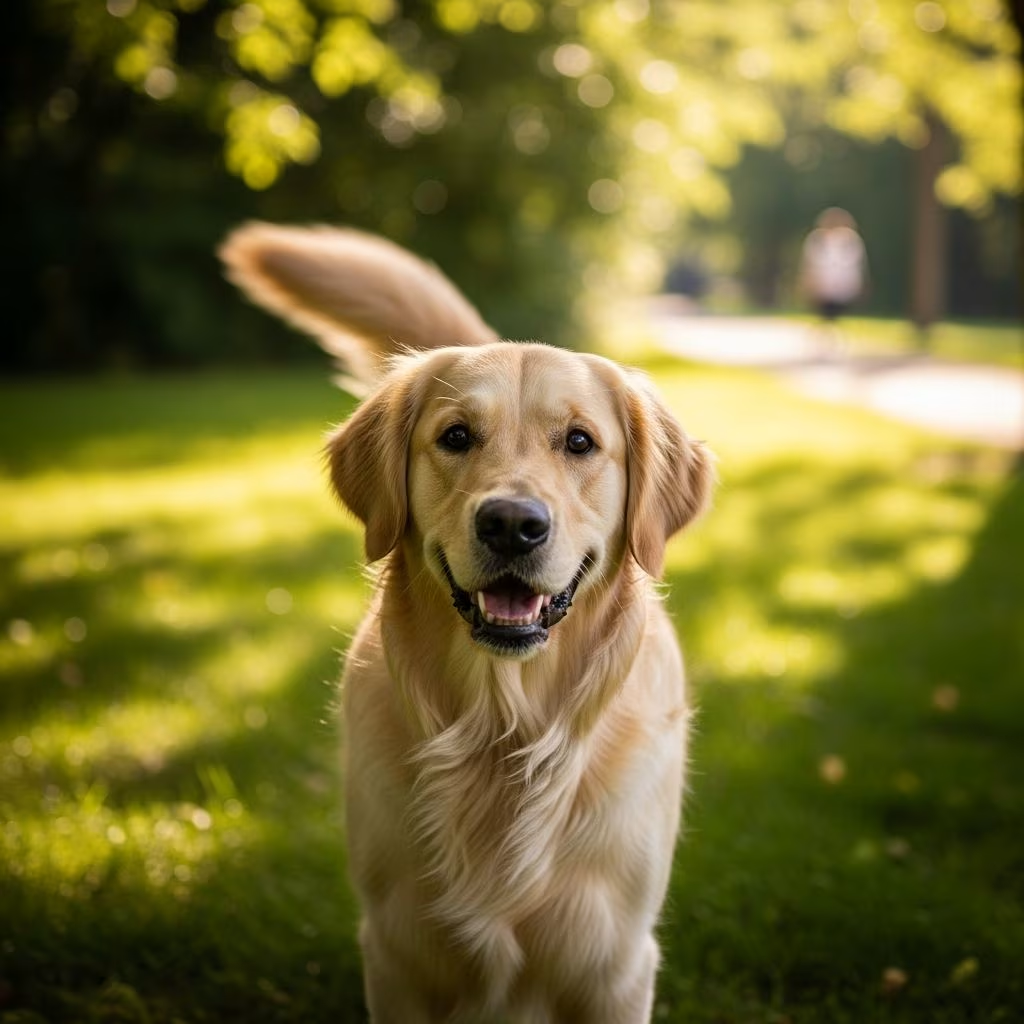
Dogs communicate volumes through their tails, with wagging serving as a primary social signal that conveys emotions ranging from joy to apprehension. Far from a simple sign of happiness, tail movements reveal complex inner states influenced by context, familiarity, and brain lateralization.
The Evolutionary Roots of Tail Wagging in Dogs
Tail wagging in dogs likely emerged as part of domestication processes spanning over 35,000 years, where humans may have selected for rhythmic, friendly behaviors. This “domestication syndrome” links tail wagging to traits like tameness, distinguishing dogs from wild canids that use tails mainly for balance or propulsion.
Unlike horses swishing tails to repel insects or kangaroos leveraging them for locomotion, dogs reserve wagging primarily for social interactions with humans or other animals. This behavior activates only in the presence of others, underscoring its role as a communicative tool rather than a solitary action.
Understanding Tail Position and Speed Variations
Tail carriage and wag intensity provide key emotional clues. A high-held tail with rapid side-to-side swings often signals confidence or excitement, while a low or tucked tail indicates fear or submission.
- High tail, fast wag: Enthusiasm or dominance.
- Neutral height, moderate wag: Relaxed curiosity.
- Low tail, slow wag: Uncertainty or caution.
- Tucked tail, stiff wag: Anxiety or aggression.
Speed correlates with arousal levels: quick wags denote high energy or stress, whereas slow movements suggest calm assessment. Frequency increases in relaxed or excited states but decreases under acute stress.
Left vs. Right: The Science of Directional Bias
Dogs exhibit pronounced asymmetry in tail wags, with direction tied to emotional valence and brain hemisphere activity. Rightward wags, controlled by the left brain hemisphere, signal positive emotions like approach motivation when seeing familiar owners. Leftward wags, driven by the right hemisphere, indicate negative states such as withdrawal from strangers or threats.
Research on Beagle dogs during human interactions showed wagging asymmetry shifting rightward over days, reflecting growing social familiarity. This change was consistent and more pronounced than variations in amplitude or velocity, which remained stable within individuals.
| Wag Direction | Emotional State | Brain Hemisphere | Example Trigger |
|---|---|---|---|
| Rightward | Positive (curiosity, joy) | Left | Familiar person approaching |
| Leftward | Negative (fear, uncertainty) | Right | Unfamiliar dog |
| Broad/Helical | High arousal (playful) | Bilateral | Play invitation |
Other dogs perceive these biases: silhouettes of left-wagging tails elicit anxious responses, while right-wagging ones prompt relaxed approaches, highlighting inter-dog communication.
Individual Signatures in Wagging Patterns
Each dog displays unique wagging traits, akin to human gait signatures, with stable frequencies, amplitudes, and velocities. Deep-learning pose estimation on free-moving dogs revealed these idiosyncrasies persist across sessions.
These patterns form during socialization and serve as identifiers in packs, much like vocal signatures. Owners can learn their dog’s baseline to detect deviations signaling health issues or mood shifts.
Dynamic Modules: How Tail Wags Evolve in Real Time
Tail wagging follows attractor-like dynamics, transitioning between stable modules (consistent patterns) and transient ones (unstable shifts). Analysis using largest Lyapunov exponents and dynamic time warping clustered wags into repeatable segments.
During interactions, dogs cycle through these modules—e.g., from calm sways to vigorous bursts—mirroring neural attractor states in motor control circuits. This organization suggests sophisticated neural processing, offering a model for studying social behaviors in neuropsychiatric contexts like autism analogs.
Context Matters: When Wags Aren’t Happy
Common myth: all wags mean happiness. In reality, vigorous wagging can precede aggression if paired with stiff posture or growling. Stressful scenarios reduce wag amplitude while increasing frequency, confusing novice interpreters.
Circular or helical wags at mid-height often invite play, contrasting linear side-to-side motions. Always consider full body language: relaxed ears and play bows amplify positive signals, while piloerection warns of tension.
Neural Underpinnings and Brain Lateralization
The rubrospinal tract, crossing near the red nucleus, enables contralateral control: left brain drives rightward wags for approach, right brain leftward for avoidance. This mirrors human prefrontal asymmetry, where left activation links to positivity.
Future neuroimaging could link wagging to hormone surges like oxytocin during bonding, or cortisol in stress, refining our grasp of canine cognition.
Practical Tips for Reading Your Dog’s Tail
- Observe baseline: Note your dog’s neutral wag in low-stakes settings.
- Check direction: Use a mirror or video for subtle biases.
- Combine cues: Pair tail with ears, eyes, and posture.
- Track changes: Sudden shifts may indicate pain or illness.
- Test responses: Note reactions to familiar vs. novel stimuli.
Training enhances communication—reward calm wags to reinforce positive associations.
Frequently Asked Questions (FAQs)
Do all dogs wag their tails the same way?
No, breeds vary: long-tailed breeds like Labs show broad wags, while natural bobs like Corgis use stubs subtly. Individuals maintain unique styles.
Why does my dog wag when aggressive?
High arousal, not joy—context like staring or raised hackles clarifies intent.
Can tail docking affect communication?
Yes, it hinders signal clarity, potentially increasing misunderstandings with other dogs.
Do puppies wag tails from birth?
Newborns show reflexive twitches; social wagging develops around 7 weeks with littermates.
Is left wag always bad?
Typically negative, but intensity and posture provide full context.
Enhancing the Human-Dog Bond Through Tail Awareness
Mastering tail language fosters trust, reduces mishaps, and deepens companionship. By attuning to these signals, owners respond aptly—comforting anxious left-wags or engaging joyful rightward ones—elevating mutual understanding.
Ongoing research promises richer insights, from AI-tracked dynamics to neural correlates, benefiting welfare and training.
References
- Left-right asymmetry and attractor-like dynamics of dog’s tail wagging during interactions with humans — Sheng et al. Cell Reports. 2022-08-02. https://pmc.ncbi.nlm.nih.gov/articles/PMC9356099/
- Tail wagging by dogs — Wikipedia (sourced from peer-reviewed studies). 2023. https://en.wikipedia.org/wiki/Tail_wagging_by_dogs
- Why Do Dogs Wag Their Tails? Scientists Examine the Endearing Behavior’s Possible Evolutionary Roots — Smithsonian Magazine. 2024-04-18. https://www.smithsonianmag.com/smart-news/why-do-dogs-wag-their-tails-180983608/
- Why do dogs wag their tails? — Royal Society Biology Letters. 2024-01-10. https://royalsocietypublishing.org/rsbl/article/20/1/20230407/63446/Why-do-dogs-wag-their-tails-Why-do-dogs-wag-their



