

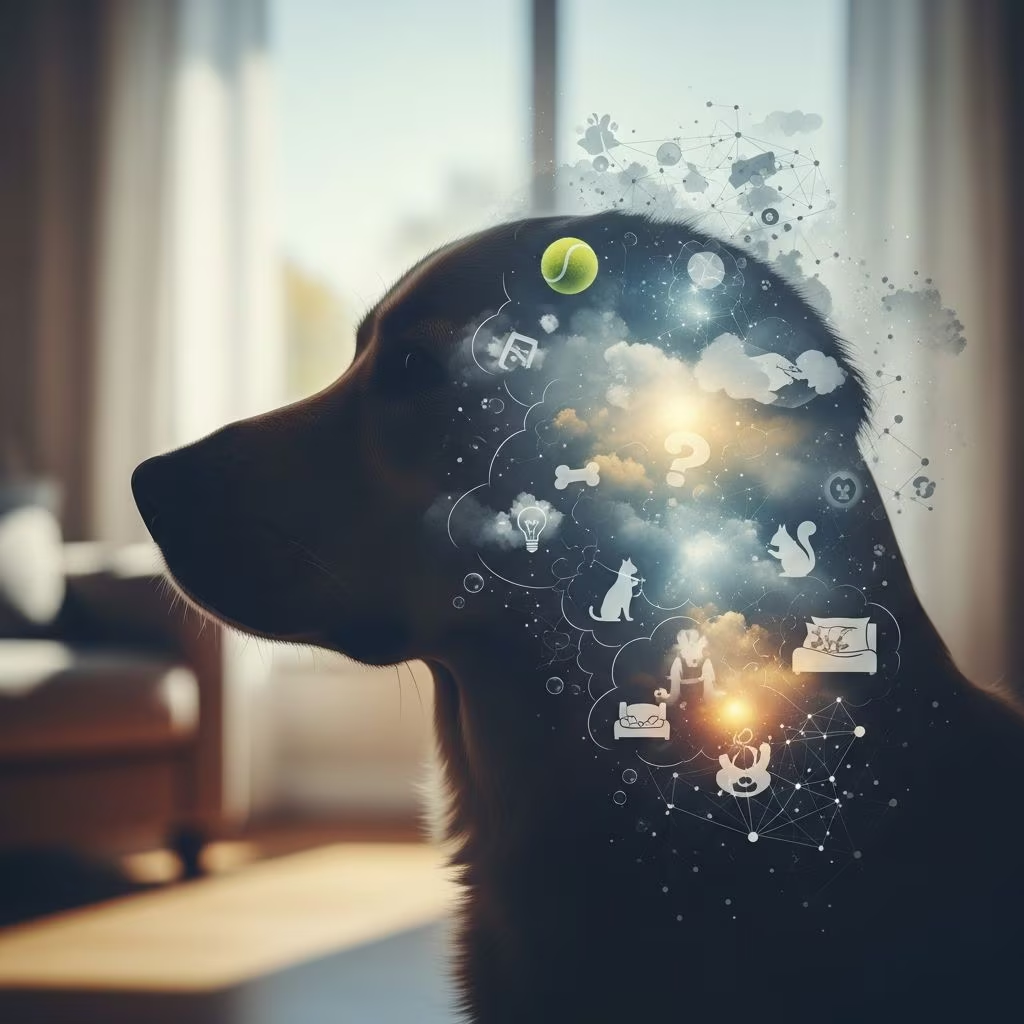
Dogs spend their days engaged in a rich tapestry of mental activities, from processing sensory inputs to forming social connections and tackling challenges. Scientific studies reveal that canine cognition mirrors aspects of human intelligence, including a general cognitive factor that influences learning, curiosity, and adaptability.
The Foundations of Dog Intelligence
At the core of a dog’s mental life lies a ‘g factor,’ a broad cognitive ability similar to that in humans, which underpins problem-solving, memory, and learning. Researchers at Eötvös Loránd University tested 129 family dogs over two and a half years, finding that higher ‘g factor’ scores correlated with greater curiosity in new environments and faster task acquisition. This overarching intelligence shapes how dogs navigate their daily experiences, making some more trainable and exploratory than others.
Individual differences emerge early and persist. A longitudinal study of 160 assistance dog candidates showed that traits like inhibitory control, attention, and social gaze improve from puppyhood to adulthood, with moderate stability in skills such as odor discrimination and human signal use. Puppies as young as 8-10 weeks exhibit measurable cognitive traits, including memory and impulse control, which predict later performance.
Sensory Worlds: How Dogs Perceive Their Environment
Dogs’ thoughts are heavily influenced by their superior senses, particularly smell, which dominates their mental processing. Olfactory discrimination remains stable from early development, allowing dogs to map their surroundings through scent trails and identify familiar pack members or food sources.
Visual and auditory cues also play roles. Basic abilities like following human gestures develop around week 8, enabling dogs to interpret pointing or voice tones as communicative signals. Throughout the day, dogs constantly scan for these inputs, pondering the significance of rustling leaves, distant barks, or their owner’s movements.
- Olfaction: Primary sense for territory mapping and social recognition.
- Vision: Detects motion and human gestures for interaction.
- Hearing: Processes pitches and tones to gauge emotions.
Social Cognition: Bonds with Humans and Peers
A significant portion of a dog’s daily mental energy focuses on social relationships. Dogs excel at reading human cues, turning to people in problem-solving scenarios, a trait linked to better everyday adaptability. In the Dog Cognitive Development Battery, social gaze and interaction times increased with age, indicating maturing attentiveness to humans.
This social pondering manifests in behaviors like awaiting dinner cues or seeking play invitations. Owners report that dogs with strong human-oriented cognition learn commands faster and display fewer frustration-based issues. Studies confirm that self-control and gesture-reading directly impact real-world obedience and companionship quality.
| Cognitive Trait | Developmental Change | Stability | Daily Impact |
|---|---|---|---|
| Social Gaze | Improves significantly | Moderate | Enhances bonding |
| Inhibitory Control | Improves with age | Moderate | Reduces impulsivity |
| Human Signals | Early emergence | Enduring | Boosts trainability |
Problem-Solving and Learning Routines
Dogs frequently contemplate challenges, from accessing toys behind barriers to mastering new tricks. Logical reasoning and spatial problem-solving correlate with owner-assessed learning speed; dogs acing cylinder tasks (retrieving hidden treats) make fewer errors in daily puzzles. The ‘g factor’ ties these abilities together, predicting overall adaptability.
Daily routines amplify this: mealtimes involve anticipation and strategy, walks spark environmental curiosity, and play sessions test persistence. Working dogs, tested longitudinally, showed executive functions like reversal learning strengthening over time, aiding complex tasks.
Memory and Routine Reflections
Short- and long-term memory occupy much of a dog’s reflective thought. Puppies demonstrate retention in object-choice tasks, with performance enhancing by young adulthood. Dogs ponder past events, like the route to the park or yesterday’s treat location, reinforcing habits.
This memory underpins routine comfort. Disruptions prompt confusion, highlighting how dogs mentally rehearse schedules. Cognitive decline in aging mirrors human patterns, linked to the ‘g factor,’ underscoring dogs’ utility in aging research.
Emotional Processing and Rest
Beyond tasks, dogs process emotions, weighing joy from play against separation anxiety. Inhibitory control helps manage impulses during waits, a skill honing from puppyhood. Sleep periods allow mental consolidation, similar to humans, where dreams may replay daily events.
Curiosity drives exploration thoughts, with high-‘g’ dogs venturing more boldly. Owners note these pups as quicker learners, blending emotion with cognition seamlessly.
Daily Mental Timeline: A Typical Day
Imagine a dog’s thought flow:
- Morning Wake-Up: Assess scents, greet family with social gazes.
- Breakfast: Anticipate food via cues, exercise impulse control.
- Walk Time: Map territory olfactorily, solve minor obstacles.
- Play/Training: Problem-solve toys, follow gestures.
- Afternoon Downtime: Reflect on memories, monitor household sounds.
- Evening Wind-Down: Strengthen bonds through interaction.
Enhancing Your Dog’s Cognitive Life
To enrich mental activity, incorporate puzzle feeders, varied walks, and training games. Early testing reveals strengths, matching dogs to roles like therapy or agility. Consistent routines build security, while novel stimuli foster ‘g factor’ growth.
- Rotate toys for novelty.
- Use scent games for olfaction.
- Practice cues emphasizing social signals.
FAQs
Do dogs think like humans?
Dogs possess a ‘g factor’ akin to humans, influencing broad cognition, though their thoughts prioritize sensory and social elements.
How can I tell what my dog is thinking?
Observe gazes, body language, and problem-solving persistence; studies link these to cognitive traits like inhibitory control.
Does age affect dog cognition?
Yes, executive functions improve to adulthood, but decline patterns parallel humans, tied to the ‘g factor’.
Are some breeds smarter?
Individual differences matter more than breed; early traits predict lifelong ability across types.
Can I boost my dog’s intelligence?
Enrichment via challenges enhances learning speed and adaptability, per problem-solving research.
References
- Groundbreaking Study Reveals Dogs Possess a Cognitive ‘G Factor’ Similar to Humans — MyVetCandy / Eötvös Loránd University. 2024-05-15. https://www.myvetcandy.com/blog/2024/5/15/groundbreaking-study-reveals-dogs-possess-a-cognitive-g-factor-similar-to-humans
- Dog cognitive development: A longitudinal study across the first two years — PMC / Bray et al. 2021-04-12. https://pmc.ncbi.nlm.nih.gov/articles/PMC8035344/
- Canine cognitive traits linked to everyday behaviour — University of Helsinki. N/A. https://www.helsinki.fi/en/news/dogs/canine-cognitive-traits-linked-everyday-behaviour
- Development of Cognitive Traits in Dogs — AKC Canine Health Foundation. N/A. https://www.akcchf.org/breakthrough/development-of-cognitive/
- How dogs think — American Psychological Association. 2025-10. https://www.apa.org/monitor/2025/10/how-dogs-think



