

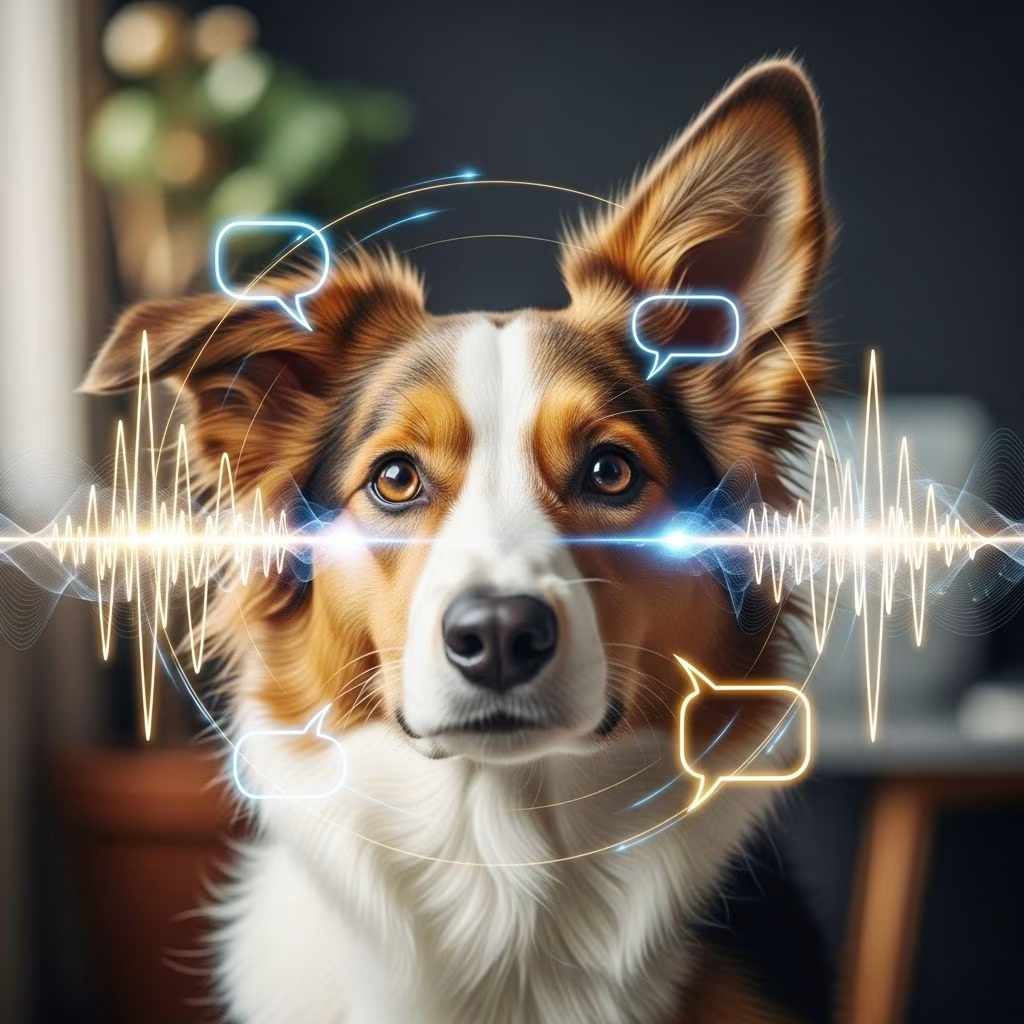
Dogs possess a rich array of communication methods that enable them to interact effectively with other dogs, humans, and their environment. These include visual cues from body posture and facial expressions, auditory signals like barks and whines, olfactory messages via scents, and even tactile interactions. Through domestication, dogs have adapted these signals, making them particularly attuned to human cues while retaining sophisticated conspecific exchanges.
The Power of Visual Signals in Dog Interactions
Visual communication forms the cornerstone of how dogs convey emotions and intentions. A dog’s body language provides immediate insights into its mindset, allowing for rapid assessment in social encounters.
- Tail movements: The direction and speed of tail wagging reveal emotional states. Rightward wags indicate positive emotions, such as joy upon seeing an owner, while leftward wags signal apprehension toward threats like unfamiliar aggressive dogs.
- Ear positions: Forward ears show alertness or interest, whereas flattened ears suggest fear or submission.
- Posture and gaze: A lowered body with averted eyes communicates deference, while direct stares can assert dominance.
Recent research confirms dogs actively produce facial expressions to engage humans, adjusting mouth, eyes, and ears to solicit responses. This voluntary display challenges the view of expressions as mere reflexes. Dogs also excel at reading human facial cues, inferring emotions with toddler-like proficiency.
Auditory Expressions: From Barks to Whimpers
Dogs employ a diverse vocal repertoire for short- and long-range messaging. Barks serve as versatile alerts, varying in pitch and rhythm to denote play, warnings, or demands.
| Vocalization Type | Context | Typical Meaning |
|---|---|---|
| Bark (rapid, high-pitched) | Play invitation | Excitement and engagement |
| Growl (low, sustained) | Threat display | Warning or defense |
| Whine | Separation or need | Distress or attention-seeking |
| Howl | Long-distance | Contact or emotional release |
Studies show dogs tailor barks to humans, with acoustic variations shaped by owner feedback during play or walks. Growls convey size and aggression level, helping humans gauge threat. Unlike wolves, domesticated dogs have expanded non-agonistic vocalizations for better human rapport.
Olfactory and Tactile Channels of Expression
Scents play a vital role in canine social dynamics. Dogs mark territories with urine or pheromones to signal presence, status, and reproductive availability. Sniffing during greetings gathers personal histories, conveying identity and health.
Tactile communication involves physical contact like nuzzling or pawing, fostering bonds or asserting play. Mutual grooming reinforces pack ties, while gentle nudges request attention.
Dogs and Human Dialogue: A Cross-Species Bridge
Domestication has honed dogs’ ability to interpret human signals. They recognize ostensive cues like eye contact or baby-talk, signaling intent to communicate. Mutual gazing boosts oxytocin, strengthening bonds akin to human parent-child interactions.
Dogs reference human emotions when approaching objects: happiness encourages exploration, fear prompts avoidance. This social referencing highlights their emotional intelligence.
Innovative Tools Enhancing Canine-Human Bonds
Modern studies explore soundboards, where dogs press buttons for words like “outside” or “play.” A UCSD-led PLOS ONE study with 30 dogs demonstrated comprehension independent of owner presence or cues, affirming word processing. Pre-registered experiments in homes and via citizen science ensured rigor.
Another Science publication details dogs learning extensive vocabularies, expanding communication possibilities. These tools reveal dogs’ cognitive depths, bridging species gaps.
Interpreting Dog-to-Dog Dynamics
Among themselves, dogs rely on calming signals like yawning or lip-licking to de-escalate tension. Tail asymmetries help deduce peers’ emotions, facilitating harmonious groups. Vocal and visual combos prevent misunderstandings in packs.
Common Misinterpretations and Owner Tips
- A wagging tail always means happiness? No—context and direction matter.
- Growling indicates pure aggression? Often a polite warning to back off.
- Ignoring whines prevents spoiling? It may heighten anxiety; address underlying needs.
Owners should observe holistically: combine signals for accurate reads. Training with consistent responses refines mutual understanding.
FAQs on Canine Communication
What does a fast tail wag mean?
Typically excitement or friendliness, especially if right-biased.
Can dogs understand human words?
Yes, evidence shows comprehension via soundboards and training.
How do dogs show fear?
Through tucked tails, flattened ears, trembling, and avoidance.
Why do dogs bark at strangers?
To alert, protect territory, or express uncertainty.
Do all dogs communicate the same way?
Breeds vary, but core signals are universal, influenced by experience.
Neural Foundations of Canine Signals
Brain lateralization underpins communication: right-side tail wags link to left-hemisphere positive processing. This asymmetry aids quick emotional reads.
Future research eyes home-based studies for ecological validity, probing button sequences and spontaneous use.
References
- Dogs Understand Words from Soundboard Buttons, Study Reveals — UC San Diego Today. 2024-11-20. https://today.ucsd.edu/story/dogs-understand-words-from-soundboard-buttons-study-reveals
- Communication in Dogs — PMC – NIH. 2018-08-21. https://pmc.ncbi.nlm.nih.gov/articles/PMC6116041/
- Can dogs truly understand each other? — ManyPets. Accessed 2026. https://manypets.com/uk/articles/can-dogs-understand-each-other/
- Dog communication — Wikipedia. Accessed 2026. https://en.wikipedia.org/wiki/Dog_communication
- Dogs with a large vocabulary of object labels learn new… — Science.org. 2023-10-31. https://www.science.org/doi/10.1126/science.adq5474



