

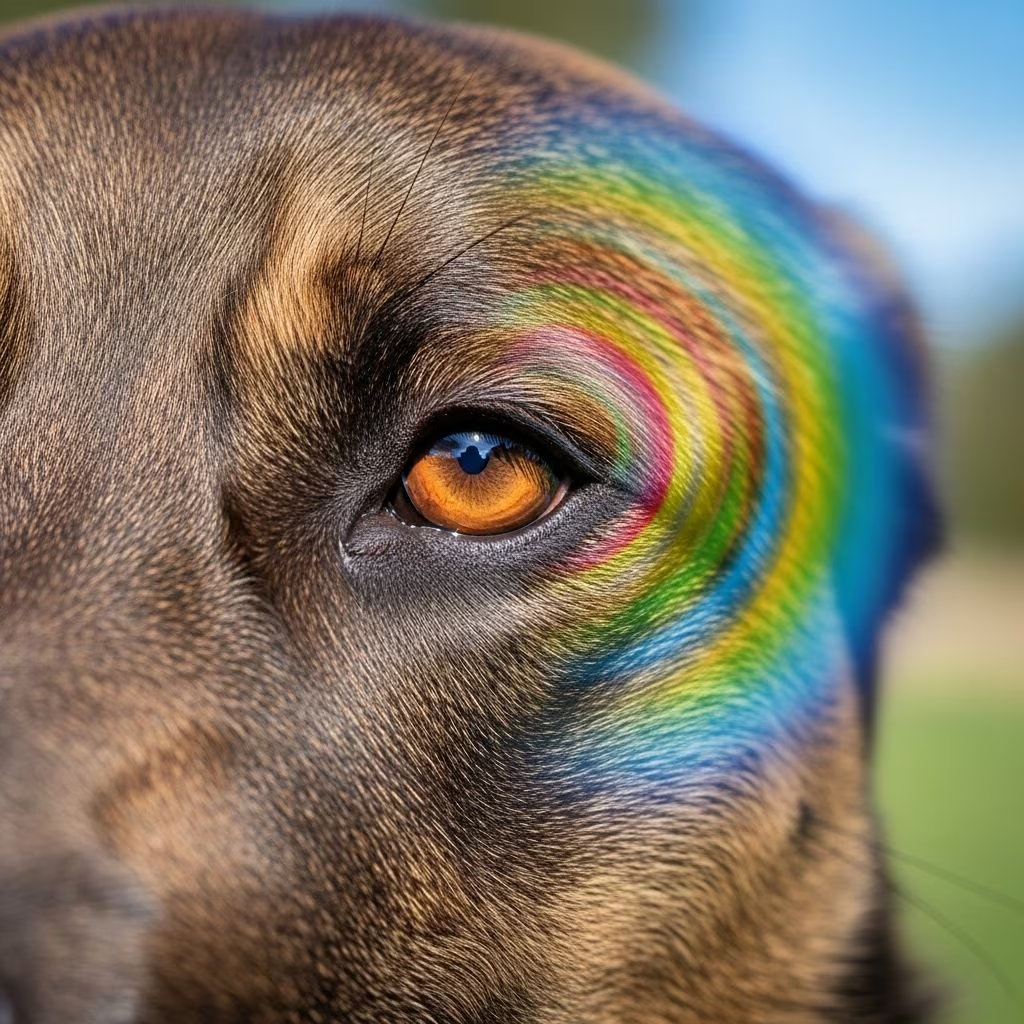
Dogs perceive the world through dichromatic vision, distinguishing primarily between blues and yellows while viewing reds and greens as shades of gray, a capability confirmed by multiple neurobiological and behavioral studies.
The Science Behind Dog Eyesight
Unlike humans with trichromatic vision relying on three cone types for red, green, and blue, dogs possess only two cone pigments: one sensitive to short wavelengths around 429 nm (blue) and another to longer wavelengths around 555 nm (yellow-green). This setup mirrors human red-green color blindness, limiting their color spectrum but enhancing other visual strengths like motion detection in low light.
Retinal studies reveal cones make up about 20% of photoreceptors in the central retina, supporting photopic vision under bright conditions. Rods dominate for scotopic vision, explaining dogs’ superior night vision but lack of color in dim light.
How Dogs Distinguish Colors in Practice
Experimental evidence shows dogs prioritize color over brightness when both cues are available. In a study with eight untrained dogs, subjects chose paper sheets based on hue (dark/light yellow vs. dark/light blue) more reliably than brightness alone, even when brightness differences were present.
- Yellow hues: Appear vivid, from dark yellow to light yellow shades.
- Blue tones: Clearly differentiated, including dark and light blues.
- Red and green: Confused as grayish-brown or yellowish-gray due to overlapping cone responses.
This preference for chromatic cues challenges earlier assumptions that dogs rely solely on luminance for object recognition.
Visual Spectrum: Dogs vs. Humans
| Color | Human Perception | Dog Perception |
|---|---|---|
| Red | Vivid red | Grayish-brown or dark gray |
| Orange | Bright orange | Dull yellow-brown |
| Yellow | Bright yellow | Light yellow (clear) |
| Green | Vibrant green | Grayish-yellow or beige |
| Blue | True blue | Light or dark blue (clear) |
| Violet | Purple hues | Dark blue-gray |
The table illustrates approximate translations based on cone sensitivities, where dogs blend yellow and blue variations. A red toy on green grass might blend into a uniform grayish field to a dog, explaining why blue or yellow toys are more visible.
Experimental Proof of Color Discrimination
Researchers adapted human Ishihara tests for dogs, confirming red-green confusion akin to deuteranopia. Dogs failed to distinguish red-green patterns but succeeded with blue-yellow ones. Another setup used meat rewards behind colored papers: dogs learned faster with color contrasts (e.g., dark yellow vs. light blue) than brightness alone, generalizing to new combinations.
Historical studies by Neitz et al. supported dichromacy via wavelength matching tasks in purebred dogs. Recent 2023 analyses reinforce that under natural lighting, color aids recognition despite metamerism risks from varying illuminants.
Implications for Everyday Dog Life
Understanding canine vision informs toy selection: opt for blues and yellows for fetch games, as reds vanish against grass. Training props in contrasting hues improve focus; avoid red-green mixes for signals like flags or collars.
In homes, blue toys stand out on carpets, while yellow balls pop in fields. Dogs’ clearer yellow-blue view explains preferences for certain items, enhancing engagement.
Strengths of Canine Visual System
Beyond color limits, dogs excel in:
- Motion sensitivity: Detect subtle movements humans miss, vital for hunting.
- Low-light acuity: Rod-rich retinas provide 4-8 times better night vision than humans.
- Wide field of view: Nearly 240 degrees peripheral vision aids predator avoidance.
- Brightness discrimination: Complements color for object detection.
Visual acuity is lower (4-8 times worse than humans), but field advantages compensate.
Myths About Dog Vision Debunked
Myth 1: Dogs see only black and white. False—dichromatic color vision exists, though limited.
Myth 2: Color is irrelevant to dogs. Studies prove color cues often supersede brightness.
Myth 3: Dogs are completely colorblind. They lack red-green but perceive blue-yellow spectra effectively.
Comparing to Other Animals
| Species | Cone Types | Color Vision Type |
|---|---|---|
| Humans | 3 (L, M, S) | Trichromatic |
| Dogs | 2 (L/M, S) | Dichromatic |
| Cats | 2 (similar to dogs) | Dichromatic |
| Birds | 4+ | Tetrachromatic |
Dogs share dichromacy with most mammals, evolved for crepuscular lifestyles.
Practical Tips for Dog Owners
- Choose blue or yellow toys for visibility during play.
- Use high-contrast colors for training aids to leverage color preference.
- Avoid red objects expecting standout appeal—they appear dull.
- Test toys in dog’s environment: grass dulls reds, brightens yellows.
- Enhance night games with glowing or highly reflective items.
Frequently Asked Questions (FAQs)
Can dogs see all colors like humans?
No, dogs have dichromatic vision, seeing blues and yellows clearly but reds/greens as grays.
Why do dogs prefer certain toys?
Blue and yellow stand out more due to strong cone responses.
Do all dogs see colors the same?
Yes, breed variations are minimal; all canines share similar cone pigments.
Is dog vision better in some ways?
Yes, superior motion detection and low-light performance.
How was dog color vision tested?
Via behavioral tasks like color vs. brightness discrimination and adapted Ishihara plates.
Enhancing Your Dog’s Visual Experience
Incorporate vibrant blues in living spaces for mental stimulation. Rotate yellow toys to maintain interest. During walks, note how dogs react to colored objects—often chasing vivid yellows over reds. This awareness fosters better bonding and tailored activities.
Future research may explore breed-specific nuances or aging effects on vision, but current data solidifies dichromatic foundations.
References
- New Study Shows That Dogs Use Color Vision After All — Smithsonian Magazine. 2013-08-14. https://www.smithsonianmag.com/science-nature/new-study-shows-that-dogs-use-color-vision-after-all-13168563/
- Are dogs red–green colour blind? — PMC – NIH (Proc Biol Sci). 2017-11-29. https://pmc.ncbi.nlm.nih.gov/articles/PMC5717654/
- Colour cues proved to be more informative for dogs than brightness — PMC – NIH (Proc Biol Sci). 2013-09-07. https://pmc.ncbi.nlm.nih.gov/articles/PMC3730601/
- What Colors Can Dogs Really See? — Oklahoma Veterinary Specialists. Recent (post-2023). https://www.okvets.com/post/what-colors-can-dogs-really-see
- Can Dogs See Color? — American Kennel Club. Recent. https://www.akc.org/expert-advice/health/can-dogs-see-color/
- Do Dogs See Color? — VCA Animal Hospitals. Recent. https://vcahospitals.com/know-your-pet/do-dogs-see-color
- Dogs don’t see life through rose-colored glasses — Phys.org. 2023-09-01. https://phys.org/news/2023-09-dogs-dont-life-rose-colored-glasses.html



