

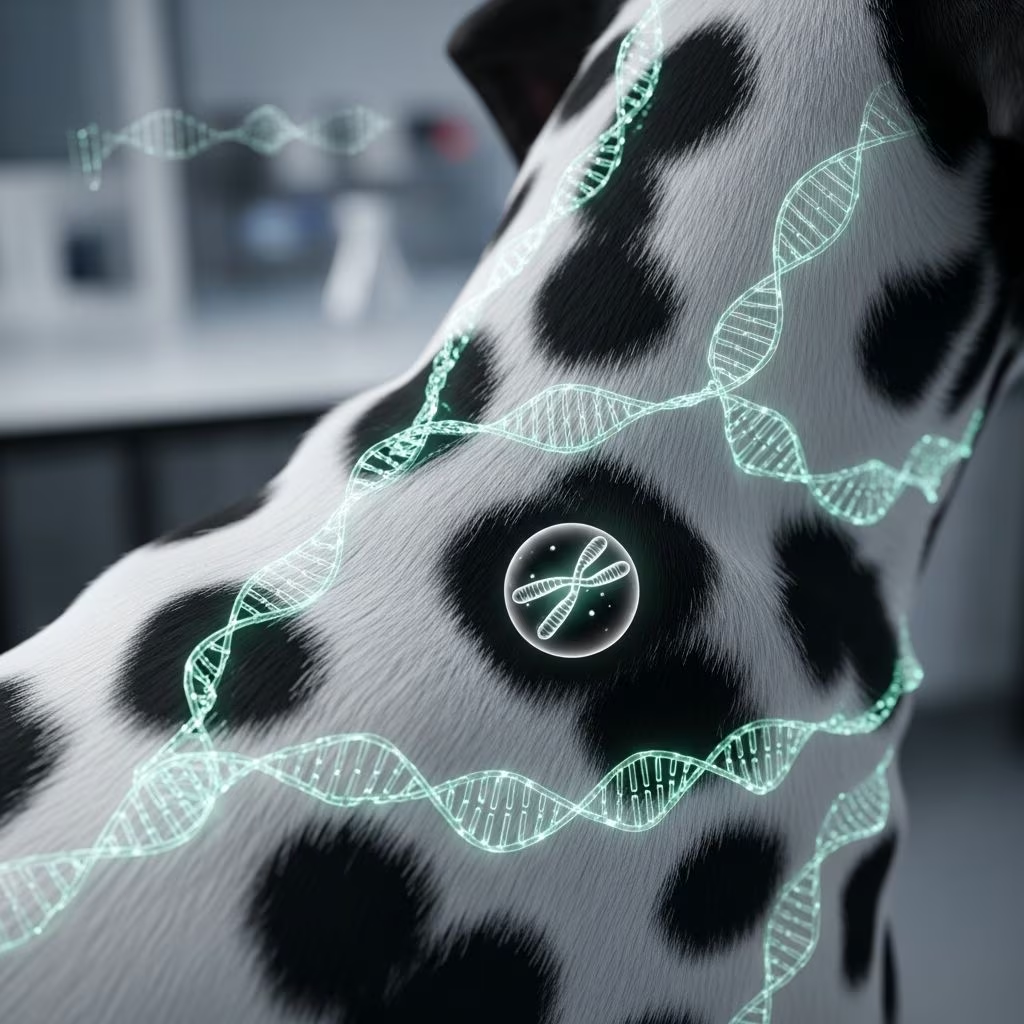
The iconic black spots on a Dalmatian’s white coat are more than just a striking visual feature—they may hold the key to identifying genetic diseases in dogs and beyond. Researchers are investigating how the genetic mutations responsible for these spots could serve as markers for health conditions, positioning Dalmatians as ideal subjects for genetic studies.
The Science Behind Dalmatian Spots
Dalmatian spots result from the interaction of multiple genes controlling pigmentation. The breed’s pattern arises from the extreme piebald allele at the Piebald locus, combined with the ticked allele at the Ticking locus and the non-flecked allele at the Flecking locus. These create pigmented spots on a white background. Black spots are dominant, while liver (brown) spots are recessive, segregating in a Mendelian fashion.
A landmark genome scan in a multi-generational Dalmatian kindred used 113 polymorphic microsatellite markers. Linkage analysis revealed a strong association (LOD score of 12.5) between spot color and marker FH2319 on chromosome 11, located just 0.4 Mb from the TYRP1 (Brown) locus at 50.1 Mb. This supports TYRP1 as the gene responsible for black versus liver spot color.
Further research identifies the R-locus on chromosome 38, associated with a tandem duplication linked to roaning and mottled patterns. All examined Dalmatians (N=262) carried this duplication, suggesting it’s a shared selection target in the breed’s formation. Dalmatian spots may represent a derived pattern from epistatic interactions between the R-locus, T-locus on chromosome 3, and modifiers like the F-locus.
Genetic Links to Health Risks
Beyond aesthetics, Dalmatian spots are genetically linked to serious health issues. The spotting pattern correlates with mutations in the SLC2A9 gene, causing hyperuricosuria—a defect in uric acid metabolism leading to high blood uric acid levels. Homozygosity for this gene results in urinary stones (urolithiasis), kidney problems, and dermatitis like hives.
These traits are closely linked on the same chromosome: the gene for absent interspersed white hairs (contributing to clean spots) and the uric acid defect originated from a common progenitor. This linkage explains why traditional Dalmatians suffer high rates of urate stones—up to 93% risk in some lines.
| Genetic Locus | Chromosome | Effect on Coat | Associated Health Risk |
|---|---|---|---|
| TYRP1 (Brown) | 11 | Black vs. Liver spots | None directly identified |
| R-locus (Roaning) | 38 | Mottled/spot modification | Potential pigmentation disorders |
| SLC2A9 | Linked to spotting | Clean spots (no white hairs) | Hyperuricosuria, urolithiasis |
| T-locus/F-locus | 3 | Ticking and spot size | Linked to SLC2A9 risks |
This table summarizes key loci influencing Dalmatian pigmentation and their health implications.
New Research: Spot the Difference Study
A groundbreaking project titled Spot the Difference: The Cellular and Clonal Basis of Dalmatian and Mouse Spots, led by the University of Bath, Lancaster University, and the Kennel Club, examines melanocytes—the pigment-producing cells behind the spots. Despite known genetic loci, the molecular and developmental mechanisms forming these irregular patches remain elusive.
The study uses experimentation and mathematical modeling to track how melanocytes migrate and establish patterns during embryonic development. Dalmatians provide a natural model: spots emerge post-birth on a white coat devoid of melanocytes elsewhere. Mouse models complement this, offering insights into mammalian pigmentation, immune development, and behavior.
“While recent advances have identified the probable genetic loci associated with Dalmatian spots, the underlying molecular and developmental mechanisms that generate these patterns are still poorly understood.” — Dr. Barbara Shih, Lancaster University.
Understanding these processes could reveal how pigmentation genes influence broader health, enabling earlier disease detection via spot pattern analysis.
Historical Context and Breeding Impacts
Selective breeding fixed these traits, but inadvertently coupled spotting with disease genes. Dr. Robert H. Schaible’s 10-year study confirmed the linkage between spot clarity and uric acid defects, advocating for low-uric-acid (LUA) Dalmatians through outcrossing.
LUA lines retain spots but carry the normal uric acid allele, drastically reducing stone risk. Genome-wide studies reinforce that Dalmatian spots evolved via novel epistasis, not just ticking enlargement.
Implications for Dog Health and Beyond
This research extends beyond Dalmatians. Pigmentation genes affect neural crest cells, precursors to melanocytes, impacting immune systems and neurology. Spot anomalies could signal genetic disorders in other breeds or mammals.
For breeders, genetic testing for TYRP1, SLC2A9, and R-locus variants enables healthier litters. Owners benefit from early screening for hyperuricosuria via urine tests or DNA panels.
Frequently Asked Questions (FAQs)
Are Dalmatian spots linked to deafness?
No, spot color is not associated with deafness, though both relate to piebald genetics. Studies confirm independent segregation.
What causes liver spots instead of black?
Liver spots result from recessive TYRP1 mutations on chromosome 11, altering eumelanin to pheomelanin.
Can spots indicate health problems?
Yes, spot patterns link to SLC2A9 mutations causing hyperuricosuria and stones. LUA Dalmatians mitigate this.
How do spots form developmentally?
Melanocytes migrate post-birth, forming patches via clonal expansion and genetic modifiers. Ongoing studies model this.
Are all Dalmatians prone to urinary issues?
Traditional lines yes (high uric acid), but LUA-bred dogs have normal levels and full spotting.
Future Directions in Genetic Research
Upcoming work will sequence TYRP1 in Dalmatians to pinpoint spot color mutations and expand GWAS for modifiers. Integrating consumer genotyping data accelerates discoveries, as seen with R-locus findings.
Mathematical models will simulate melanocyte dynamics, predicting pattern formation under genetic variations. This could revolutionize breeding and veterinary diagnostics.
Dalmatians exemplify how phenotype-driven research unveils hidden genetics, promising healthier dogs and insights into mammalian development.
References
- The color of a Dalmatian’s spots: Linkage evidence to support the TYRP1 locus — Cargill EJ et al. BMC Veterinary Research. 2005-09-20. https://pmc.ncbi.nlm.nih.gov/articles/PMC1192828/
- Dalmatians May Be the Key to Spotting Genetic Diseases — Kinship. Accessed 2026. https://www.kinship.com/uk/dog-health/dalmatian-spots-genetic-diseases-study
- R-locus for roaned coat is associated with a tandem duplication — PLoS ONE. 2021-02-24. https://journals.plos.org/plosone/article?id=10.1371/journal.pone.0248233
- Researchers to investigate how the Dalmatian got its spots — EurekAlert! 2024-10-01. https://www.eurekalert.org/news-releases/1046210
- The Genetic Correction of Health Problems — LUA Dalmatians World. Accessed 2026. https://www.luadalmatians-world.com/enus/dalmatian-articles/dalmatian-study
- How the Dalmatian got its spots — University of Bath. 2024-10-01. https://www.bath.ac.uk/announcements/how-the-dalmatian-got-its-spots/



