

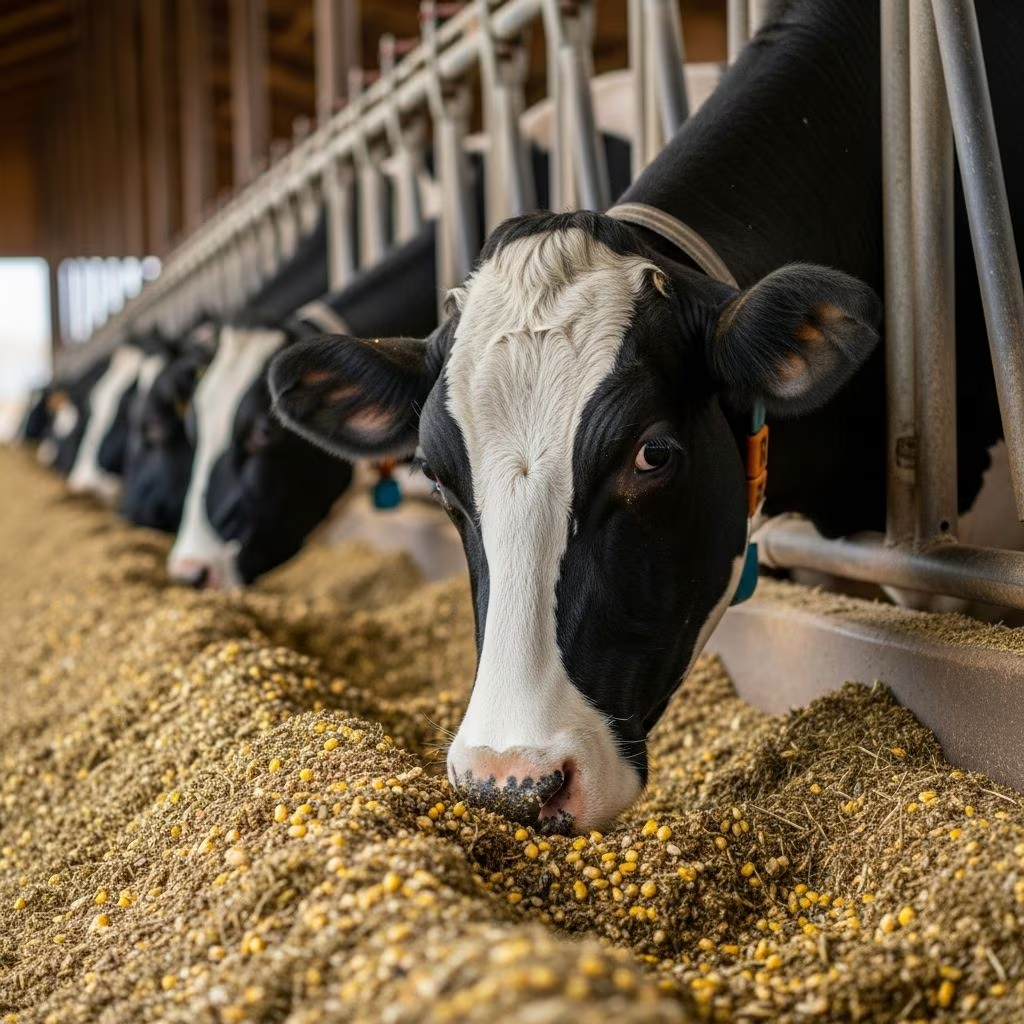
Dairy cattle require precisely balanced diets to support high milk yields, reproductive efficiency, and overall herd health. Proper nutrition addresses varying needs across life stages, from growing heifers to peak-lactation cows, ensuring economic viability for producers.
Energy Demands in Dairy Production
Energy forms the cornerstone of dairy cow rations, primarily supplied through carbohydrates, fats, and proteins that yield net energy for lactation (NEL). Lactating Holsteins producing over 40 kg of milk daily demand upwards of 30-35 kg of dry matter intake (DMI), with NEL concentrations around 1.6-1.7 Mcal/kg to sustain output.
Non-fiber carbohydrates (NFC) should not exceed 38-44% of the diet to avoid rumen acidosis, while neutral detergent fiber (NDF) maintains rumen function at 28-33% minimum. High-producing cows benefit from added fats up to 7% of dry matter, enhancing energy density without compromising fiber digestion.
| Production Stage | Target NEL (Mcal/kg DM) | Recommended DMI (kg/day) |
|---|---|---|
| Early Lactation (Peak Yield) | 1.65-1.75 | 25-35 |
| Mid-Lactation | 1.55-1.65 | 22-30 |
| Dry Period (Far-Off) | 0.65-0.75 | 12-15 |
Forage should constitute at least 40-50% of the ration, providing digestible fiber to promote chewing and saliva production, which buffers rumen pH. Total mixed rations (TMR) optimize intake uniformity, reducing minimum NDF needs compared to separate feeding.
Protein Strategies for Milk Synthesis
Dairy cows utilize rumen-degradable protein (RDP) for microbial growth and rumen-undegradable protein (RUP) for direct absorption as metabolizable protein (MP). Peak producers require 3,000-5,000 g of MP daily, with lysine:methionine ratios near 3:1 for efficiency.
First-lactation Holsteins at 15 days in milk (DIM) with 33 kg milk need about 2,034 g MP, scaling to 2,999 g at 100 DIM for 55 kg yield. RDP targets 50-60% of total crude protein (16-18%), sourced from forages and grains.
- RUP Sources: Soybean meal, fish meal, or protected amino acids for high-lysine needs.
- Monitoring: Use tools like NASEM 2021 models to predict amino acid supply and utilization.
- Growth Adjustment: Add 0.1-0.19 kg/day protein for first-calf heifers.
Excess RDP ferments to volatile fatty acids, but deficiencies limit microbial protein, capping milk protein output at 2.8-3.2%.
Macromineral Balance for Bone and Milk Health
Calcium (Ca) and phosphorus (P) are critical, with lactating cows secreting 1.1-1.25 g Ca/kg milk, demanding 0.9-1.0% Ca and 0.30-0.35% P in dry matter. Dry cows need controlled levels to prevent milk fever: far-off at 0.65-0.75% Ca, close-up under 1.0%.
Magnesium (0.40-0.42%), potassium (<1.3%), and sodium (0.18-0.23%) support muscle function and electrolyte balance. High Ca:P ratios (1.8-2.2:1) minimize urinary calculi.
| Mineral | Lactating Cows (% DM) | Dry Cows (% DM) | Function |
|---|---|---|---|
| Calcium | 0.90-1.00 | 0.45-0.65 | Milk synthesis, bone integrity |
| Phosphorus | 0.30-0.40 | 0.25-0.35 | Energy metabolism, bone |
| Magnesium | 0.40-0.42 | 0.40-0.45 | Enzyme activation |
Anionic salts in close-up diets achieve dietary cation-anion difference (DCAD) of -100 to -150 mEq/kg, reducing hypocalcemia incidence.
Trace Elements for Metabolic and Immune Support
Trace minerals like copper (15-20 mg/kg), zinc (60-100 mg/kg), and selenium (0.3 mg/kg) bolster immunity and reproduction. Cobalt (0.15-0.20 mg/kg) aids vitamin B12 synthesis, while manganese (30-40 mg/kg) supports fertility.
- Zinc: Hoof health, immune response; excess interferes with copper.
- Selenium: Antioxidant via glutathione peroxidase; pairs with vitamin E.
- Iodine: Thyroid function; 0.5-0.6 mg/kg prevents goiter.
Interactions abound: high iron antagonizes copper absorption, and calcium reduces manganese uptake. Organic chelates enhance bioavailability over inorganic forms.
Vitamin Supplementation Guidelines
Vitamin A (110 IU/kg BW for adults), D (40 IU/kg BW lactating), and E (0.8-3.0 IU/kg BW) combat deficiencies common in housed herds. Milk production over 35 kg/day elevates A needs to 4,400 IU/cow.
25-Hydroxycholecalciferol offers superior vitamin D activity over traditional D2/D3. Forages provide some via sunlight, but supplements ensure reliability. Close-up dry cows require 2,100 IU/kg DM E to mitigate retained placenta.
Stage-Specific Feeding Programs
Heifer Development
Pre-weaned calves need 18-20% crude protein starters for 0.8 kg/day gain. Post-weaning, aim for 0.45-0.75 kg/day to calve at 22-24 months, using 12-14% protein rations with 28% NDF.
Lactating Cow Rations
TMR with 18% acid detergent fiber (ADF), high-quality alfalfa or corn silage base. Limit added fat to 5-7%; salt at 0.5% meets 3-4 oz/day needs.
Dry Cow Management
Far-off: 12-15 kg DMI, low energy to avoid obesity. Close-up: 27-28 lbs DMI, low K (<1.3%), high Mg for 24-hour access.
Water and Feed Management Best Practices
Cows consume 3-5 liters water/kg milk; ensure 2-3 inches/head linear space. Feed TMR twice daily, pushing up every 2-3 hours to boost intake. Monitor body condition score (BCS) at 3.0-3.25 at calving.
Common Nutritional Disorders and Prevention
- Subacute Ruminal Acidosis (SARA): High NFC, low NDF; prevent with 28%+ NDF.
- Hypocalcemia: Excess Ca prepartum; use low-DCAB diets.
- Ketosis: Negative energy balance; supplement propylene glycol early lactation.
Frequently Asked Questions (FAQs)
What is the ideal fiber level for high-producing dairy cows?
Minimum 28% NDF and 18% ADF in TMR to maintain rumen health and milk fat.
How much calcium does a 40 kg milk cow need daily?
Approximately 90-100 g, or 0.9-1.0% of ration DM.
Can fats be added to dairy rations?
Yes, up to 7% DM from rumen-protected sources to boost energy without disrupting fiber digestion.
What DCAD is recommended for close-up dry cows?
-100 to -150 mEq/kg to prevent milk fever.
How to balance amino acids without testing?
Target lysine:methionine 3:1 with MP meeting needs; use NASEM software for predictions.
References
- Nutritional Requirements of Dairy Cattle — Merck Veterinary Manual. 2023. https://www.merckvetmanual.com/management-and-nutrition/nutrition-dairy-cattle/nutritional-requirements-of-dairy-cattle
- Basic Nutrition for Dairy Cattle — Cornell University College of Veterinary Medicine. 2023. https://www.vet.cornell.edu/animal-health-diagnostic-center/programs/nyschap/modules-documents/basic-nutrition-dairy-cattle
- Nutrient Requirements of Dairy Cattle — National Center for Biotechnology Information (NCBI). 2021-12-01. https://www.ncbi.nlm.nih.gov/books/NBK600587/
- Formulating Dairy Cow Rations — University of Minnesota Extension. 2023. https://extension.umn.edu/dairy-milking-cows/formulating-dairy-cow-rations
- Nutrient Requirements of Dairy Cattle, 8th Edition — National Academies Press. 2021. https://www.nationalacademies.org/projects/DELS-BANR-13-02/publication/25806



