

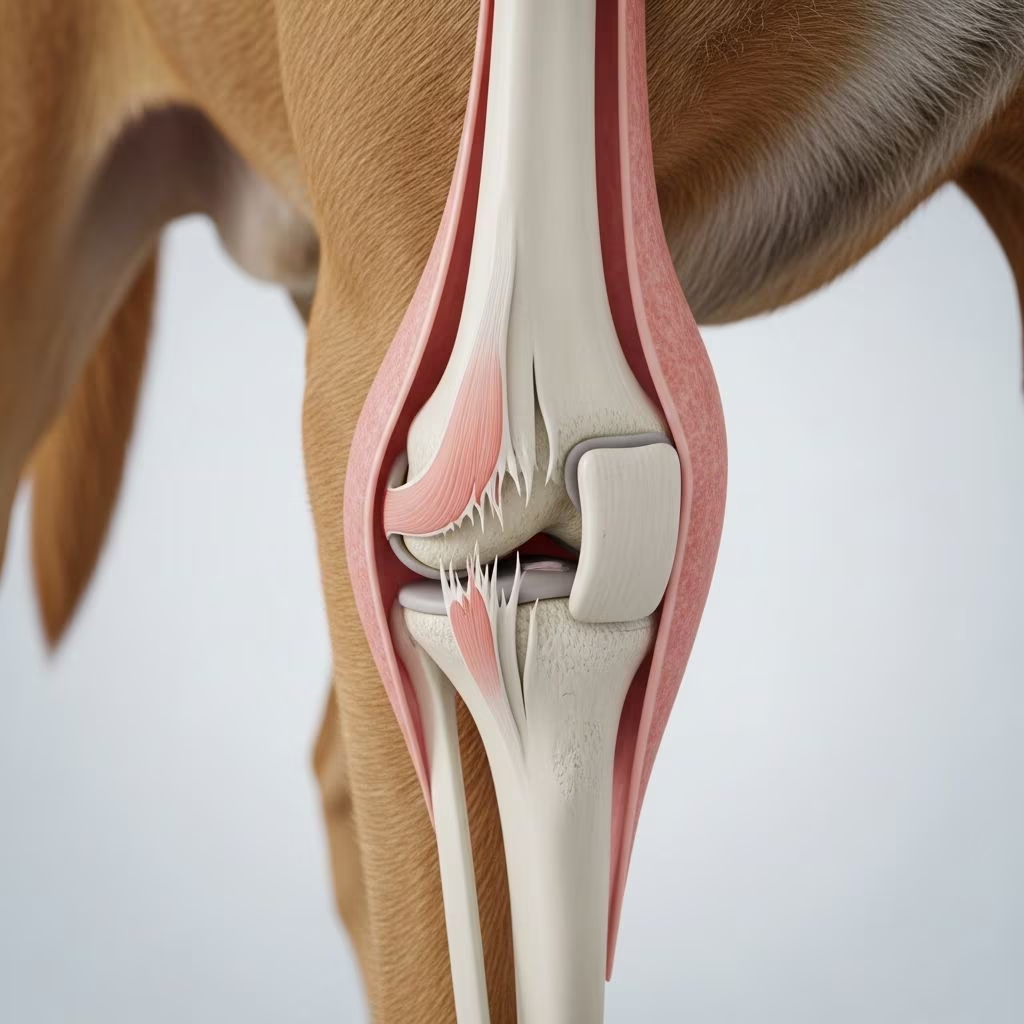
Cruciate ligament tears, often referred to as cranial cruciate ligament (CCL) ruptures in veterinary medicine, represent one of the most prevalent orthopedic issues affecting dogs’ knees. These injuries disrupt joint stability, leading to pain, lameness, and potential long-term arthritis if not addressed promptly. Understanding the anatomy, risk factors, and management strategies is crucial for pet owners seeking to restore their dog’s quality of life.
Understanding the Knee Joint Anatomy in Canines
The canine stifle joint, equivalent to the human knee, relies on four key ligaments for stability: the cranial cruciate ligament (CCL), caudal cruciate ligament, medial collateral ligament, and lateral collateral ligament. The CCL prevents excessive forward movement of the tibia relative to the femur and counters rotational forces during activity. Unlike humans, dogs experience gradual degeneration of the CCL rather than acute athletic trauma in many cases, leading to partial or complete tears.
This degenerative process, known as cruciate ligament disease, involves enzymatic breakdown of ligament fibers, often compounded by meniscal damage in the joint. Large breeds like Labrador Retrievers and Rottweilers are particularly susceptible due to conformational factors such as steep tibial plateaus, which increase biomechanical stress on the ligament.
Common Causes and Risk Factors
Cruciate ligament tears in dogs stem from a combination of genetic predisposition, conformational abnormalities, obesity, and repetitive stress. Unlike human anterior cruciate ligament (ACL) injuries that often result from sudden pivots or collisions, canine CCL ruptures frequently develop insidiously over months or years.
- Genetic factors: Breeds like Newfoundlands, Staffordshire Terriers, and Golden Retrievers show higher incidence rates due to inherited joint laxity.
- Obesity: Excess weight amplifies joint loading, accelerating ligament wear.
- Conformational issues: Sloping tibial plateaus or straight-legged stances destabilize the stifle.
- Age and activity level: Middle-aged to senior dogs and those in high-impact activities face elevated risks.
- Trauma: Acute tears can occur from falls, jumps, or twists, though less common.
Early intervention in at-risk dogs through weight management and joint supplements can mitigate progression.
Recognizing the Signs of a Cruciate Injury
Symptoms typically appear suddenly despite chronic underlying damage, prompting veterinary visits. Owners often notice a non-weight-bearing lameness after a “sudden event,” though the ligament may have been compromised beforehand.
| Symptom | Description | Acute vs. Chronic |
|---|---|---|
| Sudden limping | Dog holds leg up or toes-touch walks | Acute onset |
| Knee swelling | Joint effusion from inflammation or blood | Within hours |
| Instability | Cranial drawer sign on exam | Both |
| Pain on flexion | Discomfort when bending the knee | Chronic worsening |
| Muscle atrophy | Thigh muscle wasting over weeks | Chronic |
Additional signs include clicking noises from meniscal tears, reluctance to jump or climb stairs, and behavioral changes like reduced playfulness. Bilateral involvement occurs in up to 50% of cases, with the second leg often affected within a year.
Diagnostic Approaches for Accurate Assessment
Veterinarians employ a multi-step process to confirm CCL tears and evaluate concurrent damage. Initial physical exams test for the tibial thrust and cranial drawer maneuvers, where the tibia shifts forward under manual stress, mimicking human ACL tests.
- Sedation exam: For painful or tense dogs, light sedation reveals subtle instabilities.
- Radiographs: X-rays detect joint fluid, bone changes, or avulsion fractures, ruling out tumors or infections.
- MRI or CT: Advanced imaging visualizes ligament integrity and meniscal tears precisely, though less common due to cost.
- Arthroscopy: Minimally invasive scoping during surgery confirms diagnosis intraoperatively.
Staging the injury—partial vs. complete tear—influences treatment decisions, with partial tears sometimes managed conservatively.
Non-Surgical Treatment Options
Conservative management suits small dogs (<25 lbs), partial tears, or pets with low activity demands. The goal is to reduce inflammation, strengthen supporting muscles, and stabilize the joint.
- Strict rest: Crate confinement for 4-8 weeks, leash walks only.
- Anti-inflammatories: NSAIDs like carprofen control pain and swelling.
- Physical rehabilitation: Hydrotherapy, laser therapy, and controlled exercises rebuild quadriceps and hamstrings.
- Joint supplements: Glucosamine, chondroitin, and omega-3s support cartilage health.
- Custom braces: Hinged orthotics provide external stability for select cases.
Success rates hover around 40-50% for returning to normal function, but arthritis development remains a concern.
Surgical Interventions: Restoring Joint Stability
Surgery is the gold standard for large breeds, active dogs, or complete tears, offering superior long-term outcomes. Several techniques exist, tailored to dog size, age, and surgeon expertise.
| Procedure | Description | Best For | Pros/Cons |
|---|---|---|---|
| TPLO (Tibial Plateau Leveling Osteotomy) | Cuts and rotates tibial plateau to neutralize shear forces | Large breeds | High success (90-95%); expensive, requires plating |
| TTA (Tibial Tuberosity Advancement) | Advances tibial tuberosity to balance forces | Medium-large dogs | Faster recovery; cage rest needed |
| Extracapsular Repair | Small dogs (<50 lbs) | Less invasive; higher failure in big dogs | |
| Meniscal Release | Addresses torn cartilage during surgery | All with meniscal damage | Prevents future issues; added procedure |
TPLO, developed in the 1990s, has revolutionized treatment by addressing the root biomechanical instability rather than replacing the ligament.
Detailed Recovery and Rehabilitation Roadmap
Post-operative care spans 12-16 weeks, emphasizing gradual progression to avoid re-injury. Compliance is key to success.
Weeks 1-2: Protection Phase
Strict crate rest, pain meds, and cold compression minimize swelling. Short leash walks for elimination only.
Weeks 3-8: Controlled Strengthening
Introduce passive range-of-motion exercises, underwater treadmill sessions, and balance board work. E-collars prevent licking incisions.
Weeks 9-12: Building Endurance
Progress to hill walks, sit-to-stand reps, and agility drills. Re radiographs confirm bone healing.
Beyond 12 Weeks: Return to Activity
Gradual off-leash play, with lifetime joint maintenance via weight control and supplements.
Professional rehab facilities boost outcomes, reducing complication rates like infections (2-5%) or implant failures.
Potential Complications and How to Avoid Them
While rare, issues like surgical site infections, implant migration, or delayed meniscal tears can occur. Monitor for fever, discharge, or renewed lameness. Early detection via follow-up exams prevents escalation. Long-term, 20-30% of dogs develop progressive osteoarthritis, managed with ongoing therapies.
Prevention Strategies for Lifelong Joint Health
- Maintain ideal body weight through portion control and exercise.
- Choose breeding stock with sound hips and stifles.
- Incorporate low-impact activities like swimming over repetitive jumping.
- Start joint-protective supplements before symptoms appear.
- Regular veterinary check-ups for at-risk breeds.
Frequently Asked Questions (FAQs)
Can my dog live a normal life after CCL surgery?
Yes, over 90% of dogs return to full function with proper rehab, especially after TPLO.
How much does cruciate surgery cost?
Average $3,000-$6,000 per knee, varying by technique and location.
Should I operate on both knees at once?
Generally no; stage them 3-6 months apart to ensure rehab compliance.
What if I skip surgery?
Conservative care works for some, but most large dogs face worsening lameness and arthritis.
How long until my dog walks normally?
Most bear weight within 24-48 hours post-op; normal gait by 10-12 weeks.
References
- Anterior Cruciate Ligament Knee Injury – StatPearls — NCBI Bookshelf. 2023-07-17. https://www.ncbi.nlm.nih.gov/books/NBK499848/
- Cruciate ligament tear — Ottobock. 2024. https://www.ottobock.com/en-us/resources/diagnoses-and-symptoms/cruciate-ligament-tear
- Anterior Cruciate Ligament (ACL) Injury — Inspira Health Network. 2025. https://www.inspirahealthnetwork.org/services-treatments/rehabilitation-services/sports-injury-rehabilitation/anterior-cruciate-ligament
- ACL Tear: Symptoms and Treatments for a Torn ACL — Hospital for Special Surgery (HSS). 2024. https://www.hss.edu/health-library/conditions-and-treatments/list/acl-tear
- ACL Injuries — Mass General Brigham. 2025. https://www.massgeneralbrigham.org/en/patient-care/services-and-specialties/sports-medicine/conditions/knee/acl-injuries



