

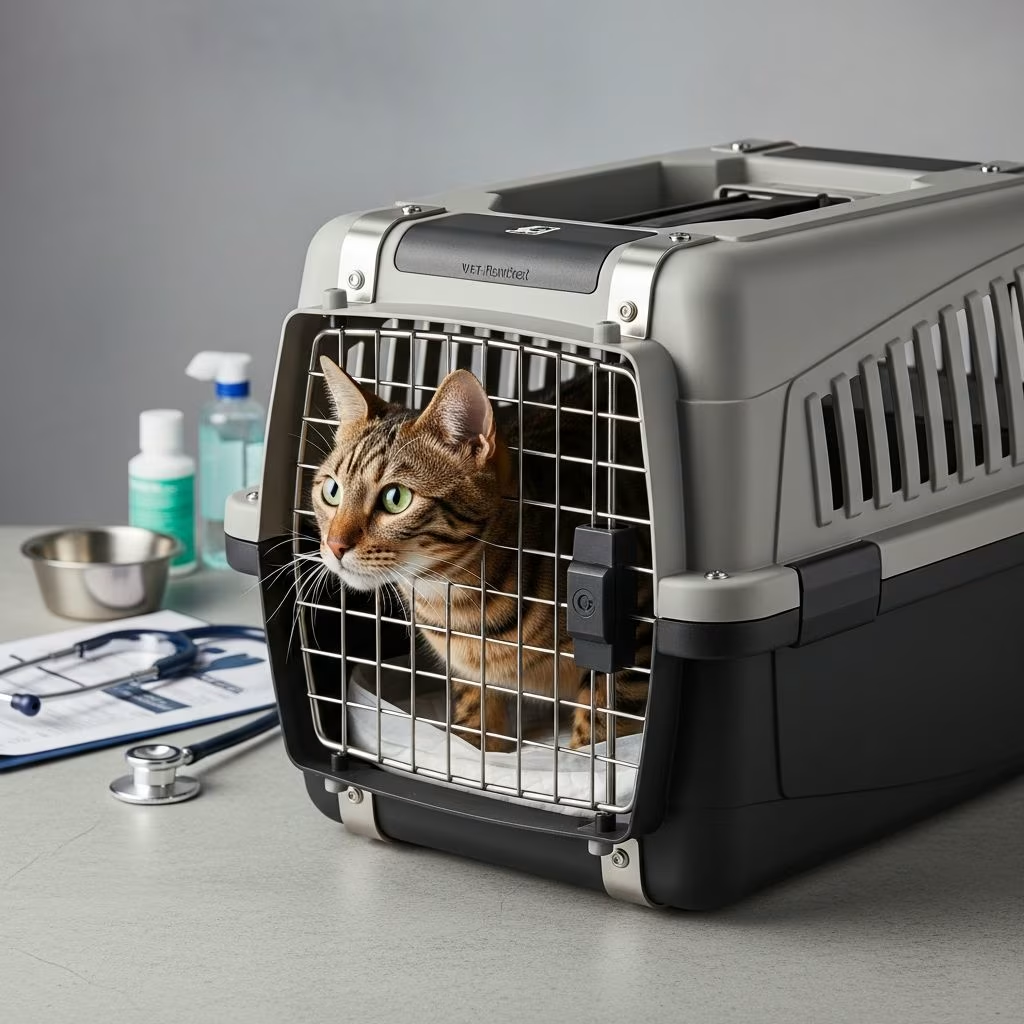
While not all cat carriers undergo crash testing, those certified by the **Center for Pet Safety (CPS)** have passed rigorous independent evaluations simulating real-world accidents. These certifications provide pet owners with reliable assurance of safety, distinguishing them from products with unsubstantiated claims.
What Is the CPS-Certified Program?
The **CPS-Certified Program** establishes industry benchmarks for pet travel safety by independently testing carriers, crates, and harnesses. Products must endure comprehensive crash simulations and additional durability assessments to earn certification, ensuring they maintain structural integrity and contain pets effectively during impacts.
Launched to address the lack of standardized regulations in the pet product industry, CPS collaborates with accredited facilities like MGA Research Corporation—where the National Highway Traffic Safety Administration (NHTSA) conducts vehicle tests. Instead of human dummies, CPS employs anthropomorphic test devices modeled after pets, including ‘crash test cats’ with realistic weights and sizes (e.g., 15-pound simulants).
Certification involves more than crash tests; products face evaluations for material strength, stitching quality (especially in soft-sided carriers), and performance across varied conditions like buckling methods (lap/shoulder belts, ISOFIX-Latch). Only carriers meeting all criteria display the prominent CPS logo, a mark of verified safety.
How Does CPS Test Pet Carriers?
CPS testing protocols mimic frontal collisions at speeds comparable to NHTSA standards, assessing key failure points. Evaluators scrutinize if the carrier remains secured to the vehicle seat, retains its shape without fracturing or shredding, and fully contains the test simulant without ejection.
For soft carriers, stitching durability is critical, as failures can lead to mesh panels ripping open. Hard-sided options are checked for shell integrity and door latches. Post-impact analysis measures excursion (pet movement distance), deformation, and potential injury risks to both the pet and vehicle occupants.
- Crash Simulation: High-speed impacts using pet-sized dummies (e.g., 15# ‘Kitty’ for cat carriers).
- Containment Check: Ensures the simulant stays inside; ejections indicate failure.
- Structural Integrity: No complete fractures, releases from seat anchors, or hazardous debris.
- Connection Testing: Lap belts, shoulder belts, or specialized systems like ISOFIX must hold firm.
- Injury Assessment: Quantifies forces to predict real harm severity.
These tests reveal stark differences. For instance, the Sleepypod Mobile Pet Bed initially failed when its top Velcro released, flipping the unit despite containing the simulant. A retest with upgraded features passed fully.
CPS-Certified Cat Carriers
Only a select few cat carriers achieve CPS certification, proven through repeated independent testing. These stand out for consistent performance across sizes and weights suitable for most cats (up to 15-20 pounds).
| Carrier Model | Test Weight | Key Success Factors | Connection Type |
|---|---|---|---|
| Sleepypod Mobile Pet Bed | 15# (Kitty) | Fully contained simulant; minimal deformation; secure anchor points | Lap/Shoulder Belt |
| PetEgo Forma Frame Jet Set Carrier (with ISOFIX-Latch) | 15# | Remained wholly connected; expected minor buckle deformation but no release | ISOFIX-Latch Connection |
These carriers excel because they prioritize multi-point attachments and robust materials. The Sleepypod, for example, doubles as a pet bed, offering comfort without compromising safety—features like removable, washable bedding and mesh ventilation enhance usability.
Owners report peace of mind, as these products prevent pets from becoming projectiles, which could injure passengers. Always match carrier size to your cat’s measurements for optimal fit.
Why CPS Certification Matters
In an unregulated market, CPS certification cuts through misleading labels. Many carriers boast ‘crash tested,’ but this often means only an internal test occurred—without published results or standardized protocols. Failures abound: Petmate carriers fractured, releasing simulants; Snoozer’s stitching ripped, launching pets; Kurgo Wander and others ejected occupants.
CPS independence is key—no industry funding influences outcomes. They retest certified products periodically and advocate for federal standards, educating consumers via transparent results (e.g., Vimeo videos of tests).
Statistics underscore the need: Pets in vehicles face forces up to 40 times their body weight in crashes. Unsecured, they risk ejection or impact with occupants. CPS-certified options mitigate this dramatically.
Common Misconceptions About Cat Carrier Safety
- ‘Crash Tested’ ≠ Safe: Manufacturers may test one size or low speeds; CPS demands comprehensive, third-party validation.
- Airline Approval ≠ Crash Safety: IATA standards focus on cargo holds, not vehicle crashes.
- Soft vs. Hard-Sided: Both can pass if designed properly; soft ones need superior stitching.
- Weight Limits: Exceeding them voids safety; always verify.
Vets emphasize crash carriers for all trips, as even short drives pose risks. Pair with acclimation training to reduce stress.
How to Choose and Use a Crash-Tested Carrier
Select CPS-certified models fitting your cat (length + 2-3 inches). Practice loading with treats for familiarity. Secure via LATCH/ISOFIX if available, or seat belts through designated loops. Place on the floor behind front seats for best protection.
- Verify CPS logo on packaging/label.
- Check size/weight compatibility.
- Test fit with cat at home.
- Secure properly—double-check connections.
- Cover partially for calm during travel.
Frequently Asked Questions (FAQs)
Are cat carriers crash-tested?
Some are, but only CPS-certified ones have independently passed rigorous crash tests simulating real accidents. Look for the CPS logo to confirm.
What does CPS certification mean for cat carriers?
It guarantees the carrier withstood crash impacts, contained the pet simulant, and maintained vehicle attachment—tested at NHTSA-approved labs.
How can I tell if a carrier is CPS certified?
Check for the official CPS Certified logo on the product, packaging, or manufacturer’s site. CPS lists all certified items transparently.
Why do some ‘crash-tested’ carriers fail CPS tests?
Internal tests often lack rigor, standardization, or publication. CPS uses ethical, replicable methods revealing true weaknesses like stitching failures.
Can I use a non-certified carrier for my cat?
Not recommended—uncertified products frequently fracture or eject pets in tests, endangering everyone. Opt for certified safety.
Which is safer: soft-sided or hard-sided cat carriers?
Depends on design; CPS-certified soft carriers like Sleepypod pass via strong stitching, while hard ones need intact shells. Certification trumps material.
How often does CPS retest certified carriers?
Periodically, to ensure ongoing compliance. They remain independent and accountable post-certification.
Choosing a CPS-certified crash-tested cat carrier prioritizes your pet’s well-being. These products, backed by science, transform travel from risky to reliable.
References
- Pet Crate & Carrier Crash Test Study Results Are In — Camelback Subaru. 2015-08-17. https://www.camelbacksubaru.com/blog/2015/august/17/pet-crate-carrier-crash-test-study-results-are-in.htm
- Are Cat’s Carrier Crash Tested? Vet-Reviewed Facts & FAQ — Catster. Recent (2023+ access). https://www.catster.com/lifestyle/crash-tested-cat-carrier/
- 2015 Carrier Study Results — Center for Pet Safety. 2015 (authoritative ongoing reference). https://www.centerforpetsafety.org/test-results/carriers/2015-carrier-study-results/
- Dogs and Cats — The Car Seat Lady. Recent (2023+ access). https://thecarseatlady.com/pets/
- Do I Have to Use a Cat Carrier in the Car? — KittyCatGO. Recent. https://kittycatgo.com/3-reasons-your-cat-should-ride-in-a-car-carrier/



