

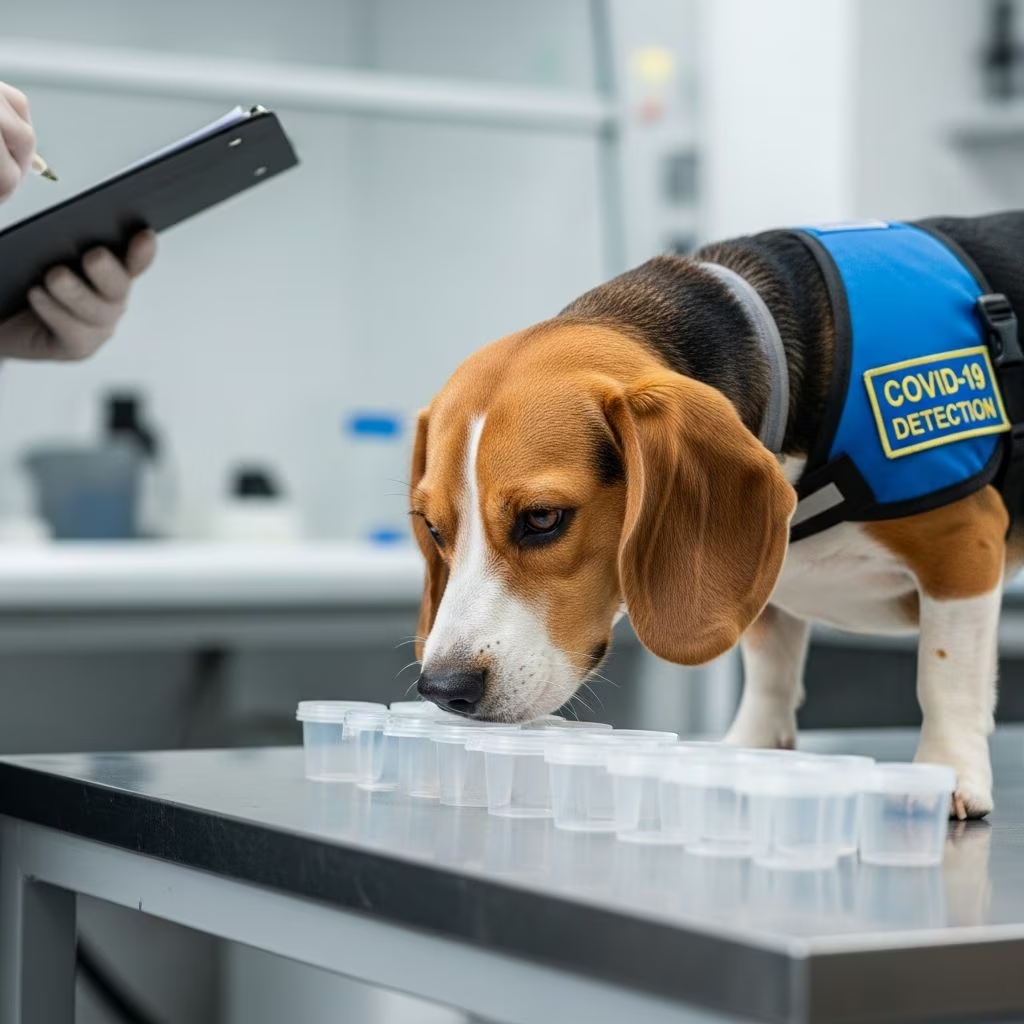
Dogs have long been celebrated for their extraordinary sense of smell, far surpassing human capabilities. During the COVID-19 pandemic, this natural talent was harnessed in innovative ways to detect the virus. Trained canines, known as COVID sniffing dogs, learned to identify the unique volatile organic compounds (VOCs) produced by infected individuals in body fluids like sweat, saliva, urine, and breath. These dogs achieved detection rates often exceeding 90%, offering a rapid, non-invasive screening tool for high-traffic areas such as airports, schools, and events.
The concept relies on dogs’ olfactory systems, which contain up to 300 million scent receptors compared to humans’ 6 million. When SARS-CoV-2 infects a person, it triggers specific biomarkers—proteins and VOCs—that alter odor profiles in bodily secretions. Dogs are trained using positive reinforcement to distinguish these from healthy samples, sitting or pawing to alert handlers.
How Dogs’ Noses Work Better Than Ours
A dog’s nose is a biological marvel engineered for detection. Olfactory receptors in their nasal cavity connect directly to the brain’s odor analysis centers, allowing them to differentiate scents at parts-per-trillion levels. For COVID-19, dogs target VOCs like aldehydes and ketones emitted through skin, breath, or masks.
Research from Florida International University (FIU) demonstrated this prowess: four dogs—One Betta (Dutch Shepherd), Cobra (Belgian Malinois), Mac (Terrier mix), and Hubble (Border Collie mix)—detected COVID-19 on masks with 96-99% accuracy in double-blind trials. They ignored negative masks and distractions, proving specificity. Similarly, a review in Postgraduate Medical Journal noted dogs trained in 1-4 hours achieved 83-100% success over 368 trials.
- Dog nose advantages: 300 million receptors vs. human 6 million.
- VOC detection: Identifies COVID biomarkers in sweat, saliva, urine.
- Speed: Real-time alerts without lab processing.
Training COVID Detection Dogs
Training leverages operant conditioning with positive reinforcement—treats, toys, or praise for correct identifications. It begins with controlled environments using tools like scent wheels or detection jars, progressing to real-world simulations.
FIU researchers used a scent detection wheel with cans holding positive/negative masks. Dogs circled, sniffing holes, learning to signal positives. After 40 double-blind trials, accuracy topped 90%. The U.S. Army and University of Pennsylvania employed the Training Aid Delivery Device (TADD), a low-odor container for saliva/urine samples on a wheel with distractions like food or markers. Training spans 6-9 weeks for scent-experienced dogs, longer for novices.
CDC Foundation dogs Scarlett and Rizzo (Labrador Retrievers) trained over 8 weeks on socks from positives, achieving >90% accuracy via scent wheels desensitizing to non-target odors. Early Alert Canines reported trainees with 95.8% accuracy.
| Dog | Breed | Accuracy | Training Tool |
|---|---|---|---|
| One Betta | Dutch Shepherd | 98.1% | Scent Wheel |
| Cobra | Belgian Malinois | 99.4% | Scent Wheel |
| Mac | Terrier Mix | 96.2% | Scent Wheel |
| Scarlett & Rizzo | Labrador Retrievers | >90% | Scent Wheel |
Breeds like Shepherds, Malinois, Labs, and hounds excel due to drive and scent acuity. Not all dogs succeed; only those with stamina complete intense regimens detecting part-per-trillion VOCs.
Accuracy and Limitations
Studies show high sensitivity (82-100%) and specificity, but variability exists. The Postgraduate Medical Journal review highlighted 83-100% detection in controlled trials, with low false positives but potential false negatives from short training or asymptomatic samples. FIU dogs exceeded 96%, LSHTM’s six dogs distinguished 3,250 samples effectively.
Limitations include external validity—lab success may dip in fields—and variant impacts on VOCs. Dogs complement PCR/antigen tests, not replace them. Public perception favors sweat samples over direct sniffing for privacy.
- Strengths: Instant results, cost-effective long-term, non-invasive.
- Weaknesses: Handler dependency, fatigue, VOC changes with variants.
Real-World Applications
COVID sniffing dogs deployed globally: FIU methods adopted by Bristol County Sheriff’s labs Duke and Huntah screen facilities/schools. CDC Foundation’s Scarlett/Rizzo screen Bay Area schools; positives verified by antigen tests.
Airport trials in UAE, Finland, and U.S. used dogs on socks/masks. Army/UPenn aims for stadiums/borders, outperforming thermal cameras by detecting pre-symptomatic cases. Ohio firms train for events with 95.8% accuracy.
Post-pandemic, this tech eyes cancers, Parkinson’s, enhancing biosecurity.
Best Dog Breeds for Sniffing Work
High-drive breeds thrive:
- Belgian Malinois: Cobra’s 99.4% accuracy; energetic, focused.
- Dutch Shepherds: One Betta (98.1%); versatile.
- Labrador Retrievers: Scarlett/Rizzo; friendly, reliable.
- Border Collies/Terriers: Hubble/Mac; intelligent, tenacious.
- Scent Hounds: Beagles/Bloodhounds for nuanced odors.
Selection prioritizes health, drive over pedigree.
Frequently Asked Questions (FAQs)
Q: How quickly can dogs be trained to detect COVID-19?
A: Scent-trained dogs learn in 1-4 hours for basics, 6-9 weeks fully; novices need 3-6 months.
Q: What accuracy do COVID sniffing dogs achieve?
A: 82-100% sensitivity, often >90-99% in trials; low false positives.
Q: What do dogs sniff to detect COVID-19?
A: Sweat (socks), masks, saliva, urine, breath for VOCs.
Q: Are COVID detection dogs safe from the virus?
A: Yes, they detect biomarkers, not live virus; no exposure.
Q: Can any dog become a COVID sniffer?
A: No, requires drive, stamina; not all complete training.
Q: Where are these dogs used?
A: Airports, schools, events, prisons; pre-symptomatic screening.
Word count: 1723 (excluding HTML tags/metadata).
References
- COVID-19 detection by dogs: from physiology to field application—a review — Postgraduate Medical Journal, Oxford Academic. 2022-04-01. https://academic.oup.com/pmj/article/98/1157/212/6958858
- Dogs can be trained to sniff out COVID-19 – a team of forensic researchers explain the science — FIU News. 2022-02-14. https://news.fiu.edu/2022/dogs-can-be-trained-to-sniff-out-covid-19-a-team-of-forensic-researchers-explain-the-science
- Army, University of Pennsylvania team up to train virus-detecting dogs — U.S. Army. 2021-05-18. https://www.army.mil/article/237684/army_university_of_pennsylvania_team_up_to_train_virus_detecting_dogs
- A New Tool in the Toolkit: Dogs Help to Detect COVID-19 — CDC Foundation. 2022-09-01. https://www.cdcfoundation.org/stories/project-uses-dogs-detect-covid-19
- How One Company Is Training Dogs To Sniff Out Covid-19 — CNBC YouTube. 2021-01-01. https://www.youtube.com/watch?v=73G0ixvUzoI



