

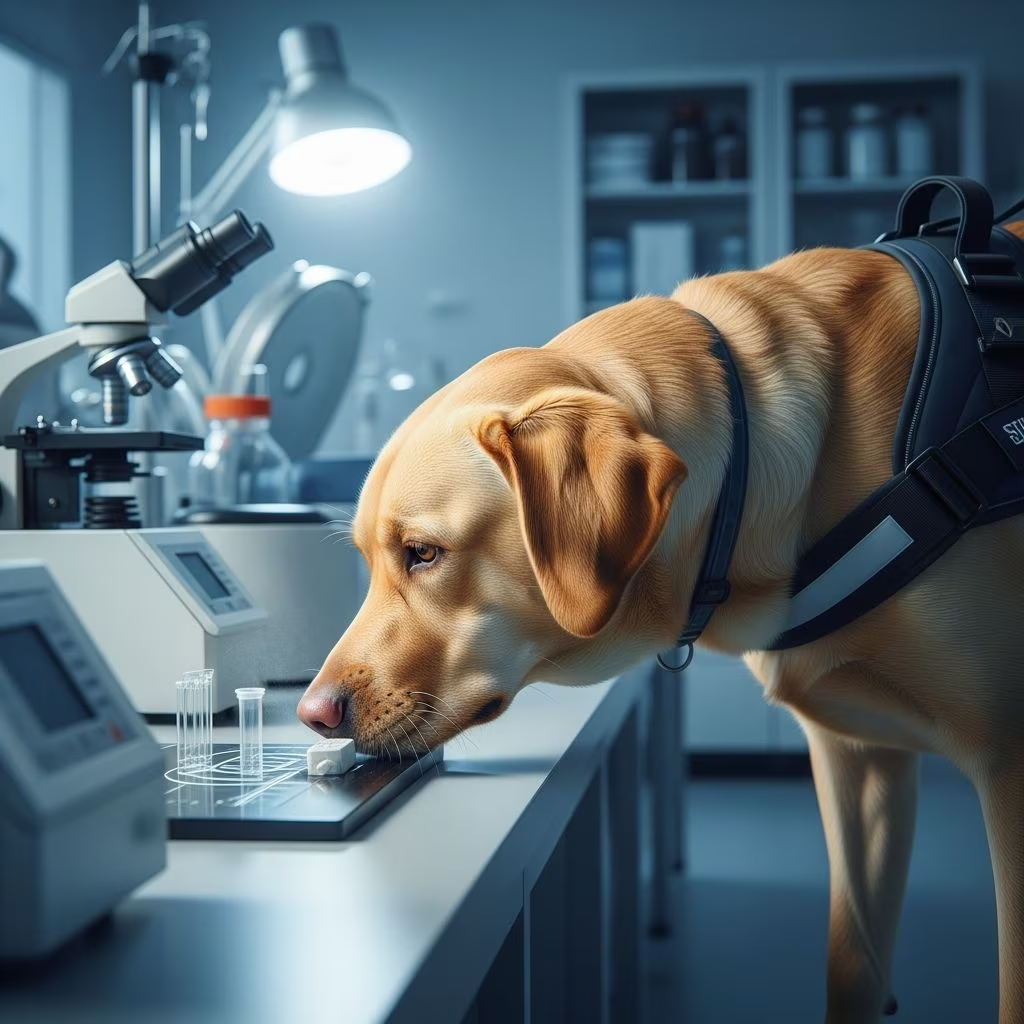
Dogs have long been celebrated for their extraordinary sense of smell, a superpower that far surpasses human capabilities. With olfactory receptors numbering in the hundreds of millions—compared to our mere six million—dogs can detect scents at concentrations as low as parts per trillion. This remarkable ability has led to their use in detecting explosives, drugs, and even diseases like cancer and malaria. During the COVID-19 pandemic, scientists and trainers harnessed this talent to train dogs to identify the virus’s unique odor signature, offering a rapid, non-invasive screening tool for airports, schools, events, and public spaces.
The concept relies on volatile organic compounds (VOCs) produced by the body when infected with SARS-CoV-2. These chemical markers, distinct from healthy individuals, emanate from breath, sweat, saliva, urine, and even worn masks or socks. Trained dogs learn to differentiate these COVID-specific scents from others, alerting handlers by sitting, barking, or pawing. Studies show detection rates exceeding 90%, often faster and more accurate than traditional tests, with results in seconds rather than hours.
How Dogs’ Noses Work Better Than Ours
A dog’s nose is a biological marvel. Each nostril operates independently, allowing stereoscopic smelling—pinpointing scent sources like our binocular vision locates objects. Their nasal cavity, lined with up to 300 million receptors, connects to a brain region devoted almost exclusively to smell processing. Humans dedicate just 5% of their brain to olfaction; dogs allocate 40% or more.
When a dog inhales, air splits: 12% reaches the olfactory epithelium for scent analysis, while the rest warms, moistens, and expels via retro-nasal airflow, preserving volatile molecules. This creates a continuous scent stream, enabling detection of faint traces lingering in the environment. For COVID-19, dogs target VOCs like aldehydes and ketones altered by infection, even in asymptomatic carriers where PCR tests might fail early.
- Olfactory Receptors: Dogs: 220-300 million; Humans: 6 million.
- Brain Allocation: Dogs: ~40%; Humans: ~5%.
- Detection Threshold: Parts per trillion for trained dogs.
This physiology explains why dogs outperform machines in complex, real-world scent discrimination, ignoring distractions like perfumes or food.
The Science Behind COVID’s Scent
SARS-CoV-2 infection triggers metabolic changes, producing a unique volatilome—a profile of VOCs in body secretions. Research confirms infected individuals emit distinct odors detectable in sweat, breath, saliva, and urine. A 2022 review in Postgraduate Medical Journal analyzed multiple studies, finding dogs reliably identify these markers.
Positive samples come from PCR-confirmed patients, including symptomatic, presymptomatic, and asymptomatic cases. Negative controls are symptom-free, PCR-negative individuals. Dogs trained on sweat odors achieved 83-100% success in 368 trials over 21 days. Another study trained eight dogs on 10,388 presentations, yielding high specificity (low false positives) but variable sensitivity due to training duration and sample types.
FIU researchers confirmed COVID biomarkers on masks, with dogs distinguishing infected from non-infected breath at over 90% accuracy after double-blind trials. Army and University of Pennsylvania teams targeted immune-response proteins via saliva/urine, using low-odor containers to avoid interference.
Training COVID Detection Dogs
Training leverages positive reinforcement and operant conditioning. Dogs learn to sit or signal only for positive samples, ignoring negatives. Sessions use scent wheels or cones: cans/jars with perforations hold samples (masks, socks, sweat pads), rotated randomly for blind trials.
Initial acquisition takes 1-4 hours (4-10 positives sniffed); full proficiency requires weeks. FIU’s four dogs (Dutch Shepherd, Belgian Malinois, Terrier mix, Border Collie mix) hit 96-99% accuracy post-40 trials. CDC Foundation Labs Scarlett and Rizzo (Labradors) exceeded 90% in eight weeks, desensitized to distractions via scent wheels.
Army protocol: 6-9 weeks for scent-trained dogs, using TADD containers and wheels with positives, negatives, controls, distractions (e.g., markers, food). Not all dogs succeed; only high-drive ones detect part-per-trillion VOCs. LSHTM trained six dogs on 3,250 samples for odor discrimination.
| Dog | Breed | Accuracy | Training Time |
|---|---|---|---|
| Mac | Terrier mix | 96.2% | Double-blind trials |
| Cobra | Belgian Malinois | 99.4% | Double-blind trials |
| One Betta | Dutch Shepherd | 98.1% | Double-blind trials |
| Hubble | Border Collie mix | 96.3% | Double-blind trials |
| Scarlett & Rizzo | Labrador Retrievers | >90% | 8 weeks |
Real-World Applications and Success Stories
Deployed dogs screen crowds swiftly: handlers walk them past lines, sniffing ankles, shoes, or bags. Alerts prompt rapid tests. Bristol Sheriff’s labs Duke and Huntah screen facilities; Bay Area Labs Scarlett/Rizzo test schools, verifying via antigens.
Airports in Finland, UAE, and Germany used dogs; Ohio firms train for events. Public health labs integrate them congregate settings. A Frontiers in Public Health study noted preference for sweat samples over direct sniffing for privacy.
- Airports/Public Events: FIU methods adopted globally.
- Schools: Bay Area screenings, high verification rates.
- Military/Borders: Pre-symptomatic detection beats thermals/PCR speed.
Advantages Over Traditional Tests
Dogs offer immediacy (seconds vs. hours), non-invasiveness (no swabs), and mobility—no labs needed. They detect pre-symptomatically, when infectiousness peaks, with 90%+ accuracy rivaling PCR but without delays. Low cost post-training; high throughput (hundreds/hour).
False negatives pose risks (variable sensitivity), but low false positives minimize unnecessary quarantines. Complementary to tests, not replacement.
Challenges and Limitations
Training demands skilled handlers; scalability limited by dog numbers. External validity concerns: lab success may dip in field with distractions. Variant shifts could alter VOCs, requiring retraining. Handler bias mitigated by blinding.
Ethical issues: animal welfare ensured via positive reinforcement, no virus exposure—dogs smell biomarkers only.
The Future of Sniffing Dogs
Beyond COVID, dogs detect cancers, Parkinson’s, tuberculosis. Integration with AI scent tech could hybridize. Post-pandemic, they’re poised for routine screening, enhancing biosecurity.
Public perception favors them for speed/privacy; ongoing trials expand breeds, protocols.
Frequently Asked Questions (FAQs)
What scents do dogs detect for COVID-19?
Dogs identify unique VOCs in sweat, breath, saliva, urine, masks, or socks from infected individuals.
How long does training take?
1-4 hours for basics; 6-9 weeks for operational dogs, up to 3-6 months for novices.
What is the accuracy rate?
83-100% in studies, often 90-99% in blind trials; high specificity, moderate sensitivity.
Are dogs exposed to the virus?
No; they detect biomarkers/proteins, not live virus.
Where are they used?
Airports, schools, events, prisons, borders for rapid screening.
Can any dog be trained?
High-drive breeds like Shepherds, Malinois, Labs excel; not all succeed.
References
- COVID-19 detection by dogs: from physiology to field application—a review — Postgraduate Medical Journal, Oxford Academic. 2022-04-01. https://academic.oup.com/pmj/article/98/1157/212/6958858
- Dogs can be trained to sniff out COVID-19 – a team of forensic researchers explain the science — Florida International University News. 2022-02-14. https://news.fiu.edu/2022/dogs-can-be-trained-to-sniff-out-covid-19-a-team-of-forensic-researchers-explain-the-science
- Army, University of Pennsylvania team up to train virus-detecting dogs — U.S. Army. 2021-05-18. https://www.army.mil/article/237684/army_university_of_pennsylvania_team_up_to_train_virus_detecting_dogs
- A New Tool in the Toolkit: Dogs Help to Detect COVID-19 — CDC Foundation. 2022-09-01. https://www.cdcfoundation.org/stories/project-uses-dogs-detect-covid-19
- How One Company Is Training Dogs To Sniff Out Covid-19 — CNBC YouTube (via transcript). 2021-01-01. https://www.youtube.com/watch?v=73G0ixvUzoI



