

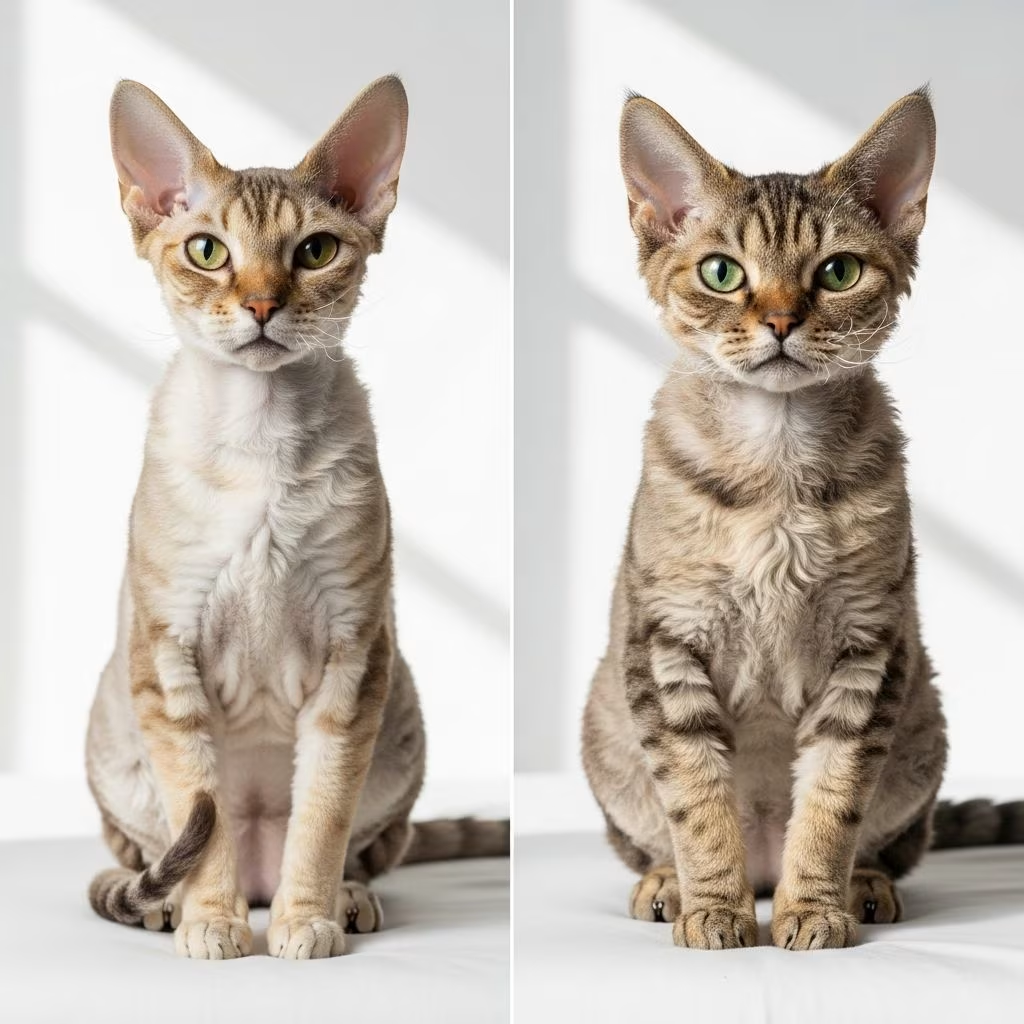
Cornish Rex vs. Devon Rex: Main Differences (With Pictures)
The Cornish Rex and Devon Rex are two distinct cat breeds that originated in the United Kingdom, yet many people confuse them due to their similar wavy coats and playful personalities. However, these two breeds have significant differences in appearance, temperament, and care requirements. Understanding these distinctions is essential when deciding which breed might be the perfect companion for your home. Both breeds are intelligent, affectionate, and energetic, but they each have unique characteristics that set them apart.
Physical Appearance and Key Traits
While both the Cornish Rex and Devon Rex share a short, curly or wavy coat, their physical appearances differ considerably. The Cornish Rex has longer legs, a smaller waist, a larger chest, and a finer coat than the Devon Rex. These physical differences extend beyond just their bodies—their facial features and overall body structure tell two very different stories.
Cornish Rex Appearance
The Cornish Rex is characterized by its distinctive and elegant appearance. The breed features an egg-shaped head with high cheekbones that could rival a supermodel. Their ears are large and triangular, often referred to as “bat-ears” because of their prominent positioning on the head. The Cornish Rex has a slim build with a long neck and long back legs, giving them a graceful, almost ethereal quality.
- Egg-shaped head, approximately one-third longer than it is wide
- Rounded forehead with prominent high cheekbones
- Roman nose with a high, prominent bridge
- Oval eyes that slant slightly upward, set high on the head
- Large, triangular ears resembling bat wings
- Long, slender legs with dainty, slightly oval paws
- Long, flexible tail that tapers toward the end
- Curvy, slender body that appears delicate but is surprisingly heavy
Devon Rex Appearance
The Devon Rex has a distinctly different look that some describe as alien-like. Their head is more of a modified wedge shape with convex curves forming the outer edge of the earlobes. Devon Rexes have large, wide-set oval-shaped eyes and strikingly large ears that are set lower on the head compared to the Cornish Rex. Their cheekbones and whisker pads are quite prominent, and they typically have much shorter whiskers than their Cornish cousins.
- Modified wedge-shaped head with convex curves
- Large, wide-set oval-shaped eyes
- Strikingly large ears set lower on the head
- Sometimes tufted ear tips with fine fur
- Shorter whiskers than the Cornish Rex
- Slightly shorter and more muscular legs
- Sleek body structure
- More rounded overall appearance
Size Comparison
| Characteristic | Cornish Rex | Devon Rex |
|---|---|---|
| Average Length (Adult) | 15–18 inches | 15–18 inches |
| Average Weight (Adult) | 6–10 pounds | 6–9 pounds |
| Height at Shoulder | 8–12 inches | 10–12 inches |
| Lifespan | 10–16 years | 9–15 years |
The Cornish Rex can reach a slightly heavier weight than Devon Rexes, though the difference is minimal. Interestingly, when it comes to height at the shoulder, Devon Rexes are on average slightly taller than their Cornish cousins, despite being lighter in weight.
Coat Type and Texture
One of the most distinctive features of both breeds is their unique coat. However, although both cats have short, curly or wavy hair, there are important differences. The Cornish Rex has a noticeably finer coat than the Devon Rex. The Cornish Rex coat consists only of an undercoat with soft, fine fur appearing without the harsh guard hairs that characterize most cat coats.
The Devon Rex’s coat is described as having a loose curl, giving it a wavy appearance. However, their hair is quite fragile, which sometimes causes them to be completely hairless in areas where they lick themselves often. This fragility also causes their whiskers to break off more easily, leaving them much shorter than those of Cornish Rexes. Some Devon Rexes have loose shaggy curls, while others have a coat that is more thin and suede-like.
Personality and Temperament
Beyond their physical differences, there are distinct personality differences between these two breeds. Understanding these temperamental distinctions is crucial for potential owners.
Cornish Rex Personality
The Cornish Rex can best be described as a charming, regal, intelligent, and confident cat that loves to be around their owners. They are happy to be handled and held, even by children, making them ideal family pets. Many Cornish Rex owners describe them as “dog-like” due to their ease of training and ability to retrieve toys.
- Highly active and always on the move
- Playful and retain kitten-like playfulness well into adulthood
- Intelligent and eager to please
- Not afraid to voice their opinion, though not as vocal as Siamese cats
- Willingness to retrieve toys like a dog
- Speed reminiscent of a sighthound
- Maintain a kitten-like attitude well into old age
- Desire to interact constantly with people
- Require constant companionship and love
Devon Rex Personality
The Devon Rex is an affectionate cat that loves to be wherever you are. They can usually be found not far from their owner, watching closely and observing their actions with quiet and gentle grace. They are a fun-loving breed always up for a play session but far more relaxed and laid-back than their Cornish cousins.
- More affectionate and devoted to family
- Playful but retain kitten-like antics less intensely than Cornish Rex
- Fairly easy-going and docile
- Likely to be curled up on the sofa with family
- Social cats that need constant companionship
- Happy with people, other cats, and even dogs
- Make fast friends with everyone
- Loyal and devoted to their family members
- More relaxed and less hyperactive overall
Training and Exercise Needs
Cornish Rex Training and Exercise
Cornish Rexes are intelligent, active, and eager to please, making them highly trainable. Their high intellect allows them to swiftly learn commands, and house training is typically no issue. They require over one hour of exercise daily to maintain their high energy levels.
- Daily exercise requirement: 1+ hours
- Intelligent and eager to please
- Swift learners of commands
- Can be taught tricks with ease
- Often taught to retrieve toys
- Highly trainable despite their energetic nature
Devon Rex Training and Exercise
Devon Rexes are also highly intelligent, making training a breeze. They can swiftly learn commands, and house training is equally manageable. While they love to play and keep children endlessly entertained with their antics, they are fairly easy-going and docile. They also require 1+ hours of daily exercise, though they are more likely to be content with a mix of active play and relaxation time with their family.
- Daily exercise requirement: 1+ hours
- Highly intelligent
- Easy-going and docile nature aids training
- Can swiftly learn commands
- House training is no issue
- Can easily be taught tricks
- Often taught to retrieve toys
Grooming and Care Requirements
The grooming needs of these two breeds differ significantly due to their coat types. The Cornish Rex has low grooming needs, while the Devon Rex requires moderate grooming. The Devon Rex’s wavy coat requires more attention to prevent matting and to manage its delicate nature. Both breeds should have their ears checked regularly, as their large ears can be prone to wax buildup.
Health and Lifespan
Both breeds are known to be healthy overall. However, the Cornish Rex has a slightly longer lifespan, living 10–16 years compared to the Devon Rex’s 9–15 years. The Cornish Rex also has fewer hereditary diseases to be concerned with than the Devon Rex. Regardless, both breeds make excellent long-term companions with proper care and veterinary attention.
Family Suitability
Cornish Rex as a Family Pet
The Cornish Rex is a loving and affectionate cat that makes a great family pet. They are well-suited to homes with children due to their friendly nature and ability to be handled and held. Their dog-like characteristics and playful demeanor mean they thrive in active households where they receive constant attention and companionship.
- Family-friendly: Yes
- Other pet-friendly: Yes
- Good with children of all ages
- Require constant attention and interaction
- Best suited to homes where they receive love and companionship
- More energetic, requiring active owners
- Slightly smaller breed
Devon Rex as a Family Pet
The Devon Rex is a loving and affectionate cat that makes an excellent family pet. They are well-suited to homes with children and make fast friends with other family pets, too. Their more laid-back and docile nature makes them ideal companions for seniors and people living in small apartments, while still being playful and entertaining enough for active families.
- Family-friendly: Yes
- Other pet-friendly: Yes
- Make fast friends with other family pets
- More docile and easy-going than Cornish Rex
- Ideal for seniors and apartment living
- Still playful and entertaining for children
- Content with moderate activity levels
Origin and History
Both breeds originated in the United Kingdom. The Cornish Rex was discovered in Cornwall and was officially registered with the CFA in 1964. The Devon Rex originated in Devonshire about a decade after the Cornish Rex. A unique genetic mutation caused their short and wavy coats in both cases. Although initially thought to be genetically the same as the Cornish Rex, the Devon Rex was quickly proven to be genetically distinct. The CFA officially recognized the Devon Rex in 1979, which was over a decade after the Cornish Rex.
Which Breed Is Right for You?
Choosing between a Cornish Rex and a Devon Rex depends on your lifestyle and preferences. If you are looking for a playful, energetic cat that maintains a kitten-like demeanor well into adulthood and requires constant attention and interaction, the Cornish Rex is an excellent choice. They are ideal for active households with people who can dedicate time to play and engagement.
If you prefer a more laid-back and affectionate companion that is still playful but more docile and easier-going, the Devon Rex is the better option. They are well-suited to families with children, seniors, and people living in smaller spaces who want a loving pet without the high energy demands of a Cornish Rex.
Both breeds are loyal, intelligent, and affectionate, making either a great choice for the right household. Consider your lifestyle, activity level, and the amount of attention and companionship you can provide before making your decision.
Frequently Asked Questions (FAQs)
Q: What are the main physical differences between Cornish Rex and Devon Rex cats?
A: The Cornish Rex has longer legs, a smaller waist, a larger chest, and a finer coat. The Devon Rex has larger, lower-set ears, shorter whiskers, and slightly shorter, more muscular legs. The Cornish Rex has an egg-shaped head, while the Devon Rex has a more modified wedge-shaped head.
Q: Which breed is more energetic?
A: The Cornish Rex is more energetic and maintains a kitten-like playfulness well into adulthood. The Devon Rex is more laid-back and docile, though still playful and active.
Q: Are both breeds good with children?
A: Yes, both breeds are family-friendly and good with children. The Cornish Rex is happy to be handled and held, while the Devon Rex is affectionate and makes fast friends with family members.
Q: What are the grooming needs for each breed?
A: The Cornish Rex has low grooming needs due to its fine coat. The Devon Rex requires moderate grooming because its fragile coat can be prone to matting and may require more maintenance.
Q: How long do these breeds typically live?
A: The Cornish Rex typically lives 10–16 years, while the Devon Rex lives 9–15 years. Both breeds are generally healthy with proper care.
Q: Which breed is better for apartment living?
A: The Devon Rex is better suited to apartment living due to its more laid-back nature and lower energy levels. However, both breeds can adapt to apartment living if provided with adequate exercise and enrichment.
Q: Are these breeds good with other pets?
A: Yes, both breeds are other pet-friendly. Devon Rexes are particularly social and make fast friends with cats and dogs, while Cornish Rexes are also generally good with other pets.
Q: How much exercise do Cornish Rex and Devon Rex cats need?
A: Both breeds require over one hour of daily exercise. The Cornish Rex is more active and benefits from more intense play sessions, while the Devon Rex is content with a mix of play and relaxation.
References
- Cornish Rex vs. Devon Rex: Main Differences (With Pictures) — Catster. https://www.catster.com/cat-breeds/cornish-rex-vs-devon-rex-cat/
- Devon Rex vs Cornish Rex — A-Z Animals. https://a-z-animals.com/blog/devon-rex-vs-cornish-rex/
- The Rex Breeds — The Cat Fanciers’ Association. https://cfa.org/cat-talk/the-rex-breeds/



