

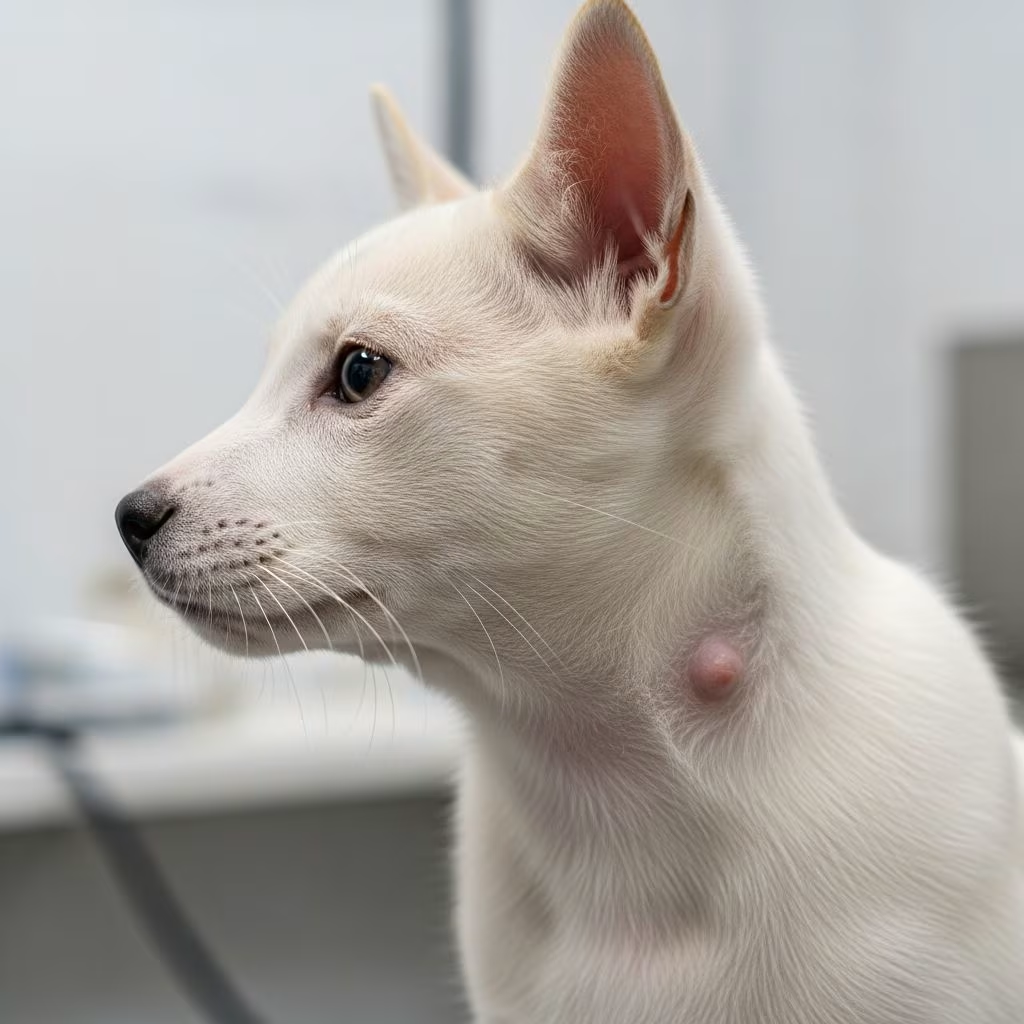
Fluid-filled sacs known as congenital cysts form in the head and neck areas of animals due to irregularities during early embryonic growth. These uncommon anomalies arise from incomplete closure or persistence of embryonic structures, often appearing as soft, movable lumps detectable shortly after birth or later in life. Veterinary professionals must differentiate these from infectious swellings or tumors to guide appropriate care.
Embryonic Foundations of Head and Neck Cysts
During fetal development, the neck and head region evolves from a series of tissue folds called pharyngeal arches, grooves, and pouches. Disruptions in this process can lead to cysts from trapped epithelial remnants. For instance, branchial cleft cysts stem from the external grooves failing to fuse properly, creating pockets lined with respiratory or squamous epithelium. These structures typically remain dormant until triggered by growth or inflammation.
Thyroglossal duct cysts develop along the path where the thyroid gland descends from the tongue base, retaining a tract of tissue that forms a cyst with potential thyroid elements in its wall. Duplication cysts mimic segments of the esophagus or respiratory tract, featuring glandular or ciliated linings reflective of their foregut origins.
- Pharyngeal arch derivatives contribute to jaw, throat, and glandular tissues.
- Groove persistence results in lateral neck cysts.
- Pouch anomalies produce internal or medial swellings.
Species-Specific Presentations and Prevalence
In dogs, these cysts often manifest as midline or lateral neck masses, sometimes confused with sebaceous or follicular types, though true congenital ones link to embryonic defects. Breeds like Rhodesian Ridgebacks show dermoid variants along the dorsal midline due to skin layer separation. Cattle cases, such as bilateral second pharyngeal cleft cysts in calves, highlight rarity and potential environmental influences, as seen in unrelated animals from the same farm.
Horses frequently present with branchial arch cysts or foregut duplication cysts, identifiable by cartilaginous rings in respiratory types. Foals may exhibit ventral neck masses requiring imaging for confirmation. Cats and other species report fewer incidences, often esophageal duplications lined by columnar epithelium.
| Species | Common Cyst Type | Typical Location | Age at Detection |
|---|---|---|---|
| Dogs | Branchial, Dermoid | Lateral neck, Midline back | Birth to maturity |
| Cattle | Pharyngeal cleft | Ventral craniolateral neck | Neonatal |
| Horses | Branchial arch, Bronchogenic | Ventral neck, Pharynx | Foals to adults |
| Cats | Esophageal duplication | Cervical esophagus | Variable |
Clinical Signs and Differential Diagnosis
Affected animals usually show painless, fluctuant swellings that grow slowly. Ulceration may occur from trauma, as in neonatal calves with ventral erosions. Respiratory distress arises if cysts compress airways, while dysphagia signals esophageal involvement. Unlike abscesses, these lack fever or leukocytosis unless secondarily infected.
Vets employ a systematic approach: palpation reveals characteristic softness and transillumination confirms fluid content. Differentials include neoplasia, salivary mucoceles, and traumatic hematomas.
- Palpation: Soft, non-painful, movable masses.
- Fine-needle aspirate: Clear serous or mucoid fluid, low cellularity.
- Imaging: Ultrasound shows thin-walled anechoic structures; CT delineates extent.
Advanced Imaging and Confirmatory Tests
Ultrasonography excels for superficial cysts, displaying well-defined walls and internal debris if infected. Radiography identifies gas-filled or calcified variants, while endoscopy visualizes pharyngeal or laryngeal types. CT or MRI provides three-dimensional mapping pre-surgery, crucial for deep-seated lesions.
Histopathology post-excision is definitive, revealing epithelial linings: ciliated columnar for respiratory origins, squamous for branchial, or glandular for foregut duplications. Ectopic cartilage or thyroid tissue pinpoints embryologic source.
Treatment Strategies and Surgical Interventions
Surgical excision offers the gold standard, aiming for complete removal to prevent recurrence. Complete resection includes cyst wall and tracts, minimizing complications like fistula formation. Marsupialization suits inoperable cases, though recurrence risks persist.
In horses, sclerotherapy with iodine derivatives provides alternatives for accessible cysts. Postoperative care involves antibiotics, drainage monitoring, and wound management. Prognosis excels with early intervention, yielding full recovery in most cases.
Potential Complications
- Infection leading to abscessation.
- Malignant transformation, rare in veterinary reports but noted in canines.
- Recurrence from incomplete excision.
Rare Cases and Research Insights
Bilateral pharyngeal cleft cysts in calves from one farm suggest environmental teratogens, despite no familial ties—first such veterinary documentation. A Dalmatian dog developed carcinoma from a thymic cyst, underscoring neoplastic potential. Geographic clustering prompts investigation into feed contaminants or deficiencies.
Ongoing research explores genetic markers, though most cases appear sporadic. Multicenter studies could clarify prevalence and risk factors across species.
Preventive Measures and Owner Education
No proven prevention exists due to multifactorial etiologies, but avoiding teratogenic exposures during gestation aids. Owners should monitor neonates for swellings and seek prompt veterinary evaluation. Breeds prone to dermoids benefit from genetic screening where available.
FAQs on Congenital Neck Cysts
Are these cysts cancerous?
Rarely; most are benign, but long-standing cysts warrant monitoring for transformation.
Can cysts resolve without surgery?
Spontaneous regression is uncommon; surgical removal is typically required for cure.
Which animals are most affected?
Dogs, cattle, and horses report highest incidences, varying by cyst type.
How do vets diagnose them?
Through history, exam, imaging, and histopathology.
Is prognosis good post-treatment?
Excellent with complete excision; complications are infrequent.
References
- Congenital and Inherited Disorders of the Digestive System of Dogs — MSD Veterinary Manual. 2023. https://www.msdvetmanual.com/dog-owners/digestive-disorders-of-dogs/congenital-and-inherited-disorders-of-the-digestive-system-of-dogs
- Bilateral second pharyngeal cleft cysts in 2 calves on the same farm — PMC (PubMed Central). 2022-02-01. https://pmc.ncbi.nlm.nih.gov/articles/PMC8842260/
- Cysts – VCA Animal Hospitals — VCA Hospitals. 2023. https://vcahospitals.com/know-your-pet/cysts
- Types of Cysts on Dogs: What You Need to Know — American Kennel Club. 2023. https://www.akc.org/expert-advice/health/types-of-cysts-on-dogs/
- A diagnostic approach to congenital neck masses in foals — BEVA (British Equine Veterinary Association). 2020-11-01. https://beva.onlinelibrary.wiley.com/doi/10.1111/eve.13495



