

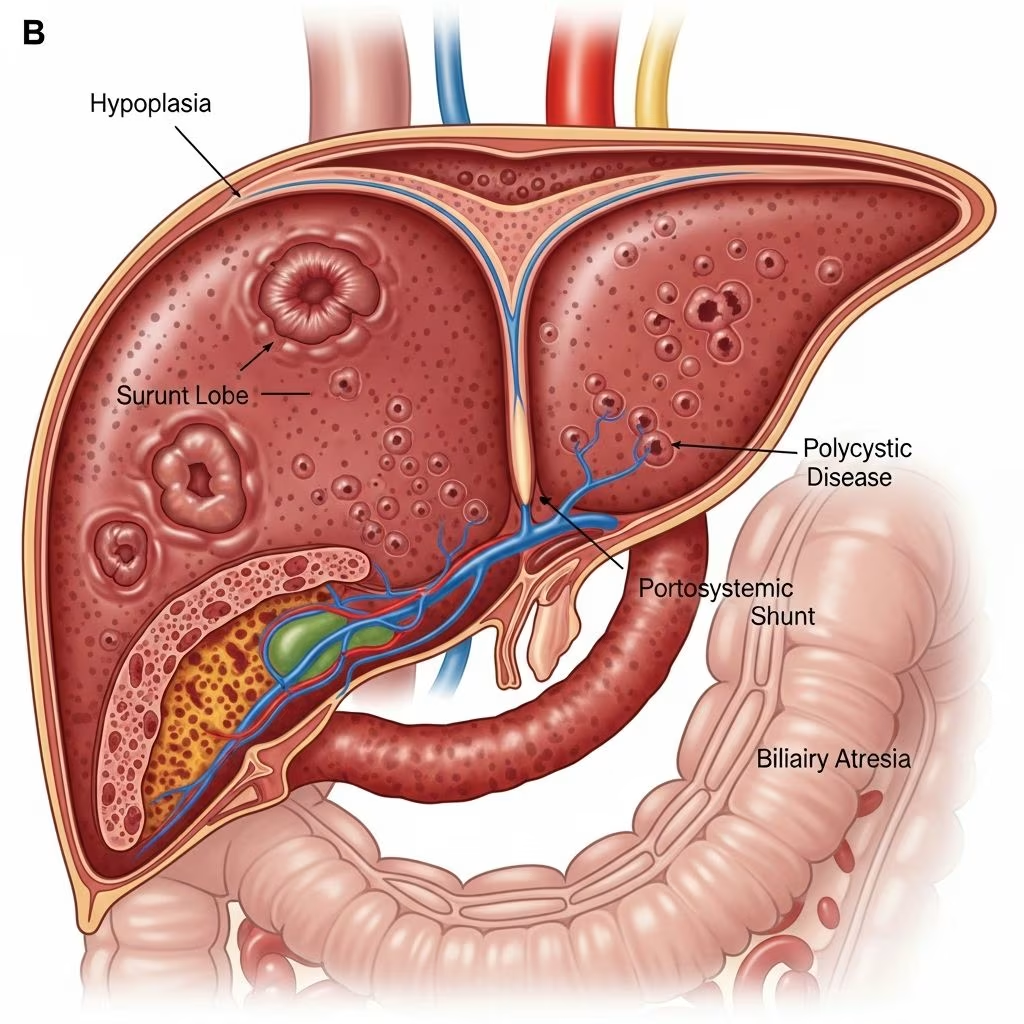
Congenital and inherited anomalies of the liver represent a diverse group of developmental disorders that impair hepatic function from birth in animals, especially dogs and cats. These conditions arise from irregularities in the formation of blood vessels, bile ducts, and liver parenchyma during embryonic development, leading to a range of clinical manifestations from mild dysfunction to life-threatening complications.
Understanding the Origins of Liver Malformations
The liver’s intricate vascular and biliary architecture develops early in fetal life, making it susceptible to genetic and environmental disruptions. Disruptions in ductal plate remodeling—a critical process where primitive bile duct structures mature—can result in persistent embryonic configurations, manifesting as fibrosis or cyst-like formations. Similarly, vascular anomalies stem from failures in angiogenesis, where portal veins, hepatic arteries, and veins form abnormally.
In dogs, breeds such as Yorkshire Terriers, Maltese, Pugs, Cairn Terriers, and Miniature Schnauzers show predispositions due to hereditary factors. These small breeds often exhibit microvascular issues alongside macroscopic shunts, complicating prognosis.
Key Vascular Anomalies Impacting Liver Function
Arteriovenous Malformations and Fistulas
Hepatic arteriovenous malformations (AVMs) involve direct connections between arteries and veins, bypassing capillary beds and reducing efficient blood filtration through the liver. Congenital forms are rare but documented, while acquired fistulas may develop post-trauma or inflammation. These lead to portal hypertension, ascites, and schistocyte formation from turbulent flow, mimicking portosystemic vascular anomalies (PSVAs).
Diagnosis relies on ultrasonography revealing abnormal vascular interconnections within specific liver lobes, confirmed by histopathology showing multiple AV links. Treatment via lobectomy or artery ligation often fails if diffuse microvascular dysplasia coexists, necessitating biopsies from unaffected lobes.
Portal Vein Hypoplasia and Microvascular Dysplasia
Portal vein hypoplasia, also termed hepatic microvascular dysplasia (MVD) or portal atresia, features underdeveloped or absent microscopic portal vessels. This congenital defect impairs toxin clearance and protein synthesis, causing liver atrophy.
Affected animals present with stunted growth, neurological signs from hepatic encephalopathy (e.g., ataxia, head-pressing, seizures), and urinary issues like urolithiasis or infections. Breeds like Yorkshire Terriers and Cairn Terriers are overrepresented.
| Breed | Prevalence Risk | Common Co-morbidities |
|---|---|---|
| Yorkshire Terrier | High | MVD, PSVA |
| Maltese | High | Veno-occlusive disease |
| Cairn Terrier | Moderate-High | Portal hypoplasia |
| Pug | Moderate | Microvascular anomalies |
| Miniature Schnauzer | Moderate | Acquired shunts |
Hepatic Venous Outflow Obstructions
Conditions like sinusoidal occlusion syndrome (SOS), Budd-Chiari syndrome, and veno-occlusive disease (VOD) block venous drainage. SOS involves fibrotic occlusion post-injury, with collagen deposition verifiable by Masson trichrome staining. VOD, prevalent in small breeds with MVD, shows obliterative changes in venules via foamy macrophages and debris.
Agnogenic myeloid metaplasia, rare in dogs, contributes by hematopoietic cell infiltration. Once fibrosed, these lesions are irreversible, demanding early intervention.
Biliary and Fibropolycystic Disorders
Congenital hepatic fibrosis and ductal plate malformations (DPM) arise from stalled biliary maturation, yielding irregular ducts embedded in fibrous stroma. These often pair with vascular defects, forming fibropolycystic syndromes. Dogs with severe portal atresia may develop ascites akin to AVMs.
In cats, cholangiovenous reflux—bile backflow into veins—poses perioperative risks, causing hypotension, collapse, and renal failure despite precautions.
Recognizing Clinical Manifestations
- Gastrointestinal signs: Vomiting, diarrhea, poor appetite due to toxin buildup.
- Neurological symptoms: Hepatic encephalopathy with disorientation, tremors, or coma.
- Systemic effects: Ascites, jaundice, coagulopathies, and growth failure in juveniles.
- Urinary complications: Polyuria, crystalluria, stones from ammonium biurate.
- Behavioral changes: Aggression, vocalization abnormalities, or seizures.
Laboratory findings include hypoalbuminemia, elevated bile acids, schistocytes in AVMs, and azotemia in severe cases.
Diagnostic Approaches for Precision
Advanced imaging is cornerstone: Ultrasonography detects venular distention in congestion or hypoplasia in obstructions, with Doppler assessing flow. CT or MRI delineates shunts and malformations. Liver biopsy—pre- or percutaneously—provides definitive histopathology, essential for microvascular assessment.
Exclude cardiac or pericardial causes first in outflow obstructions. Bile acid stimulation tests screen for shunts.
Management and Therapeutic Strategies
Treatment varies by anomaly:
- Surgical options: Shunt attenuation or lobectomy for focal lesions, though MVD limits success.
- Medical therapy: Lactulose for encephalopathy, low-protein diets, antibiotics for infections, diuretics for ascites.
- Supportive care: Fluid therapy, nutriceuticals like SAMe or milk thistle for hepatoprotection.
- Prognosis factors: Isolated MVD allows normal lifespans with management; combined defects worsen outcomes, especially with VOD.
For cholangiovenous reflux, vigilant perioperative care mitigates risks.
Breeding Implications and Prevention
Given genetic underpinnings, breeding affected animals is discouraged. Screening via bile acids or genotyping in high-risk breeds (e.g., Yorkshire Terriers) aids selection. Early spaying/neutering prevents propagation.
Recent Advances in Veterinary Hepatology
Emerging research emphasizes multimodal diagnostics, including scintigraphy for shunt fractions. Gene therapies and targeted antifibrotics hold promise, though clinical trials lag in veterinary medicine.
Frequently Asked Questions (FAQs)
What breeds are most prone to congenital liver issues?
Small breeds like Yorkshire Terriers, Maltese, Pugs, and Cairn Terriers face higher risks due to genetic predispositions.
Can congenital liver defects be cured?
Many require lifelong management; surgical correction succeeds in select shunt cases but fails with diffuse dysplasia.
How is hepatic microvascular dysplasia diagnosed?
Through liver biopsy confirming absent portal veins, alongside imaging and bile acid tests.
What is the prognosis for dogs with veno-occlusive disease?
Guarded, as fibrotic changes are irreversible; early biopsy guides therapy.
Is cholangiovenous reflux preventable in cats?
Minimized with optimal surgical protocols, but risks persist.
Table: Comparison of Common Congenital Liver Anomalies
| Anomaly | Key Features | Breeds Affected | Treatment Approach |
|---|---|---|---|
| Arteriovenous Malformation | Turbulent flow, ascites, schistocytes | Variable | Lobectomy, biopsy distant lobes |
| Microvascular Dysplasia | Portal hypoplasia, encephalopathy | Yorkie, Cairn | Medical management |
| Veno-occlusive Disease | Venule obliteration, fibrosis | Maltese, Pug | Symptomatic, poor response to surgery |
| Ductal Plate Malformation | Biliary fibrosis, cysts | Dogs generally | Supportive |
This comprehensive overview equips veterinarians and owners with knowledge to navigate these challenging conditions effectively.
References
- Miscellaneous Congenital and Acquired Hepatic Vascular Disorders in Small Animals — Merck Veterinary Manual. 2023. https://www.merckvetmanual.com/digestive-system/hepatic-diseases-of-small-animals/miscellaneous-congenital-and-acquired-hepatic-vascular-disorders-in-small-animals
- Miscellaneous Congenital and Acquired Hepatic Vascular Disorders in Small Animals — MSD Veterinary Manual. 2023. https://www.msdvetmanual.com/digestive-system/hepatic-diseases-of-small-animals/miscellaneous-congenital-and-acquired-hepatic-vascular-disorders-in-small-animals
- Congenital Intrahepatic Disease — PubMed (NCBI). 1985-06. https://pubmed.ncbi.nlm.nih.gov/40368649/
- Hepatic Microvascular Dysplasia — VCA Animal Hospitals. 2023. https://vcahospitals.com/know-your-pet/hepatic-microvascular-dysplasia
- Portosystemic Vascular Anomalies — VSC Sarasota (PDF). 2023-02. https://vscsarasota.com/wp-content/uploads/2023/02/Portosystemic-Vascular-Anomalies.pdf



