

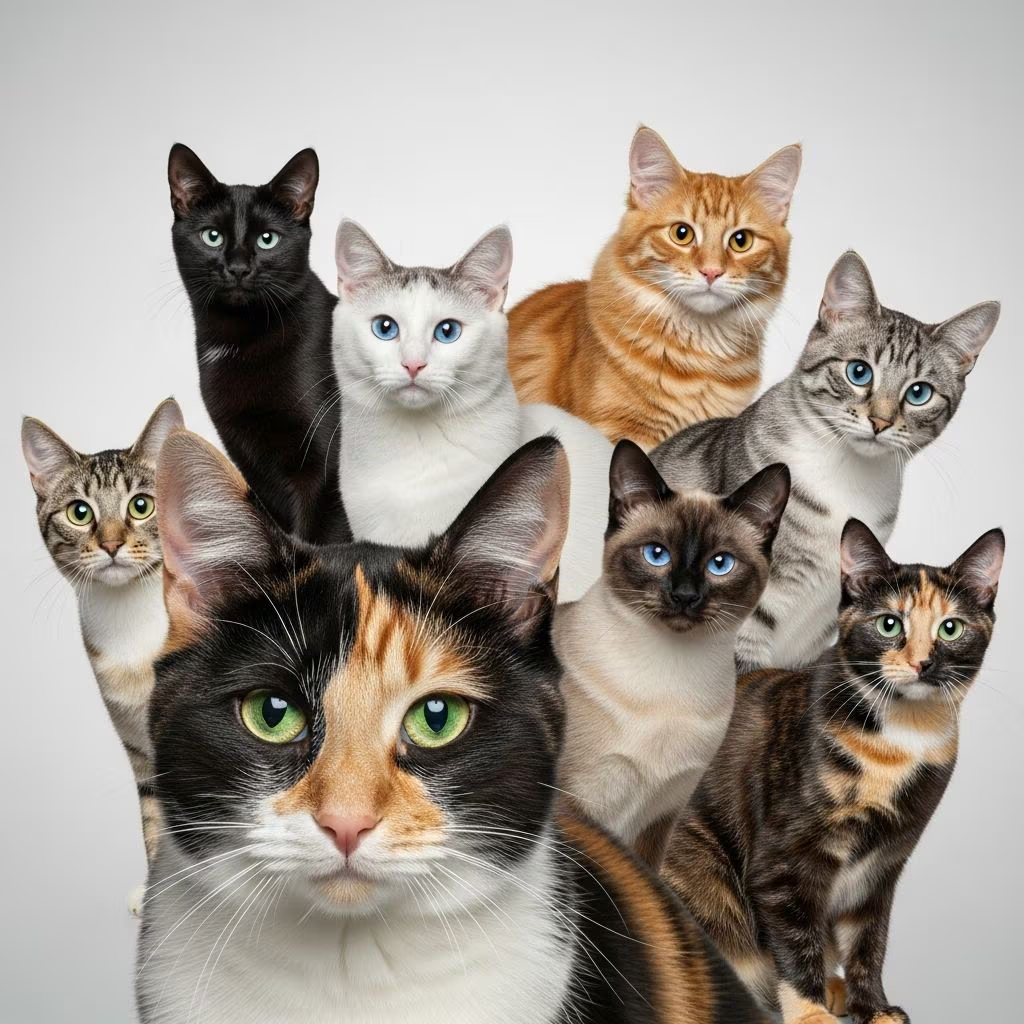
Cats captivate us with their mesmerizing coat colors and intricate patterns, each one a testament to nature’s artistry. From the bold stripes of the tabby to the swirling mosaics of the tortoiseshell, these colorings are determined by complex genetics involving multiple genes like the primary coat color gene (B/b/b1), red gene (O/o), dense/dilute gene (D/d), and others. Understanding these patterns not only highlights the diversity in feline aesthetics but also reveals links to health traits, such as deafness in white cats due to the dominant white gene (W). This article explores the most common cat colorings, their genetic foundations, and why they make every cat a unique masterpiece.
1. Tabby Cats: The Striped Symphony
**Tabby cats** dominate the feline world as one of the most prevalent patterns, characterized by bold stripes, swirls, and spots that resemble a tiger’s coat in miniature. This pattern arises from the agouti gene (A), which creates banded hairs alternating yellow and black pigments (pheomelanin and eumelanin), allowing tabby markings to express when active. There are four main tabby varieties: classic, mackerel, ticked, and spotted.
- Classic Tabby: Features bold, swirling patterns on the sides, often called ‘marbled’ or ‘blotched,’ with a bull’s-eye on the flank. These cats showcase thick lines circling the body, creating an artistic bullseye effect.
- Mackerel Tabby: The most common, displaying narrow stripes with parallel lines running along the spine and ‘fishbone’ patterns on the sides, accented by a necklace of stripes on the chest.
- Ticked Tabby: Lacks stripes or spots; instead, individual hairs are banded with multiple colors, giving a shimmering, Abyssinian-like appearance, influenced by the ta ta allele.
- Spotted Tabby: Similar to mackerel but with broken lines forming spots, popular in breeds like the Egyptian Mau.
Genetically, tabby patterns are controlled by the Tabby gene (T), with alleles determining the type: mackerel (dominant Ta), classic (recessive ta), and ticked/spotted variants. Tabby cats can appear in any color base—black, brown, red, or dilute versions like blue or cream—proving their versatility as nature’s canvas. Fun fact: Even solid-colored cats carry the tabby gene (a/a non-agouti), but it’s masked; stress or anesthesia can reveal ‘ghost tabby’ markings.
2. Solid Color Cats: Elegance in Simplicity
Solid-colored cats embody **pure elegance** with their uniform coats in shades like black, white, blue, red, or cream, lacking any tabby patterns due to the recessive non-agouti gene (a/a), which suppresses the agouti banding. Black cats, coded by dominant B allele for eumelanin, absorb light dramatically, while whites result from the dominant KIT gene (WD), masking all other colors.
These solids highlight pigment intensity via the dense/dilute gene (D/d): dominant D yields full color, while recessive d/d dilutes black to blue (gray), red to cream, chocolate (b/b) to lilac, and cinnamon (b’/b’) to fawn. Solid blacks are sleek and mysterious, often linked to superstitions but scientifically common. White solids, however, carry health notes: the W gene causes white masking and is pleiotropic, linking to blue eyes and congenital deafness with reduced penetrance—not all white cats are deaf, but risk increases.
3. Bi-Color Cats: The High-Contrast Duo
**Bi-color cats** dazzle with their high-contrast mix of white and one other color, like black-and-white or orange-and-white, thanks to the white spotting gene (Ws), a KIT variant causing variable white patches from ‘gloves’ to vast areas. This gene’s expression ranges from minimal (1-20% white) to dominant bicolor (50%+), creating tuxedo patterns with white chest, paws, and face.
Genetics combine Ws with underlying colors: a black-based bi-color has solid black plus white, while red-based shows vibrant orange. These cats are artistic in asymmetry, with patterns like the ‘cow’ or ‘tuxedo’ evoking formalwear. No health issues tie directly to bi-coloring, unlike full whites.
4. Tortoiseshell Cats: The Calico’s Patchwork Sibling
**Tortoiseshell (Tortie) cats** are living mosaics of black, red, and cream in irregular patches, almost exclusively female due to the X-linked orange gene (O/o). Females (XX) with one O (orange) and one o (non-orange) allele on each X exhibit X-inactivation, creating brindled or patched fur where cells randomly express one pigment: eumelanin (black) or pheomelanin (red).
Males are rare (XY), requiring anomalies like Klinefelter syndrome (XXY). Torties can be dilute (blue-cream) via d/d gene. Their ‘tortitude’—feisty personality—is anecdotal, but their coat’s randomness makes each unique, like abstract art.
5. Calico Cats: Tri-Color Masterpieces
**Calico cats** elevate torties with added white spotting (Ws gene), blending black, red, and white in large, distinct patches. Also mostly female for the same X-linked reasons, calicos require O/o heterozygosity plus white. Large white areas (40-80%) frame the tortie patches, creating piebald artistry.
Japanese folklore calls them ‘money cats’ for luck. Genetics mirror torties but with KIT spotting, yielding dilute versions like blue-cream-and-white.
6. Colorpoint Cats: The Siamese Enigma
**Colorpoint patterns**, iconic in Siamese and related breeds, feature darker fur on extremities (ears, face, tail, legs) due to the recessive colorpoint allele (cs/cs) at the Tyrosinase (C) locus. This temperature-sensitive enzyme produces pigment only in cooler body areas, lightening the body to cream while points are seal, chocolate, or blue.
Not a color but a pattern, it overlays any base: lynx points add tabby to points. This ‘Himalayan’ effect proves genetics’ ingenuity.
Bonus: Silver and Smoke Cats: Shimmering Effects
Beyond basics, **silver and smoke** add ethereal glows via the inhibitor gene (I), bleaching phaeomelanin (yellow/red) from agouti hairs, leaving silver tabby or chinchilla (wide-band wide). Smoke cats have colored undercoat with white roots, parting to reveal ‘smoky’ bases. These modifiers combine with any pattern, enhancing artistry.
Cat Coat Genetics: The Science Behind the Art
Cat colors stem from ~5-10 key genes: B locus (black/chocolate/cinnamon), O (red, X-linked), D (dilute), C (colorpoint), KIT (white). Agouti (A) enables tabby; T modifies it. Dilute modifier (Dm) further lightens.
| Gene | Effect | Example |
|---|---|---|
| B/b/b’ | Base eumelanin | Black (B), Chocolate (b/b), Cinnamon (b’/b’) |
| O/o | Red (X-linked) | Orange (O), Non-orange (o) |
| D/d | Dilution | Blue (black + d/d), Cream (red + d/d) |
| KIT (WD/Ws) | White | Full white (WD), Spots (Ws) |
| A/a | Agouti/Tabby | Patterned (A), Solid (a/a) |
This interplay yields infinite variations.
Frequently Asked Questions (FAQs)
What determines a cat’s coat color?
Multiple genes like B (black), O (red), D (dilute), and KIT (white) interact, with X-linkage explaining tortie/calico sex bias.
Why are most ginger cats male?
O gene on X; males (XY) need one O, females (XX) need two for full ginger.
Are white cats always deaf?
No, but dominant W gene links white coat to deafness risk via pleiotropy, not 100% penetrant.
Can male calico cats exist?
Rarely, via genetic anomalies like XXY Klinefelter.
What is the rarest cat color?
True cinnamon or chocolate in non-pedigree cats; male torties are rarer.
References
- From Tabby to Tortoiseshell: Understanding Cat Coat Patterns — Beverly Hills Vets. 2023-05-15. https://www.beverlyhillsvets.com/blog/from-tabby-to-tortoiseshell-understanding-cat-coat-patterns/
- The link between coat colour, disease and behaviour in cats — Vet Times. 2022-11-10. https://www.vettimes.com/news/vets/small-animal-vets/the-link-between-coat-colour-disease-and-behaviour-in-cats
- The Genetics of Cat Colours and Coat Types — Melbourne Cat Vets. 2024-02-20. https://www.melbournecatvets.com.au/post/the-genetics-of-cat-colours-and-types-unlocking-the-mystery-of-feline-fur-part-1
- Cat Genetics: A Progressive Look at Coat Colors & Patterns — Liz’s Kitty Bootcamp. 2020-08-24. https://lizskittybootcamp.com/2020/08/24/cat-genetics-a-progressive-look-at-coat-colors-patterns/
- Cat Genetics 2.0: Colours — Laboratoire de génétique vétérinaire. 2023-07-12. https://labgenvet.ca/en/cat-genetics-2-0-colours/
- Feline Coat Color — Veterinary Genetics Laboratory, UC Davis. 2024-01-05. https://vgl.ucdavis.edu/resources/cat-coat-color



