

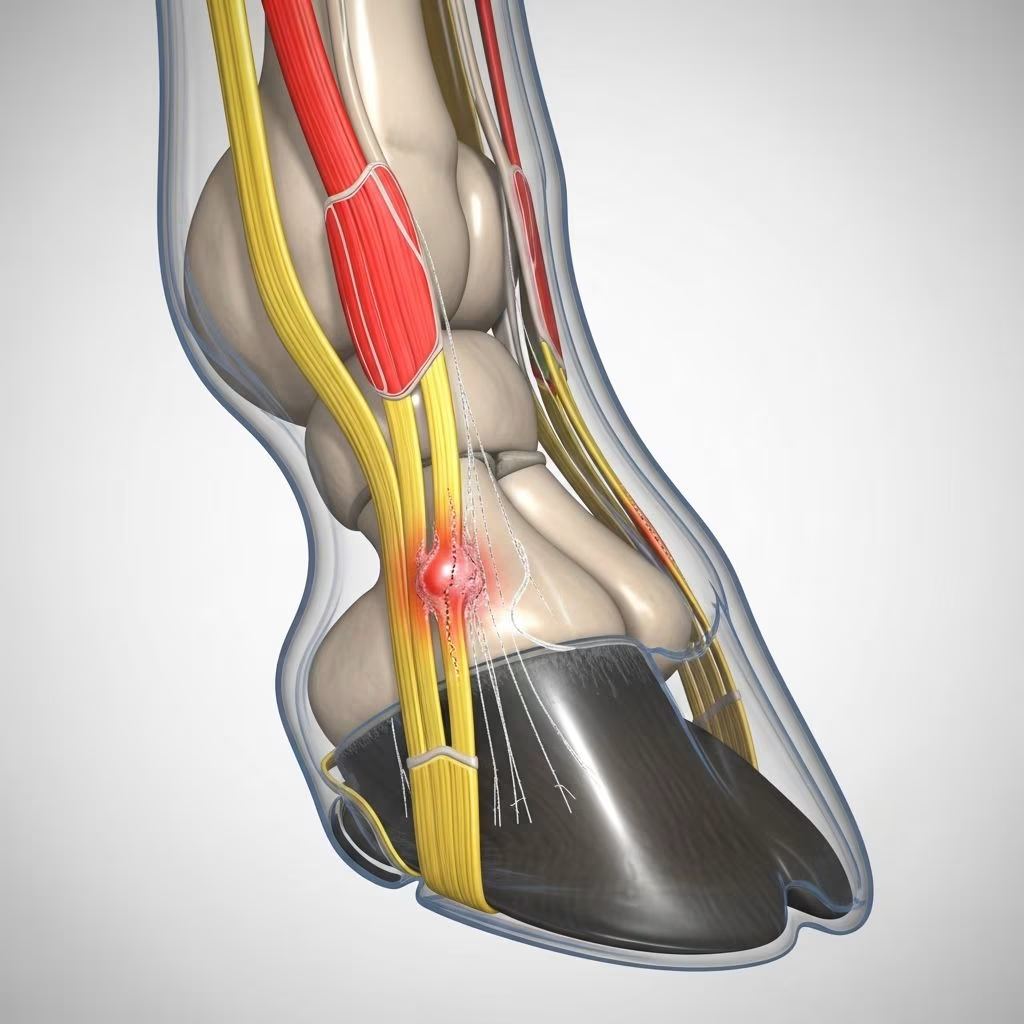
The distal interphalangeal joint, commonly known as the coffin joint, plays a pivotal role in equine locomotion. Injuries to its collateral ligaments represent a significant challenge in veterinary practice, often leading to persistent lameness that impacts performance and welfare. These ligaments provide lateral stability, preventing excessive side-to-side movement during weight-bearing and turning maneuvers.
Fundamental Anatomy of the Equine Distal Limb
Understanding the structural framework of the horse’s foot is essential for grasping ligament pathology. The distal limb features a series of phalanges: the proximal phalanx (P1), middle phalanx (P2), and distal phalanx (P3), also called the coffin bone. Nestled behind P3 is the navicular bone, which interacts with the deep digital flexor tendon (DDFT). The collateral ligaments originate from P2 and insert obliquely onto P3, forming paired structures on the medial and lateral sides.
These ligaments work in tandem with tendons like the common digital extensor tendon anteriorly and the DDFT posteriorly, which wraps around the navicular bone before attaching to P3’s solar surface. The hoof capsule encases this assembly, with sensitive laminae interlocking the hoof wall to P3, and lateral cartilages extending from the coronary band to support expansion during loading.
- Key stabilizing elements: Collateral ligaments prevent abduction and adduction.
- Movement enablers: Extensor tendon extends the joint; DDFT flexes it.
- Supportive tissues: Impar ligament connects navicular to sole corium; sesamoidean ligaments bolster the podotrochlear apparatus.
Mechanisms Leading to Ligament Desmopathy
Collateral ligament desmopathy arises from acute trauma or chronic repetitive stress. Sudden torsional forces during slipping, uneven terrain navigation, or sharp turns overload these structures, causing tears or sprains. In performance horses, repetitive hyperextension or varus/valgus stresses from poor footing exacerbate micro-damage.
Age-related degeneration contributes, as collagen fibrils weaken over time, reducing elasticity. Conformation issues, such as long toes or sheared heels, alter joint angles, compressing one ligament while straining the other. Radiographic evidence often reveals hoof imbalance, with uneven joint spaces straining collaterals.
| Factor | Description | Risk Level |
|---|---|---|
| Acute Trauma | Slips, falls, or collisions | High |
| Chronic Overuse | Jumping, barrel racing | Moderate-High |
| Conformational Faults | Toed-out, unbalanced feet | Moderate |
| Age Degeneration | Collagen loss in seniors | Low-Moderate |
Recognizing Clinical Signs of Injury
Horses with collateral desmopathy typically exhibit grade 2-4 lameness, most pronounced on circles or lunging, where lateral forces peak. Forelimb involvement predominates, though hindlimbs can be affected. Pain intensifies on the affected side during flexion tests or hoof tester application over the collateral region.
Swelling may appear dorsal to the coronary band in severe cases, but intra-capsular damage often yields subtle externals. Joint effusion or heat signals synovitis. Advanced instability manifests as a ‘bobbing’ gait or positive wedge test, where elevating the heel exacerbates lameness.
- Short-stride lameness worsening with turns.
- Resistance to lateral work.
- Hoof tester sensitivity near quarters.
- Occasional distal limb filling.
Diagnostic Approaches for Accurate Assessment
Diagnosis begins with a thorough lameness exam, including hoof testers, flexion, and wedge tests. Radiography assesses alignment, joint space narrowing, or P3 rotation. Lateromedial and dorsopalmar views reveal imbalances stressing ligaments.
Magnetic Resonance Imaging (MRI) is gold standard, delineating ligament fiber disruption, core lesions, or associated DDFT pathology within the hoof capsule. Ultrasound visualizes proximal ligament portions but struggles distally. Arthroscopy inspects synovial recesses for tears.
Nuclear scintigraphy detects active bone remodeling, while contrast-enhanced MRI highlights inflammation hotspots.
Treatment Strategies: Conservative to Surgical
Management hinges on injury severity. Acute cases demand strict stall rest (4-6 weeks), ice therapy, and NSAIDs like phenylbutazone to curb inflammation. Therapeutic shoeing corrects imbalances: rolled toes, medial/lateral extensions, or raised heels redistribute loads.
Regenerative therapies shine: platelet-rich plasma (PRP) or stem cell injections promote healing via growth factors. Shockwave therapy boosts angiogenesis and collagen repair. Serial ultrasounds or MRIs monitor progress, extending rest up to 6-12 months for full tears.
Surgical options include ligament desmotomy for chronic cases or navicular bursa endoscopy for debridement. Farriery adjustments, like heart-bar shoes, support DDFT tension relief.
Rehabilitation and Return to Function
Rehab phases progressively reload the limb. Phase 1: Controlled hand-walking post-immobilization. Phase 2: Underwater treadmill for low-impact cardio. Phase 3: Hill work and circles on soft footing build proprioception.
Nutritional support with omega-3s, glucosamine, and antioxidants aids tendon health. Regular farrier checks maintain balance. Success rates vary: mild strains recover 80-90% function; severe desmitis may cap at pasture soundness.
- Monitor with monthly diagnostics.
- Incorporate cross-training.
- Avoid premature intense work.
Preventive Measures for Long-Term Hoof Health
Proactive care mitigates risks. Routine hoof trimming every 4-6 weeks ensures even wear. Balanced shoeing suits discipline: racing plates prioritize breakover; eventing wedges enhance stability.
Footing management—deep sand arenas, rolled fields—absorbs shock. Warm-up routines with lateral stretches precondition ligaments. Annual lameness screens catch subclinical issues early.
Prognosis Factors Influencing Recovery Outcomes
Favorable prognosis attends acute, partial tears in young horses with ideal conformation. Chronic, bilateral, or DDFT-associated injuries portend guarded outcomes, with 40-60% returning to prior athleticism. Early intervention is paramount; delays foster fibrosis and instability.
Breed influences: Warmbloods heal better than Thoroughbreds due to robust vasculature. Owner compliance with rehab protocols dictates success.
FAQs on Equine Collateral Ligament Desmopathy
What is the most common cause of collateral ligament injury in horses?
Torsional forces from turns or slips on poor footing, compounded by imbalance.
How long does recovery typically take?
3-12 months, depending on grade; mild cases resolve faster.
Is MRI always necessary for diagnosis?
Not always; it’s ideal for intra-capsular confirmation when radiographs are inconclusive.
Can these injuries recur?
Yes, especially without corrective farriery and footing improvements.
What role does farriery play in treatment?
Crucial for load redistribution, preventing further strain.
References
- Horse Hoof Anatomy, Part 1 — The Horse. 2019-10-01. https://thehorse.com/148888/horse-hoof-anatomy-part-1/
- The coffin bone is the predominant bone within… — Anatomy of the Equine. N/A. https://www.anatomy-of-the-equine.com/Coffin-Bone.html
- Understanding hoof ligament injuries in horses — Horse & Hound. 2019-11-01. https://www.horseandhound.co.uk/plus/foot-ligament-injuries-horses-hh-vip-659296
- Know Your Horse’s Foot Anatomy — Premiere Equine Vet Service. N/A. https://www.premierequinevetservice.com/news/know-your-horses-foot-anatomy/
- Hoof Anatomy – A Beginner’s Guide — EPAUK. N/A. https://www.epauk.org/about-equine-podiatry/articles/hoof-anatomy-a-beginners-guide/
- Tendon and ligament anatomy – Large Animal Surgery — University of Minnesota Libraries Publishing. 2022-01-01. https://open.lib.umn.edu/largeanimalsurgery/chapter/tendon-anatomy/
- Ligaments- Their Farriery Relevance — The Equine Documentalist. N/A. https://www.theequinedocumentalist.com/ligaments-their-farriery-relevance/



