

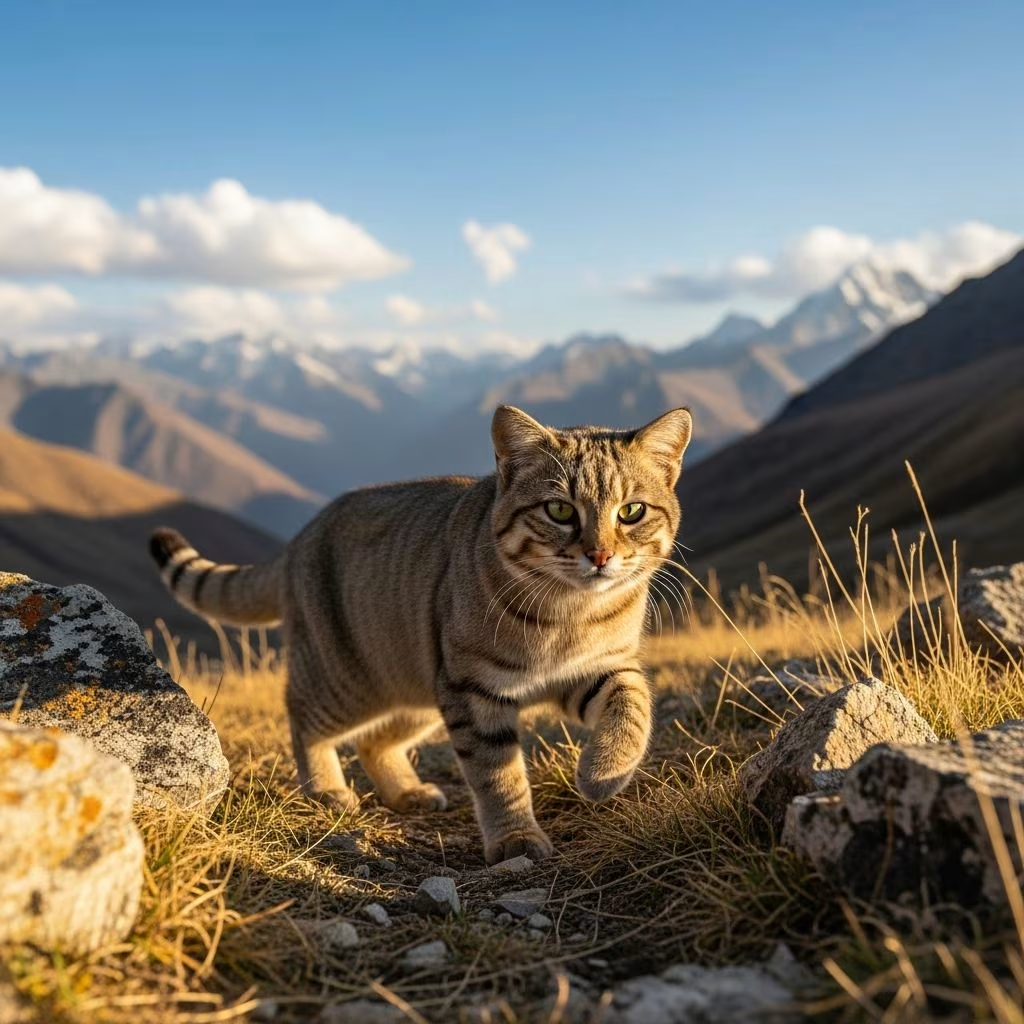
The Chinese mountain cat, scientifically named Felis bieti, stands out as a resilient wild feline uniquely suited to the demanding landscapes of high-elevation regions in China. This small yet robust predator navigates alpine meadows and steppes with remarkable adaptability, blending seamlessly into its surroundings through seasonal fur changes and specialized physical traits. Endemic to the Tibetan Plateau and surrounding areas, it faces ongoing challenges from habitat alteration and human expansion, earning a Vulnerable classification on the IUCN Red List since 2002.
Physical Build and Adaptations
Chinese mountain cats possess a compact, sturdy frame designed for endurance in rugged terrains. Adults typically weigh between 4 to 9 kilograms (8.8 to 19.8 pounds), with a head-body length of 60 to 85 centimeters (23.6 to 33.5 inches) and a tail measuring 29 to 41 centimeters (11 to 16 inches), comprising about 40% of their total length. Their build features relatively short legs, a broad skull, and enlarged auditory bullae—hollow structures housing the middle and inner ears that occupy up to 25% of the skull’s length, enhancing their hearing for prey detection.
Their coat is dense and double-layered, providing insulation against extreme cold, heat, and high winds at elevations from 2,500 to 5,000 meters (8,200 to 16,400 feet). In winter, the fur lightens to pale grey for snow camouflage, shifting to darker brown in summer to match dry grasslands, often called ‘grass cat’ by locals for its grass-like hue. Subtle dark horizontal stripes grace the face, legs, cheeks, and sides, with black ear tips, a white belly, pale yellowish throat, and a bushy tail ending in black rings and a dark tip. Long hair between the foot pads aids traction on rocky, snowy ground. Males exhibit sexual dimorphism, being larger than females.
| Physical Trait | Details |
|---|---|
| Weight | 4-9 kg (8.8-19.8 lbs) |
| Body Length | 60-85 cm (23.6-33.5 in) |
| Tail Length | 29-41 cm (11-16 in), ~40% of body |
| Coat Color | Seasonal: grey winter, brown summer; sandy with stripes |
| Special Features | Large auditory bullae, foot pad hair, black ear tips |
Natural Habitat and Distribution
Exclusive to western and southern China, particularly the Tibetan Plateau’s Qinghai-Tibet region, these cats inhabit alpine meadows, steppe grasslands, shrublands, and forest edges at altitudes exceeding 2,500 meters. They avoid lowland deserts despite occasional misnomers like ‘Chinese desert cat,’ thriving instead in cold, windy open spaces up to 5,000 meters. Habitats include sparsely wooded areas and high-elevation coniferous forest fringes, where dense fur buffers harsh climates. Recent studies in the Qilian Mountains confirm their presence in these remote, elevated ecosystems.
Hunting Techniques and Diet
As apex predators in their niche, adult Chinese mountain cats face few threats, though juveniles risk predation by wolves, bears, or foxes. They are cursorial hunters—built for pursuing prey over distances—and primarily target rodents like pikas, voles, and mole rats, supplemented by birds such as pheasants.
Nocturnal and crepuscular, they peak in activity from late afternoon to early night, using acute hearing to detect subterranean movements as shallow as 3-5 cm below ground, then excavating with powerful paws. They also employ stalking and pouncing on surface prey or kill marmots to claim burrows. This opportunistic diet sustains them in sparse environments, with no recorded predation on adults.
- Primary Prey: Pikas, voles, mole rats
- Secondary Prey: Birds (e.g., pheasants), marmots
- Hunting Style: Auditory detection + digging; stalking/pouncing
Daily Life and Social Patterns
Solitary by nature, these cats interact mainly during breeding or maternal care, maintaining undefined home ranges possibly marked by scent, akin to related species spanning 45-180 square kilometers. Diurnal flexibility shows in Qilian Mountain observations, but they predominantly rest in burrows—self-dug or commandeered from prey like marmots or badgers—during daylight, emerging at dusk. Cursorial, motile, and elusive, they evade detection in vast grasslands.
Reproduction and Family Dynamics
Polygynandrous breeders mate seasonally from January to March, with females birthing 2-4 altricial kittens in May inside secluded south-facing burrows for protection. Kittens, born underdeveloped and immobile, receive exclusive maternal care including provisioning and defense; independence arrives at 7-8 months. Males may occasionally guard territories, mirroring jungle cat behaviors. Iteroparous, females breed yearly, ensuring population persistence despite vulnerabilities.
Conservation Status and Threats
Classified as Vulnerable by IUCN since 2002, Chinese mountain cats contend with habitat loss from overgrazing, rodent control poisoning their prey base, and infrastructure development. Their remote, high-altitude range limits data, but populations dwindle amid grassland degradation. Conservation demands protected areas, anti-poaching, and pika management reevaluation, as these rodents are vital prey. Camera traps and studies like those in Qilian Mountains (2020-2021) inform efforts. Not suited for captivity, they embody wild integrity.
Comparing with Similar Wild Cats
| Feature | Chinese Mountain Cat | Jungle Cat | Bobcat |
|---|---|---|---|
| Habitat | High-altitude grasslands (China) | Varied, including steppes | Forests, deserts (N. America) |
| Size | 4-9 kg | Similar, up to 15 kg | 6-18 kg |
| Coat | Seasonal sandy/striped | Spotted | Spotted/gray |
| Activity | Nocturnal/crepuscular | Similar | Twilight |
Insights from Recent Field Studies
From June 2020 to December 2021 in Qilian Mountains, ten tracked cats displayed all-day activity peaking late afternoon to early evening, using burrows on south slopes and preying on marmots. Such data underscores their adaptability amid climate pressures.
FAQs
Where do Chinese mountain cats live?
They inhabit high-elevation grasslands and shrublands on the Tibetan Plateau in China, from 2,500-5,000 meters.
What do they eat?
Mainly rodents like pikas and mole rats, plus birds; hunted via hearing and digging.
Are they endangered?
Vulnerable per IUCN due to habitat loss and prey decline.
Can Chinese mountain cats be pets?
No, they are wild and not suited for private ownership.
How do they reproduce?
January-March mating; 2-4 kittens in May burrows, independent at 7-8 months.
References
- Chinese Mountain Cats – Facts and Details — Facts and Details. N/A. https://factsanddetails.com/china/cat6/sub38/entry-9349.html
- Chinese Mountain Cat Breed Info — Catster. N/A. https://www.catster.com/cat-breeds/chinese-mountain-cat/
- Chinese mountain cat – Wikipedia — Wikipedia. 2023-10-15. https://en.wikipedia.org/wiki/Chinese_mountain_cat
- Living Species – Chinese Mountain Cat — IUCN Cat Specialist Group. N/A. https://www.catsg.org/living-species-chinesemountaincat



