

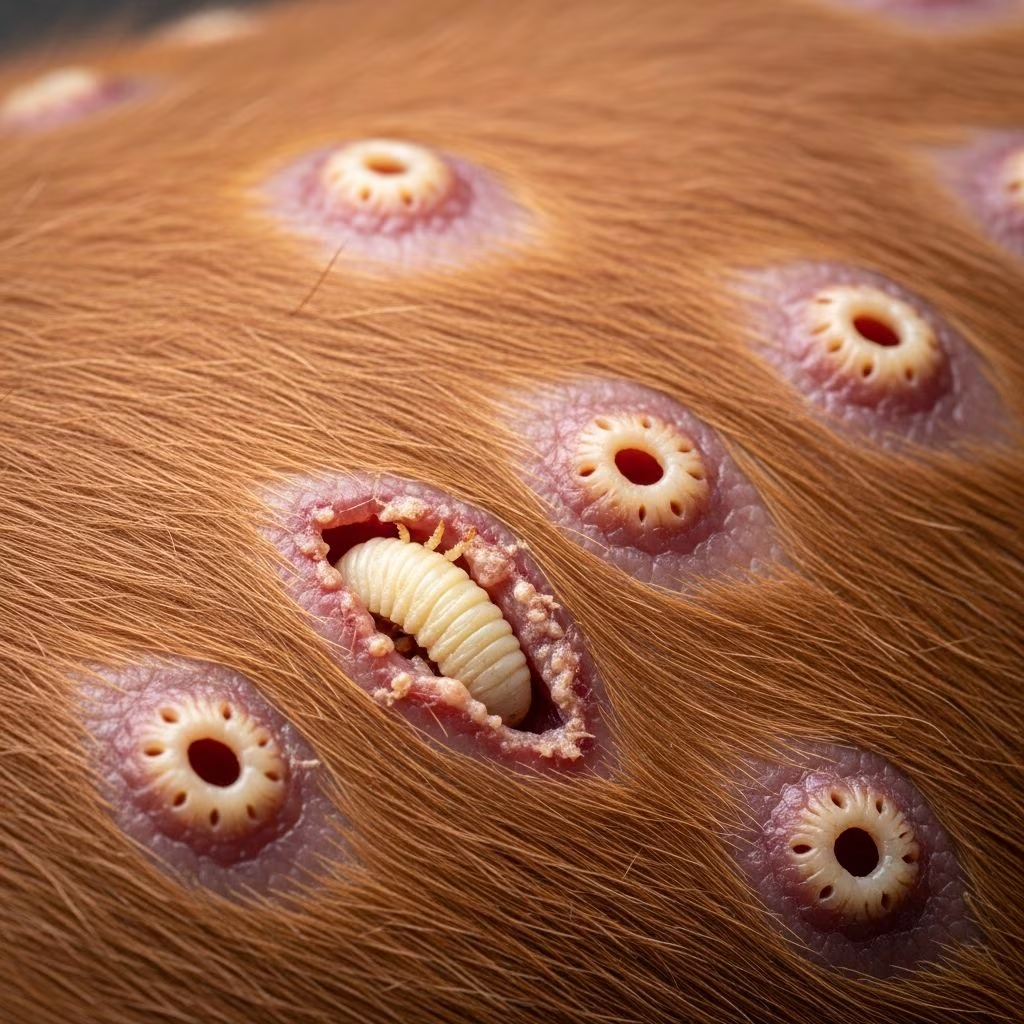
Cattle grubs, caused by flies of the genus Hypoderma, represent a significant parasitic challenge for ruminant health worldwide. These pests, particularly Hypoderma bovis and Hypoderma lineatum, inflict damage through larval migration in host tissues, leading to warbles and economic losses in cattle production.
Biological Profile of Hypoderma Species
The primary culprits in cattle infestations are H. bovis, known as the northern cattle grub, and H. lineatum, the common cattle grub. Adult flies resemble large, hairy bees, measuring about 15 mm in length, and are active in spring and early summer. These flies target cattle, water buffalo, and occasionally other ruminants like yaks, reindeer, deer, horses, sheep, goats, and even humans in rare cases.
Geographically, Hypoderma thrives between 25° and 60° latitude in the Northern Hemisphere, spanning North America, Europe, Africa, and Asia. While macrocyclic lactones have nearly eradicated clinical cases in North America and parts of Europe, the parasite persists in resource-limited regions of North Africa and Asia.
Life Cycle Stages: From Egg to Warble
The Hypoderma life cycle is intricate, spanning nearly a year and involving dramatic migrations within the host. It begins with egg-laying on cattle hairs, especially on legs and lower body.
- Adult Oviposition: H. lineatum lays eggs in clusters of 3–10 per hair, while H. bovis deposits them singly. Eggs hatch in 4–7 days, and first-instar larvae (L1) penetrate the skin, causing irritation.
- L1 Migration: Larvae burrow into subcutaneous tissues, traveling up legs toward the body core. H. lineatum heads to the esophagus wall, growing to 12–15 mm; H. bovis migrates to the spinal canal’s epidural fat.
- Resting Phase: Larvae remain dormant through summer and fall, resuming activity in early winter.
- L2–L3 Development: They move to the back’s subcutaneous tissue, forming breathing holes (warbles). Second-instar (L2) and third-instar (L3) larvae create fist-sized nodules with yellow pus. L3 larvae are identifiable: H. bovis (27–28 mm, no spines on segment 10, funnel-shaped spiracles); H. lineatum differs in morphology.
- Emergence: Mature L3 drop out in spring to pupate in soil, emerging as adults.

Image: Illustrative life cycle of cattle grubs showing key migration paths.
Pathological Effects on Infected Animals
Hypoderma larvae cause multifaceted damage beyond visible warbles (1 to over 300 per animal, typically under 100). Young cattle suffer most, as adults develop partial immunity.
| Stage | Primary Damage | Species-Specific Impact |
|---|---|---|
| L1 Migration | Skin penetration irritation, tissue disruption | Both species |
| Resting (Esophagus/Spine) | Fat necrosis, inflammation, periostitis, osteomyelitis | H. bovis: Spinal damage; H. lineatum: Esophageal lesions |
| Warble Formation | Granulomatous reactions, hide damage | Back nodules reduce leather quality |
Dead larvae can trigger anaphylactic reactions or fatalities, though rare. Economic toll includes reduced weight gain, milk yield, and hide value—up to 20% depreciation from warble scars.
Clinical Signs and Diagnosis Methods
Early signs are subtle: cattle exhibit “gadding”—restless fleeing from invisible flies due to conditioned fear. Winter brings back lumps; spring reveals open warbles with breathing holes and larval movement.
Diagnosis relies on:
- Visual/palpation of warbles along dorsal/lumbar regions.
- Larval extraction and morphological ID (size, spines, spiracles).
- Historical prevalence in endemic areas.
Differential includes abscesses or other myiases, but Hypoderma’s migration history is distinctive.
Prevention Strategies for Herd Managers
Proactive measures curb infestations:
- Timing Awareness: Fly activity peaks spring/summer; monitor calendars by latitude.
- Herd Management: Avoid stressing cattle (castration, transport) during treatment windows.
- Environmental Controls: Soil disruption in fly breeding areas, though challenging.
- Vaccination Research: Extracts like hypodermin A show promise for immunity, reducing larval burdens in older cattle.
Treatment Options: Parasiticides and Application
Modern controls target all stages with macrocyclic lactones (ivermectin, doramectin), effective against L1–L3. Salicylanilide closantel treats L2–L3 in beef cattle.
- Pour-Ons: Apply along back midline; avoid wet conditions or rain within 6 hours. Clean application sites essential.
- Injections: Systemic delivery for migrating larvae.
- Timing: Treat post-resting phase (late fall/early winter) to avoid killing L1 in critical sites, preventing fatal reactions.
Integrated pest management combines chemicals with monitoring for sustainable control.
Economic and Global Perspectives
In developed regions, prevalence is low due to parasiticide use, but outbreaks occur in untreated herds. Developing areas face ongoing losses; education on timely interventions is key. Bison, water buffalo, and yaks also suffer, broadening zoonotic concerns.
FAQs on Cattle Grubs
Q: Can humans get cattle grubs?
A: Rare, but possible via accidental larval contact.
Q: How many warbles indicate heavy infestation?
A: Over 100 per animal signals severe cases, common in calves.
Q: Are there natural predators for Hypoderma?
A: Limited; focus on chemical controls and hygiene.
Q: What’s the best treatment timing?
A: After L1 migration to safe sites, typically November–January.
Q: Do goats/sheep get warbles?
A: Occasionally, but larvae rarely complete development.
Future Directions in Research
Ongoing studies explore vaccines using larval proteases (hypodermins A–C) to boost immunity. Genomic sequencing may yield targeted biopesticides, reducing reliance on chemicals.
References
- Hypoderma spp – Integumentary System – Cattle Grubs — Merck Veterinary Manual. 2023. https://www.merckvetmanual.com/integumentary-system/cattle-grubs/hypoderma-spp
- Common Cattle Grub, Hypoderma lineatum (Villers) — University of Florida IFAS Extension. 2022-05-15. https://ask.ifas.ufl.edu/publication/IN146
- Biology and Control of Cattle Grubs — University of Nebraska-Lincoln Digital Commons (USDA ARS). 1985. https://digitalcommons.unl.edu/cgi/viewcontent.cgi?article=2057&context=usdaarsfacpub



