

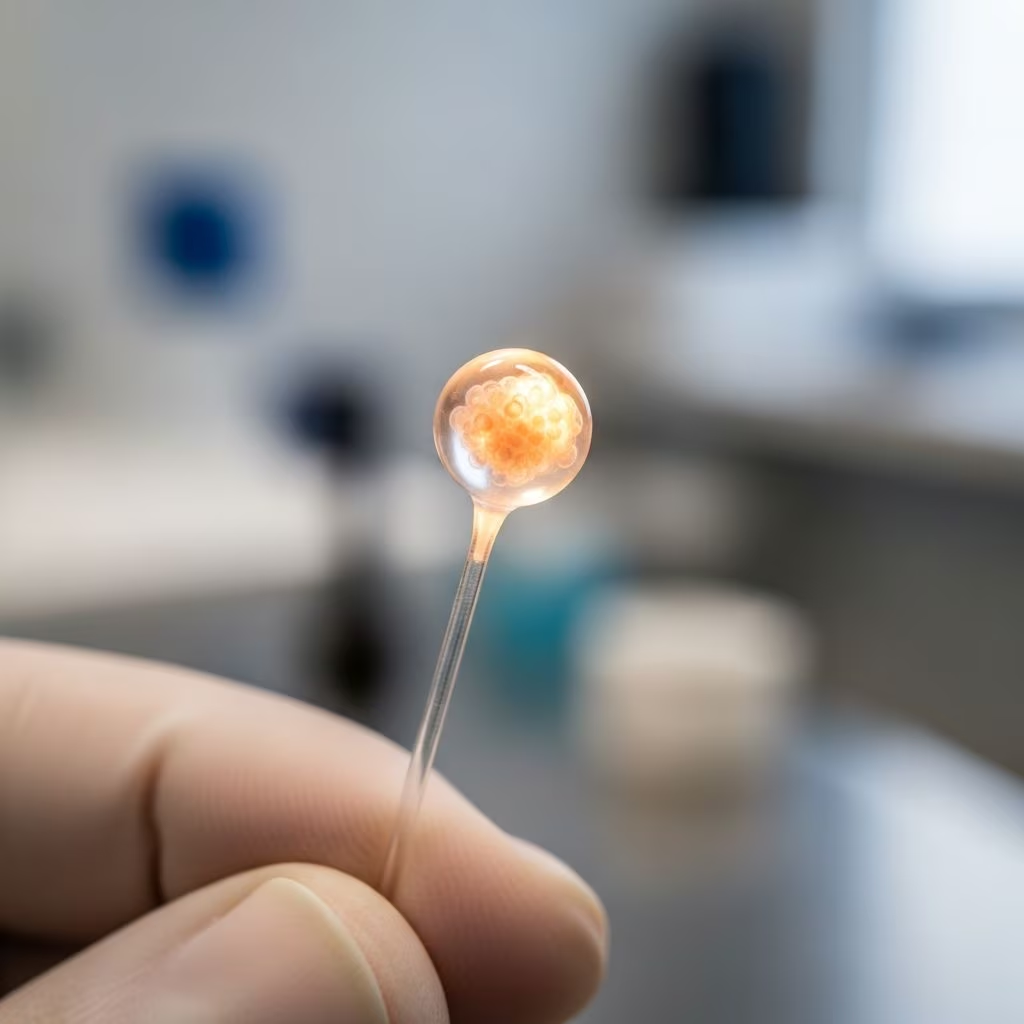
Embryo transfer in cattle revolutionizes genetic improvement by allowing elite females to produce far more offspring than natural limits permit. This technology multiplies the genes of top donors, accelerating herd progress in traits like milk yield, growth rate, and disease resistance.
Fundamentals of Bovine Reproductive Biotechnology
At its core, embryo transfer involves harvesting embryos from genetically superior donor cows and implanting them into synchronized recipient females. This bypasses the single-calf-per-year constraint, enabling one donor to yield dozens of calves annually. The process integrates hormonal synchronization, surgical or non-surgical collection, laboratory evaluation, and precise placement into hosts.
Key benefits include rapid dissemination of desirable genetics, reduced disease transmission risks compared to live cover, and the ability to preserve elite bloodlines via cryopreservation. Success hinges on meticulous timing, as embryos must align with the recipient’s reproductive cycle, typically at day 6-8 post-estrus when they reach the blastocyst stage.
Selecting and Preparing Donor Animals
Choosing the right donor is paramount. Opt for healthy, fertile cows or heifers with proven genetics, free from reproductive disorders, and in prime body condition. Nutrition plays a critical role; donors require high-energy diets rich in protein, vitamins, and minerals like zinc, copper, and selenium to support superovulation and embryo quality.
- Health screening: Test for brucellosis, BVD, and neosporosis to safeguard embryos.
- Age and parity: Heifers aged 15-24 months or multiparous cows up to 12 years excel.
- Genetic merit: Prioritize animals with high EBV for production, fertility, or carcass traits.
Pre-treatment involves cycle synchronization using prostaglandins or progestins to predict estrus accurately. Donors rest 30-60 days post-calving before protocols begin.
Superovulation Protocols for Maximum Yield
Superovulation stimulates donors to release multiple oocytes per cycle, typically 10-30, versus the natural one. Follicle-stimulating hormone (FSH) is administered in declining doses over 4 days, combined with progesterone to control timing.
| Day | FSH Dose (mg) | Progesterone Device | Expected Outcome |
|---|---|---|---|
| 0 | Insert CIDR | Yes | Synchronization start |
| 7-10 | 40 / 40 / 20 / 20 | Yes | Follicle recruitment |
| 14 | PGF2α + CIDR removal | No | Estrus induction |
| 15-16 | AI x 2 | No | Fertilization |
| 22-23 | Flush | No | Embryo recovery |
This timeline yields 5-10 transferable embryos per flush on average. Variations exist for beef versus dairy breeds, with Bos indicus requiring adjusted doses due to heat tolerance.
Detailed Embryo Collection Techniques
Non-surgical uterine flushing, performed 6-8 days post-AI, recovers 70-80% of embryos. The donor receives epidural anesthesia, and the perineum is scrubbed antiseptically. A Foley catheter (16-24 Fr) with stylet navigates the cervix under rectal guidance.
- Advance catheter to uterine horn bifurcation.
- Inflate cuff with 15-30 mL air to seal cervix.
- Infuse 40-60 mL saline, massage uterus via rectum.
- Collect outflow in embryo filters (50-100 μm mesh).
- Repeat for both horns, using 2-4 L total fluid.
Post-flush, filters are processed in a lab. Embryos are searched in gridded dishes under 10-50x stereomicroscopy, washed thrice in holding medium to remove debris and pathogens.
Laboratory Processing and Quality Assessment
Recovered structures are graded by IETS standards: excellent (symmetrical blastocyst, intact zona), good (minor flaws), fair (usable but lower viability). Only top grades transfer fresh; others freeze.
Viable embryos store at room temperature in PBS + 10% fetal calf serum for 24 hours or cryopreserve in ethylene glycol. Bisection doubles numbers for twins, though pregnancy rates dip 5-10%. Sexing via biopsy adds precision for herd balancing.
IVF as an Alternative Pathway
In vitro fertilization bypasses superovulation by aspirating oocytes via ultrasound-guided OPU from live donors. Oocytes mature 24 hours, fertilize with sexed semen, and culture to day 7-8 blastocysts. Yields match or exceed flushing, ideal for repeat donors.
Synchronizing Recipients for Optimal Implantation
Recipients must match embryo age ±24 hours. Select cycling heifers/cows (BCS 5.5-6.5), palpate for normal tracts. Synchronization mirrors donors: CIDR + PGF2α + GnRH for tight estrus groups.
- Monitor heat 48-72 hours post-PGF.
- Transfer day 6-8 embryos to day 6-8 recipients.
- Choose uterine horn ipsilateral to corpus luteum.
Pregnancy rates hit 50-70% fresh, 40-60% frozen with skilled technicians.
Mastering Non-Surgical Transfer Procedures
The gold standard since 1978, non-surgical transfer uses a 0.25 mL straw in a Cassou gun. Rectal palpation threads the gun through the cervix to the horn tip.
Steps include sheathing the gun sterilely, depositing the embryo cranially, and minimizing manipulation (<2 min). Ultrasound guidance enhances precision in heifers. Surgical flank methods persist in research but risk infection.
Cryopreservation Strategies for Long-Term Storage
Freezing enables global shipping and offseason use. Direct transfer post-thaw skips culture, boosting efficiency. Vitrification or slow-freeze in glycerol/ethylene glycol yields 90% post-thaw survival, though calving rates drop 10-20% versus fresh[10].
Thaw at 30°C, dilute stepwise, load fresh straws. Ship in liquid nitrogen vapor.
Evaluating Success and Troubleshooting Failures
Pregnancy diagnosis at 28-35 days via ultrasound. Metrics: flush yield (avg 6-8), transfer rate (50-70%), return estrus (<15%). Failures trace to poor synchrony, low oocyte quality, or infections.
| Issue | Cause | Solution |
|---|---|---|
| Low flush yield | Suboptimal FSH | Adjust dose/brand |
| Embryo degeneration | Heat stress | Climate control |
| Low pregnancy | Mismatch timing | Tighter sync |
Advanced Applications and Future Directions
Embryo transfer pairs with genomics for marker-assisted selection, cloning, and chimeras. IVF with sexed semen hits 90% heifer bias. Automation in OPU and AI grading looms.
Economics favor operations: $200-400/transfer yields $1000+ calf value premium.
Frequently Asked Questions (FAQs)
What is the average number of transferable embryos per donor flush?
Typically 4-8 excellent/good embryos from superovulated cattle.
Can embryo transfer work in Bos indicus breeds?
Yes, with modified protocols for tropical climates; yields slightly lower.
How long can frozen embryos be stored?
Indefinitely in liquid nitrogen with >90% viability retention[10].
Is non-surgical transfer safe for recipients?
Highly, with <1% complications versus 5-10% surgical.
What nutrition supports best embryo outcomes?
Balanced rations with elevated zinc, selenium, copper minerals.
References
- Steps of Bovine In-Vitro Fertilization (IVF) — ETSchool. Accessed 2026. https://etschool.com/Steps-of-Bovine-In-Vitro-Fertilization-IVF.asp
- Embryo Transfer in Cattle — Merck Veterinary Manual. Accessed 2026. https://www.merckvetmanual.com/management-and-nutrition/embryo-transfer-in-farm-animals/embryo-transfer-in-cattle
- Embryo Transfer in Cattle — University of Arkansas Extension (FSA-3119). 2018. https://www.uaex.uada.edu/publications/PDF/FSA-3119.pdf
- Transfer of Embryos (Chapter 8) — FAO Animal Reproduction Training Manual. Accessed 2026. https://www.fao.org/4/t0117e/T0117E08.htm
- Embryo Transfer: Beef (Video Transcript) — YouTube/AgSmartTV. Accessed 2026. https://www.youtube.com/watch?v=Roh-goM-czo
- IVF – A Beginner’s Guide & Timeline — Trans Ova Genetics. 2021-07. https://transova.com/2021/07/ivf-a-beginners-guide-timeline
- Embryo Transfer 101 with a Technical Slant — Kansas State University Veterinary. Accessed 2026. https://www.vet.k-state.edu/academics/student-faculty-handbook/studentorgs/aadpDocs/ChrisFriedel.pdf



