

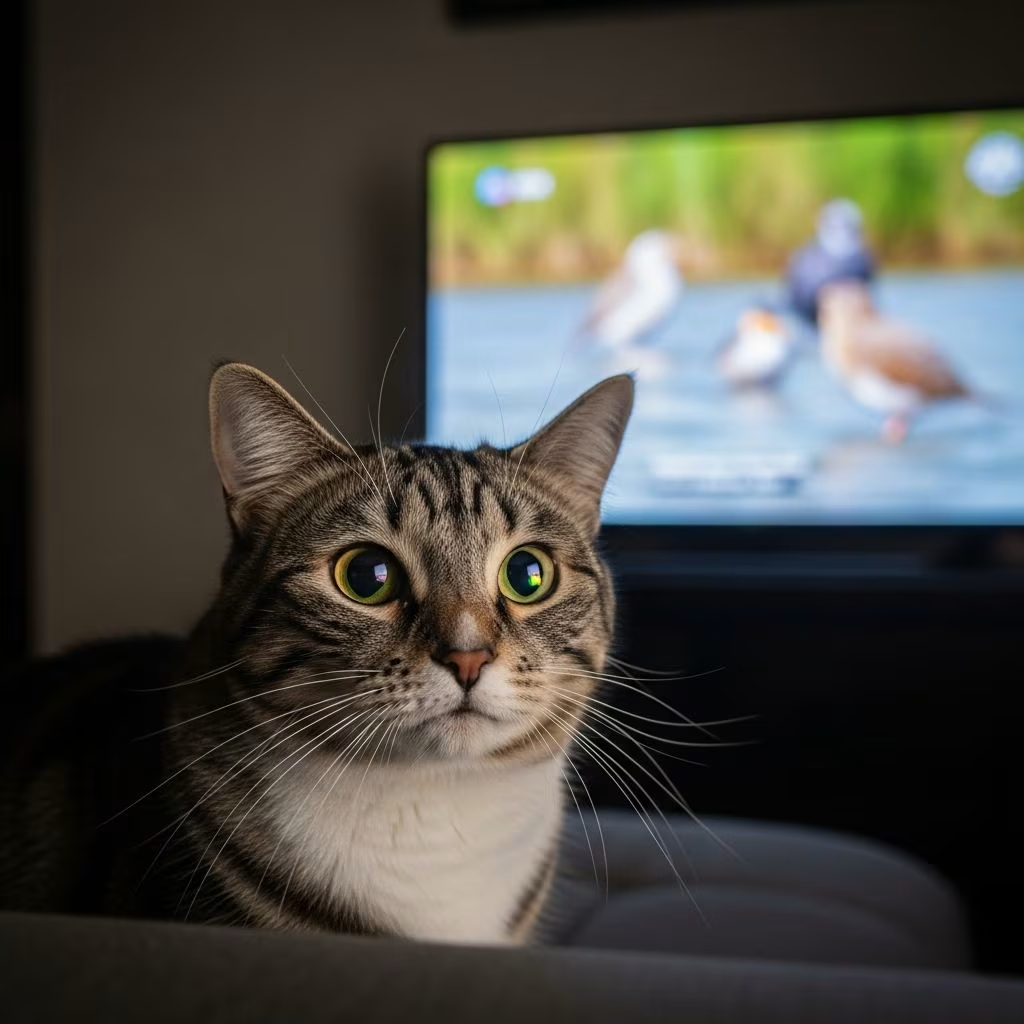
Pet owners frequently observe their cats staring intently at television screens, sometimes with apparent fascination and other times with complete indifference. This common behavior raises an important question: do cats genuinely perceive what appears on the screen, or are they simply responding to visual and auditory stimuli without true comprehension? Understanding how cats interact with television requires examining their unique sensory capabilities and the limitations of their cognitive processing.
The Reality of Feline Television Viewing
The straightforward answer is that cats can perceive television in a limited way, though their experience differs fundamentally from human viewing. Cats detect movement and color on screens, but they lack the cognitive framework to process these images into meaningful narratives or entertainment value as humans do. When a cat watches a bird flutter across the television screen, it doesn’t appreciate the beauty of the creature or follow a storyline; instead, its brain registers only the basic components: movement, size potential, and hunting opportunity.
This distinction matters for cat owners trying to determine whether television serves as genuine enrichment or merely fleeting distraction. The answer lies in understanding the specific biological and behavioral characteristics that make cats responsive to certain types of content while leaving them indifferent to others.
Understanding Feline Vision and Color Perception
A cat’s visual system operates through a sophisticated biological process that begins the moment light strikes the eye. When photons enter the eye, they hit the retina, where specialized cells called cones and rods convert light into electrical signals. These signals travel to the brain, allowing cats to construct visual representations of their environment.
The cone cells in a cat’s eye provide what veterinarians describe as excellent visual acuity and binocular vision. These cells also enable color perception, though cats see a more limited color palette than humans. While humans can distinguish numerous shades across the visible spectrum, cats perceive primarily red, green, and blue. This means television programs featuring these primary colors, particularly those designed for children with bright, vivid imagery, naturally attract feline attention more than programs with muted or complex color schemes.
What cats possess in abundance relative to humans are rod cells, which excel in low-light conditions. This adaptation allowed their wild ancestors to hunt effectively during twilight hours. As a result, cats can see with clarity in dim lighting conditions that would leave humans essentially blind, achieving vision up to six times superior to humans in such environments. This heightened night vision explains why cats might be drawn to television in darker rooms, where the screen’s luminescence provides enhanced contrast against their surroundings.
The Critical Role of Auditory Perception
While vision provides the foundation for television engagement, a cat’s hearing proves equally, if not more, important in determining whether it remains interested in what appears on screen. Cats possess one of the most sophisticated auditory systems among domestic animals, capable of detecting sounds at frequencies and distances that exceed human capabilities.
The precision of feline hearing is remarkable. A cat positioned just three feet from a sound source can pinpoint its origin within a few inches in less than one-tenth of a second. Additionally, cats hear sounds at distances four to five times farther than humans can detect. This exceptional auditory capability means that when a television program includes natural sounds—bird calls, rodent squeaks, rustling leaves—cats immediately recognize these as potential prey indicators and respond accordingly.
This explains why cats show heightened interest in nature documentaries, videos featuring birds and small animals, or programming with sudden, sharp sounds. The audio component essentially triggers hunting instincts that have remained largely unchanged since cats were solitary predators in the wild.
Behavioral Responses and Hunting Instincts
Observing cat behavior while watching television reveals the deep connection between what they perceive on screen and their instinctive responses. Many cat owners report their pets attempting to paw at the television screen, chirping or chattering, and tensing their bodies as though preparing to pounce. These behaviors directly reflect hunting preparations rather than entertainment appreciation.
Cats typically hunt small prey including birds, rodents, and fish. Television content featuring these animals naturally activates predatory responses. When a program combines visual movement with realistic hunting-related sounds, a cat’s brain essentially enters hunting mode, even though the cat quickly recognizes that the prey on the screen cannot be physically reached.
Interestingly, individual cats display varying degrees of engagement with television, depending on their inherited hunting drive. Some cats become intensely focused and reactive, while others watch with calm detachment, and still others ignore television entirely. This variation reflects differences in temperament and the strength of individual hunting instincts rather than differences in visual or auditory ability.
Content Preferences and Television Categories
Research examining cat preferences provides insights into what actually captures and maintains feline attention. Studies tracking how long cats look at various types of content reveal that cats spend relatively little time watching television overall, averaging only about 6% of observed time looking at screens. However, this attention increases significantly when programs feature movement, whether the motion comes from animated objects or living animals.
Cats show markedly reduced interest in programs featuring primarily human activity or static scenes. This makes sense given that humans move more slowly and predictably than typical prey animals, and the sounds associated with human activity rarely trigger hunting responses. Additionally, research suggests that cats experience habituation to television content, watching new programming more intently during the first hour of exposure but decreasing their attention as the same content continues.
Videos specifically created for cats, typically featuring birds, mice, and other small creatures with jerky, rapid movements, capture attention more effectively than general entertainment programming. The frame rates and flicker characteristics of modern flat-screen televisions may also influence cat perception compared to older CRT technology, though research on this aspect remains limited.
The Question of Cat Recognition and Understanding
A fascinating question emerges when considering whether cats recognize images on television as representing real objects. Some cats show interest in programming featuring other cats, though researchers have not definitively determined whether cats visually recognize other felines on screen or whether they understand the images represent real animals.
The role of scent perception proves crucial in this context. Cats rely heavily on olfactory information to identify individuals and determine threat levels. With over 200 million scent receptors compared to humans’ 5 million, cats gather enormous amounts of information from smell. When a cat views another cat on television, it detects no scent cues, which likely prevents the viewing experience from triggering territorial responses or fear that a neighbor cat might provoke. This explains why cats generally show minimal negative reactions to seeing other cats on screen—they unconsciously recognize that something essential for threat assessment is missing.
Television as Environmental Enrichment
The question of whether television provides meaningful enrichment for cats requires careful consideration. While cats clearly perceive and react to television content, the enrichment value remains limited and temporary. Cats exhibit short attention spans with television, typically losing interest after brief viewing periods. This suggests that while television might provide momentary stimulation, it shouldn’t serve as a primary enrichment strategy for indoor cats.
Some researchers propose that television functions as a “false window” for cats, similar to how aquariums provide visual interest. Like looking out an actual window, cats may find television watchable without understanding its nature as a mediated image. However, unlike genuine windows where cats can detect outdoor prey they might realistically hunt or observe natural movements, television remains fundamentally inaccessible and ultimately frustrating as a hunting outlet.
Factors Influencing Individual Cat Interest
Not all cats respond equally to television. Several factors influence whether a particular cat will show sustained interest in screen content:
- Strength of individual hunting instinct, which varies genetically among cats
- Age and energy levels, with younger, more active cats potentially more responsive
- Previous exposure to television and habituation effects
- Specific content characteristics including color, movement speed, and audio elements
- Environmental context, including room lighting and screen distance
- Individual personality and temperament traits
Recommendations for Cat Owners
For owners interested in providing television-based enrichment, certain strategies can maximize potential interest:
- Select content featuring fast-moving animals, particularly birds and rodents
- Ensure the television uses modern display technology with higher frame rates and reduced flicker
- Consider dedicated “cat videos” created specifically to appeal to feline sensory preferences
- Limit television exposure, as cats quickly habituate and lose interest
- Recognize that television should supplement, not replace, interactive enrichment activities
- Monitor your individual cat’s response rather than assuming all cats respond uniformly
The Limitations of Feline Cognitive Processing
While cats demonstrate sophisticated sensory abilities, their cognitive capabilities don’t extend to the abstract thinking television viewing requires in humans. Cats cannot follow narrative storylines, appreciate character development, or understand cause-and-effect relationships as depicted on screen. Their brain processes television primarily as a collection of sensory stimuli triggering instinctive responses rather than as entertainment with meaning or emotional content.
This fundamental difference separates cat viewing from human entertainment consumption. When humans watch television, we engage complex cognitive processes including memory, prediction, and emotional investment. Cats experience something far more basic—a sensory experience that may or may not align with their immediate interests and instincts.
Modern Television Technology and Cat Perception
The evolution of television technology may have implications for feline viewing experience. Older CRT televisions operated at lower frame rates with noticeable flicker, potentially making images appear unstable or unclear to cats. Modern flat-screen televisions display content at higher frame rates with minimal flicker, which may render images more stable and realistic from a cat’s perspective. Research on shelter cats and television preferences suggests that newer technology might be more engaging for cats, though definitive scientific conclusions remain preliminary.
Frequently Asked Questions
Can cats actually see what’s on the television?
Yes, cats can perceive images on television screens. However, their visual experience differs from humans due to their limited color palette (reds, greens, and blues) and different perception of motion. Cats see clearly in the television’s general light conditions but don’t process content with human-like comprehension.
Why do some cats watch TV while others ignore it?
Individual variation in hunting drive, temperament, and personality explains these differences. Additionally, the specific content matters significantly—cats show more interest in programs featuring movement and animal sounds that trigger their hunting instincts.
Is leaving the TV on good for cats?
Leaving television on continuously provides limited enrichment value and may become background noise without genuine engagement. Cats quickly habituate to the same content, watching less intently as time progresses. Interactive play and environmental enrichment prove more beneficial.
Do cats understand that TV images aren’t real?
Cats don’t conceptually understand that television displays images. Instead, they likely perceive television as a “false window” that provides visual and auditory stimulation without actual tactile or scent information. This gap in sensory information may prevent them from becoming frustrated by the inaccessibility of screen content.
What type of TV content do cats prefer?
Cats show the strongest interest in content featuring rapid movement, particularly animals like birds and rodents. Natural sounds such as bird calls and rustling trigger greater attention than programs featuring primarily human activity or dialogue.
References
- Can Cats See TV? — Hill’s Pet Nutrition. https://www.hillspet.com/cat-care/behavior-appearance/can-cats-see-or-watch-tv
- Can Cats Understand TV? — Wag Walking. https://wagwalking.com/sense/can-cats-understand-tv
- Does Your Cat Like to Watch TV? — What Your Cat Wants. https://whatyourcatwants.com/does-your-cat-like-to-watch-tv
- How Cats See TV (The Science Will Shock You) — YouTube. https://www.youtube.com/watch?v=OL1fEuutcZs
- Is Your Pet Actually Watching TV With You? — Northeastern University News. 2025-03-20. https://news.northeastern.edu/2025/03/20/is-your-pet-watching-tv/



