

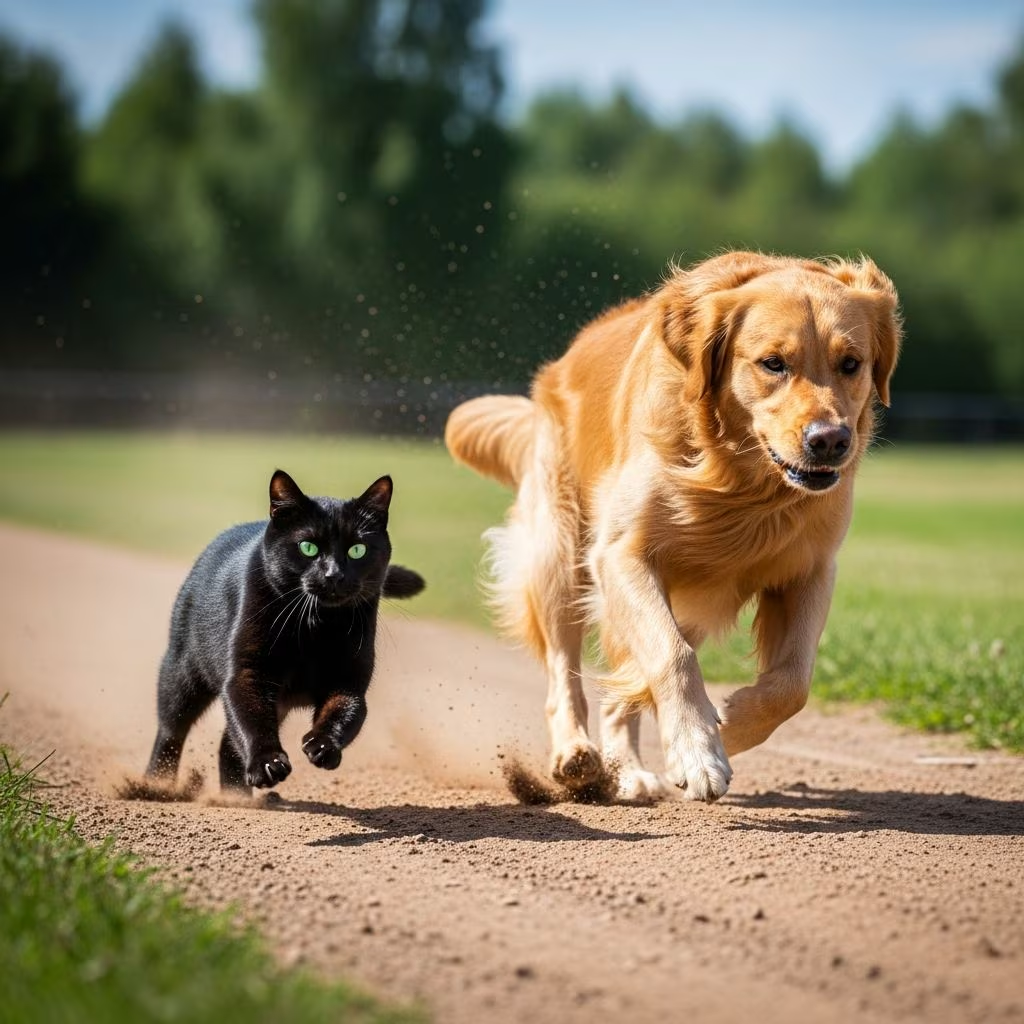
Pet owners often ponder whether their agile cat could outpace their energetic dog in a backyard chase. This comparison hinges on multiple factors like body structure, breed genetics, and purpose-built physiology. While domestic cats edge out average dogs in quick sprints, elite dog breeds like Greyhounds dominate top speeds, and wild cheetahs leave all competitors behind.
Understanding Animal Speed Basics
Speed in mammals arises from muscle power, skeletal design, and aerobic capacity. Cats rely on explosive power for short pursuits, thanks to flexible spines and lightweight frames that enable rapid acceleration. Dogs, conversely, vary widely: some excel in bursts, others in sustained trots over distances, supported by stronger endurance from larger hearts and lungs. Factors such as leg length, paw grip, and weight distribution play crucial roles. For instance, longer limbs propel Greyhounds forward, while cats’ retractable claws provide traction for sudden stops and turns.
Average Domestic Speeds: Cats Take the Lead
Typical household cats clock around 30 mph in short dashes, leveraging their nimble builds for household escapades. This agility stems from powerful hind legs and a spring-like spine that compresses and releases like a coiled spring. Everyday dogs average 12-20 mph, with many breeds like Labradors or Beagles prioritizing stamina over velocity. In a 50-yard sprint, your tabby might dust the family mutt, but over a mile, the dog pulls ahead due to better fatigue resistance.
- Cat advantages: Burst acceleration, sharp turns, vertical leaps.
- Dog advantages: Longer strides, sustained pace, pack hunting endurance.
Wild Kings of Velocity: Cheetah Supremacy
No discussion of cat speed omits the cheetah, Earth’s sprint champion at 60-75 mph in brief 300-meter chases. Their semi-retractable claws act like cleats, long tails stabilize high-speed maneuvers, and enlarged nasal passages fuel oxygen demands. Cheetahs accelerate from 0-60 mph in three seconds, outstripping sports cars, but overheat after 20-30 seconds, collapsing to recover. This predator-prey adaptation highlights cats’ specialization in ambush hunting over marathon pursuits.
Top Dog Breeds: Greyhound Glory
Greyhounds reign as the fastest canines, hitting 40-45 mph with aerodynamic bodies, deep chests for oxygen, and whip-like tails for balance. Bred for centuries to chase game, they reach peak velocity almost instantly, unlike cheetahs’ gradual buildup. Salukis and Whippets follow closely at 35-40 mph, their lean frames echoing ancient desert hunters. These sighthounds prioritize flat-out racing over agility, making them track stars but less adept at rough terrain.
| Breed | Top Speed (mph) | Strength |
|---|---|---|
| Greyhound | 45 | Instant acceleration, racing |
| Saluki | 42 | Endurance in heat |
| Whippet | 40 | Compact power |
| Border Collie | 30 | Herder agility |
| German Shepherd | 30 | Versatile pursuit |
This table showcases elite dog speeds, drawn from breed standards and observed races. Note how speeds drop for working breeds focused on utility over pure pace.
Fastest House Cats: Agile Household Sprinters
Among pets, the Egyptian Mau leads at 30 mph, its spotted coat belying cheetah-like athleticism from ancient Egyptian lineage. Abyssinians and Bengals match this with bounding gaits and muscular builds suited for climbing and pouncing. These breeds retain wild traits, darting at blurring speeds across floors or fences. Unlike dogs, cat speed emphasizes verticality—leaping 5-6 feet high aids evasion. Domestic limits cap at 30 mph due to smaller size versus wild relatives.
| Breed | Top Speed (mph) | Notable Trait |
|---|---|---|
| Egyptian Mau | 30 | Spotted agility |
| Abyssinian | 28-30 | Playful endurance |
| Bengal | 28 | Wild hybrid vigor |
| Domestic Shorthair | 25-30 | Everyday quickness |
Breed Matchups: Head-to-Head Analysis
Pitting averages, cats win short races under 100 yards. Against speedy dogs like Vizslas (40 mph), however, canines prevail due to stride length. Size matters: a Chihuahua (15 mph) loses to any cat, but a Greyhound crushes even Mäus. Terrain shifts dynamics—cats navigate obstacles better, dogs handle open fields. Fitness, age, and training amplify individual potentials; obese pets lag regardless of genetics.
Short Sprint (50m)
- Winner: Cat (explosive start)
- Example: Tabby vs. Bulldog—cat by 10 lengths.
Endurance Run (1km)
- Winner: Dog (stamina edge)
- Example: Bengal vs. Labrador—dog finishes strong.
Physiological Secrets Behind the Speeds
Cats’ fast-twitch muscles favor glycolysis for anaerobic bursts, ideal for pounces. Dogs blend fast- and slow-twitch fibers for mixed performance. Cheetahs’ spines flex 150 degrees per stride, storing elastic energy like a pogo stick. Greyhounds’ 200+ bones in lithe frames minimize drag, with hearts twice human size proportionally. Evolution shaped these: cats for solitary stalks, dogs for cooperative hunts requiring staying power.
Practical Implications for Pet Owners
Knowing speeds informs play and exercise. Provide cats high perches and laser toys for sprints; dogs need trails for trotting. Racing events like Greyhound tracks or cat agility competitions highlight breeds’ potentials safely. Health checks ensure joints support speeds—overexertion risks injury in speed demons.
FAQs: Speed Myths Busted
Can my indoor cat really hit 30 mph?
Yes, in straight-line bursts across open spaces; furniture limits demos.
Is a Greyhound faster than a cheetah?
No, cheetahs peak higher (60+ mph) but tire quicker; Greyhounds sustain 40-45 mph longer.
What slows down fast breeds?
Age, weight gain, poor diet, or injuries; regular vet care maintains peak form.
Do bigger dogs always run faster?
No, sighthounds’ slenderness trumps bulk; Mastiffs top 20 mph despite size.
Can I train my pet to run faster?
Somewhat—conditioning builds muscle, but genetics set ceilings.
Debunking Common Misconceptions
Myth: All dogs outrun all cats. Reality: Averages favor cats in sprints, but outliers flip it. Myth: Cheetahs run marathons. Reality: They’re sprinters only, panting post-chase. Appreciate each species’ niche: cats for finesse, dogs for versatility.
References
- Are Cats Faster Than Dogs? Vet-Verified Facts & Explanation — Catster. 2023. https://www.catster.com/lifestyle/are-cats-faster-than-dogs/
- Which Is Faster: Cats Or Dogs? – PetGuide360.com — YouTube (PetGuide360). 2023. https://www.youtube.com/watch?v=drvUuKcU2ZA
- How the World’s Fastest Cat Compares to the World’s Fastest Dog — Labroots. 2023. https://www.labroots.com/trending/plants-and-animals/16800/worlds-fastest-cat-compares-to-worlds-fastest-dog
- Which is Faster—A Cat or a Dog? — East Valley Animal Hospital. 2023. https://www.eastvalleyanimal.com/faster-cat-dog/
- How Fast Can Dogs Run? Running Speeds By Breed — Rover.com. 2025. https://www.rover.com/blog/how-fast-can-a-dog-run/



