

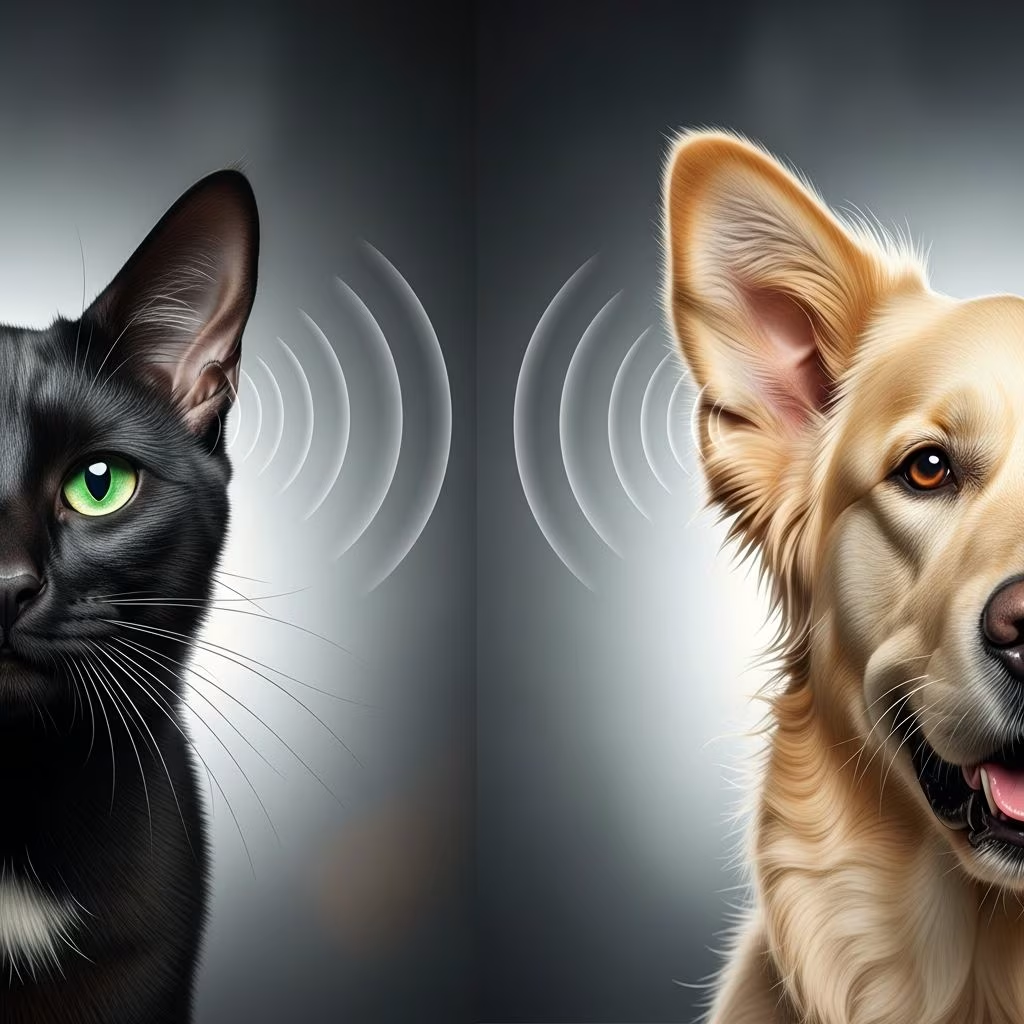
Domestic cats possess a superior auditory system compared to dogs, excelling in high-frequency detection, sound localization precision, and overall sensitivity, adaptations honed for stealthy predation on small rodents.
The Anatomy of Feline and Canine Ears
Cat ears feature a cone-shaped pinna that amplifies incoming sound waves, particularly in the 2,000 to 6,000 Hz range, boosting signals by two to three times and enabling detection from up to 50 meters away. This external structure rotates up to 180 degrees independently, powered by 30 muscle sets for fine-tuned directional adjustments. Dogs, while equipped with mobile auricles for sound source pinpointing, lag with fewer muscles—typically 18—limiting their swivel range and amplification efficiency.
Internally, both species share a similar middle and inner ear setup to humans, but felines optimize for ultrasonic prey noises. The cat’s tympanic membrane vibrates more responsively to faint rustles, channeling them through ossicles to the cochlea, where specialized hair cells transduce high pitches. Canine cochbasae prioritize broader mid-range detection suited to pack communication over solitary hunts.
- Pinna amplification: Cats boost 2-6 kHz by 2-3x; dogs focus on localization via movement.
- Muscle count: 30 in cats vs. 18-21 in dogs for superior mobility.
- Rotation capability: 180 degrees in felines; less in canines.
Hearing Frequency Ranges Compared
Cats detect sounds from 45 Hz to 64,000 Hz, surpassing human limits (20 Hz-20 kHz) and canine capabilities (20 Hz-60 kHz). This edge allows cats to perceive the ultrasonic squeaks of mice at 60-100 kHz, inaudible to dogs beyond 45 kHz. Dogs excel in lower mid-frequencies for tracking distant howls, but falter at the high end where feline prey emits distress calls.
| Species | Low End (Hz) | High End (Hz) | Key Advantage |
|---|---|---|---|
| Humans | 20 | 20,000 | Balanced speech range |
| Dogs | 20 | 60,000 | Distance detection |
| Cats | 45 | 64,000 | High-pitch prey sounds |
At the upper octave, cats hear 1.6 times beyond humans and one full octave above dogs, pinpointing sources within three inches at three feet distance. Puppies start deaf, developing hearing around day 21, reaching four times human strength but never matching feline highs.
Sensitivity and Distance Detection
Feline ears act as satellite dishes, capturing faint peeps four to five times farther than human perception. Cats judge sound travel distance and origin with millimeter accuracy, vital for pouncing on hidden rodents. Dogs, though sensitive, prioritize volume over nuance, reacting strongly to cat vocalizations in interspecies studies.
Research confirms cats’ greater overall sound sensitivity, rooted in predatory ancestry targeting high-frequency emitters like rodents. Loud environments risk feline auditory damage more than canines due to this acuity.
Hunting Applications of Superior Hearing
In the wild, cats leverage audition for nocturnal stalks, localizing rustles under foliage. Domestic breeds retain this, swiveling ears to triangulate can openers or kibble shakes from rooms away. Dogs rely more on olfaction and vision for retrieval, their ears aiding pack alerts over precision strikes.
- Hunting mice: Cats tune to 60+ kHz squeals; dogs miss them.
- Household cues: Felines detect fridge hums or toy squeaks dogs overlook.
- Predator avoidance: High-pitch vigilance warns of birds or insects.
Domestic Implications for Pet Owners
Household noises like vacuums trigger stronger canine stress, per soundscape surveys categorizing 79 dog-reactive sounds. Cats, ultrasensitive, may flee fireworks or alarms piercing their range. Audiometric screening should use broad-spectrum tones to cover frequency-dependent losses, avoiding overlaps in tests like clickers or bells.
For multi-pet homes, dogs respond most to cat audio cues over visuals or scents, with cat-killers fixating longer on meows. Play high-pitch toys to engage felines without overstimulating canines.
Age-Related Hearing Decline
Both species suffer presbycusis, but cats lose high-frequency acuity first, mimicking human patterns. Regular vet checks via behavioral responses (e.g., to squeaky toys) detect early loss. Dogs show U-shaped audiograms, poorest at extremes, with emotional sensitivity varying independently of thresholds.
Training and Enrichment Through Sound
Harness cat hearing with ultrasonic clickers for recall training, undetectable to dogs. Enrich environments with varied pitches: birdsong recordings for felines, bass rumbles for hounds. Avoid prolonged loud music, as it harms cat cochleae more.
FAQs
Can cats hear dog whistles?
Yes, many dog whistles (23-54 kHz) fall within cat range up to 64 kHz, though ultra-high ones may exceed.
Do deaf kittens recover hearing?
No, congenital deafness is permanent; monitor breeds like white cats prone to it.
Which hears footsteps better?
Dogs detect low-frequency thuds from farther; cats excel at high-pitch scratches.
How to test pet hearing at home?
Use apps with sweeping tones from 100 Hz to 50 kHz; note ear flicks or head turns.
Are cats bothered by TV more than dogs?
Often yes, due to amplified highs; choose pet-specific channels with balanced audio.
Protecting Your Pet’s Ears
Minimize exposure to volumes over 85 dB, especially highs for cats. Groom ear flaps regularly to prevent infections muffling sound. Nutritional support with antioxidants may slow age decline, though evidence is preliminary.
References
- Dogs Vs. Cats: A Comparison of the 5 Senses — Midoricide. 2023. https://www.midoricide.com/blogs/midoricide-blog/dogs-vs-cats-a-comparison-of-the-5-senses
- Do Cats Hear Better Than Dogs? — Virbac US. 2023. https://us.virbac.com/home/resources/blog/pagecontent/the-buzz-and-bark-from-virbac/do-cats-hear-better-than-dogs
- New study examines whether dogs are feline-friendly, or not — ScienceDaily. 2017-03-07. https://www.sciencedaily.com/releases/2017/03/170307141826.htm
- How do different animals hear? — Audionova US. 2023. https://www.audionova.com/blog/hearing-health/how-do-different-animals-hear/
- Animals with the best hearing in the world — IFAW. 2023. https://www.ifaw.org/journal/animals-best-hearing-world
- The Dog Soundscape: Recurrence, Emotional Impact, Acoustics … — PMC (NCBI). 2024. https://pmc.ncbi.nlm.nih.gov/articles/PMC10812668/



