

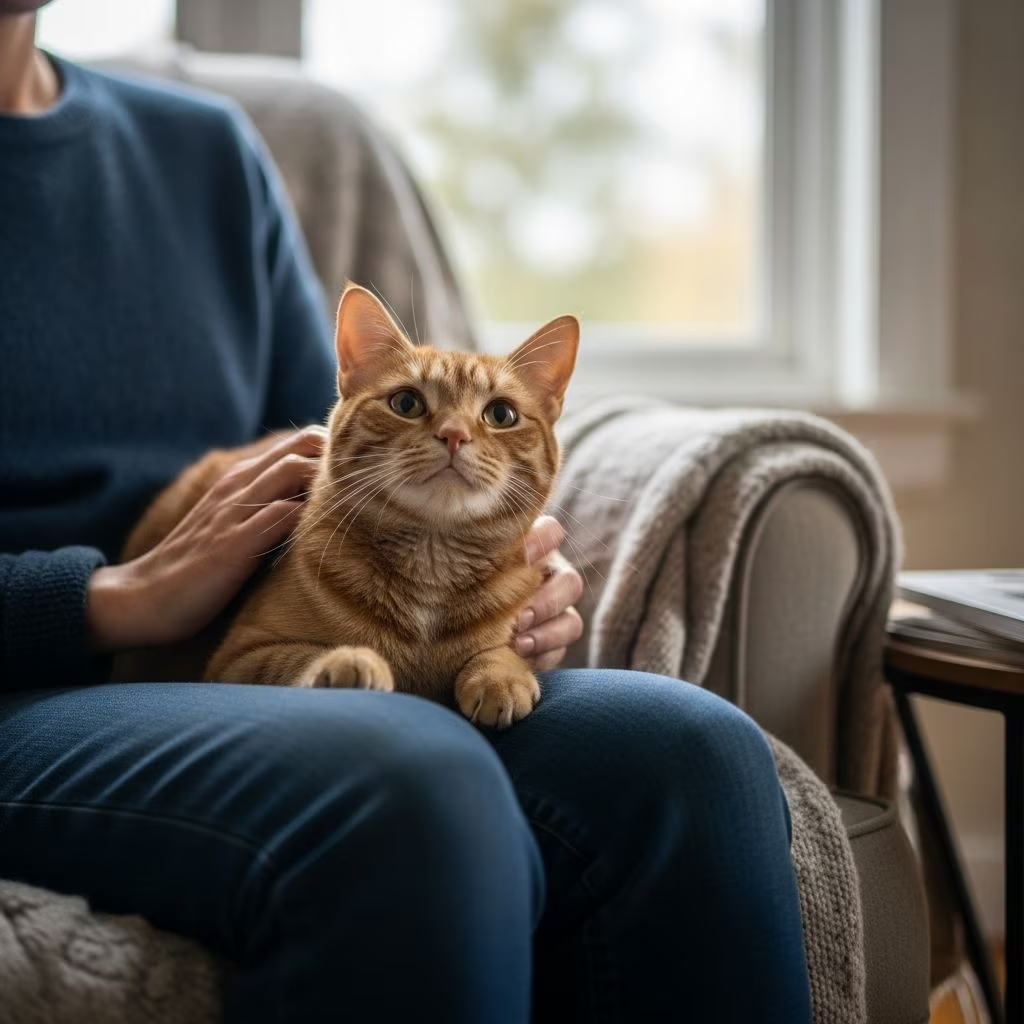
Feline companions have long been celebrated for their intuitive behaviors, and recent observations suggest they may play a vital role in supporting individuals with epilepsy by providing early warnings of oncoming seizures. This capability stems from their exceptional sensory perception, allowing them to pick up on subtle physiological changes in humans that precede epileptic events.
The Science Behind Feline Sensory Prowess
Cats possess highly developed senses that surpass human capabilities in several areas, particularly smell, hearing, and sensitivity to electromagnetic fields. Their olfactory system contains around 200 million scent receptors compared to humans’ mere 5 million, enabling detection of chemical shifts in human sweat or breath that might signal a seizure’s approach. Auditory acuity allows them to hear frequencies up to 64,000 Hz, potentially picking up on irregular heartbeats or muscle twitches imperceptible to us.
Research into animal-assisted interventions highlights how these traits enable cats to respond to human distress signals. While dogs dominate service animal roles, cats’ independent nature and similar sensory advantages make them promising candidates for informal alerting roles in home settings.
Mechanisms of Seizure Detection in Cats
Seizures involve abnormal electrical activity in the brain, often preceded by prodromal phases where autonomic changes occur, such as elevated heart rate, altered pheromone emissions, or minor tremors. Cats, attuned to their owners’ baselines, may notice these deviations through:
- Olfactory cues: Volatile organic compounds released during stress or neurological shifts.
- Behavioral precursors: Subtle changes in posture, breathing, or vocalization.
- Electromagnetic sensitivity: Some studies suggest cats respond to bioelectric fields disrupted during auras.
Anecdotal reports describe cats becoming unusually attentive, vocalizing, or positioning themselves protectively before a seizure, behaviors that align with their instinctual caregiving in multi-cat households.
Real-World Accounts of Feline Alerts
Pet owners with epilepsy frequently share stories of their cats intervening during crises. One common pattern involves the cat jumping onto the person’s chest, pawing at the face, or meowing insistently minutes before collapse. These actions not only alert nearby individuals but also provide comfort post-event. Online communities and support groups document hundreds of such instances, with some owners crediting their cats with preventing injuries by summoning help.
While not systematically trained like service dogs, these natural responses underscore cats’ potential as low-maintenance alert companions, ideal for those unable to accommodate larger animals.
Understanding Epilepsy in Cats Themselves
To appreciate cats’ detection abilities, it’s essential to examine epilepsy within felines. Epileptic seizures in cats manifest in phases: the aura (pre-seizure unease), ictus (active convulsion), and postictal (recovery period with disorientation). Focal seizures, starting in one brain area, may present as facial twitching or fly-biting, while generalized ones involve full-body convulsions. Studies indicate seizures often occur during rest or non-REM sleep, with postictal signs like aggression, excessive thirst, or ataxia aiding diagnosis.
| Seizure Type | Common Signs in Cats | Potential Causes |
|---|---|---|
| Focal | Facial twitching, salivation, staring | Idiopathic epilepsy, hippocampal issues |
| Generalized | Convulsions, paddling, loss of consciousness | Structural brain disease, metabolic |
| Status Epilepticus | Prolonged/repeated seizures | Requires emergency intervention |
Diagnosis involves ruling out reactive causes like toxins or metabolic imbalances via bloodwork, then advanced imaging such as MRI, which offers superior brain detail over CT. Interictal EEGs rarely capture abnormalities in clinical settings, complicating confirmation.
Veterinary Diagnosis and Management Strategies
For cats exhibiting seizures, a systematic approach is crucial. Begin with a detailed history and physical exam to identify systemic issues. Metabolic screening checks for hypoglycemia or electrolyte imbalances, common reactive triggers. Neurological assessment localizes lesions; multifocal signs suggest infectious or neoplastic causes.
Advanced diagnostics include:
- MRI for structural anomalies, preferred for its resolution in detecting neoplasia or inflammation.
- CSF analysis post-imaging, if no intracranial pressure risks, to check for infections.
- Infectious panels for FIV, FeLV, though rarely primary causes in neurologically normal cats.
Treatment escalates from benzodiazepines for acute clusters to long-term anticonvulsants like phenobarbital, with phenytoin showing promise in resistant cases.
Training Cats for Reliable Seizure Alerts
Unlike dogs, cats resist formal training, but positive reinforcement can enhance natural instincts. Steps include:
- Observe and note pre-seizure cat behaviors consistently.
- Reward alert actions with treats or affection during controlled simulations.
- Pair with auditory cues like alarms to generalize responses.
- Consult trainers experienced in exotic service animals.
Success varies; some cats achieve 70-80% reliability in owner trials, though scientific validation lags due to ethical training challenges.
Benefits and Limitations of Cat Assistance
Cats offer unique advantages: compact size, emotional bonding, and 24/7 availability without structured schedules. They reduce seizure-related anxiety and provide postictal solace. However, limitations include unpredictability, inability to fetch help, and legal non-recognition as service animals in many regions.
Pros and cons at a glance:
- Pros: Cost-effective, affectionate, discreet.
- Cons: Less trainable, no physical intervention capability.
Integrating Cats into Epilepsy Care Plans
For humans with epilepsy considering a cat alert system, start by documenting interactions during known seizure cycles. Veterinary neurologists can assess the cat’s health to ensure it won’t develop epilepsy itself, especially if onset occurs between 1-4 years. Collaborate with epileptologists for holistic management, combining tech wearables with pet monitoring.
Family education on interpreting cat signals maximizes utility, fostering a supportive environment.
Frequently Asked Questions
Can any cat detect seizures?
Not all cats show this ability; it depends on individual sensitivity and bonding. Breeds like Siamese, with heightened vocalization, may excel.
How accurate are cat alerts compared to dogs?
Anecdotes suggest comparable sensitivity, but dogs have more rigorous training data. Cats shine in passive home alerting.
What if my cat has seizures?
Seek immediate vet care; early intervention improves prognosis. Track episodes for pattern recognition.
Are there studies proving cats detect human seizures?
Primarily anecdotal with supportive sensory science; controlled trials are emerging.
Can I train my cat like a service dog?
Limited success; focus on encouragement rather than commands.
Future Research Directions
Ongoing studies aim to quantify cat detection via wearable tech syncing human vitals with feline behaviors. EEG correlations in cohabitating humans and cats could solidify claims. Veterinary advances in feline epilepsy, like better EEG protocols, parallel human insights.
As awareness grows, cats may gain formal roles in therapeutic support, bridging companionship with clinical utility.
References
- Epilepsy in Cats: Theory and Practice — PMC. 2016-05-26. https://pmc.ncbi.nlm.nih.gov/articles/PMC4857998/
- Epileptic seizures in cats: practical approaches to diagnosis — PMC. 2025-01-01. https://pmc.ncbi.nlm.nih.gov/articles/PMC12901927/
- ACVIM Consensus Statement on the management of status epilepticus — Wiley Online Library. 2023-01-01. https://onlinelibrary.wiley.com/doi/10.1111/jvim.16928
- Case Report: Generalized motor tonic seizures characterized by… — Frontiers in Veterinary Science. 2025-01-01. https://www.frontiersin.org/journals/veterinary-science/articles/10.3389/fvets.2025.1597258/full
- Complex partial seizures with orofacial involvement in 35 cats — SAGE Journals. 2025-01-01. https://journals.sagepub.com/doi/10.1177/1098612X251365423



