

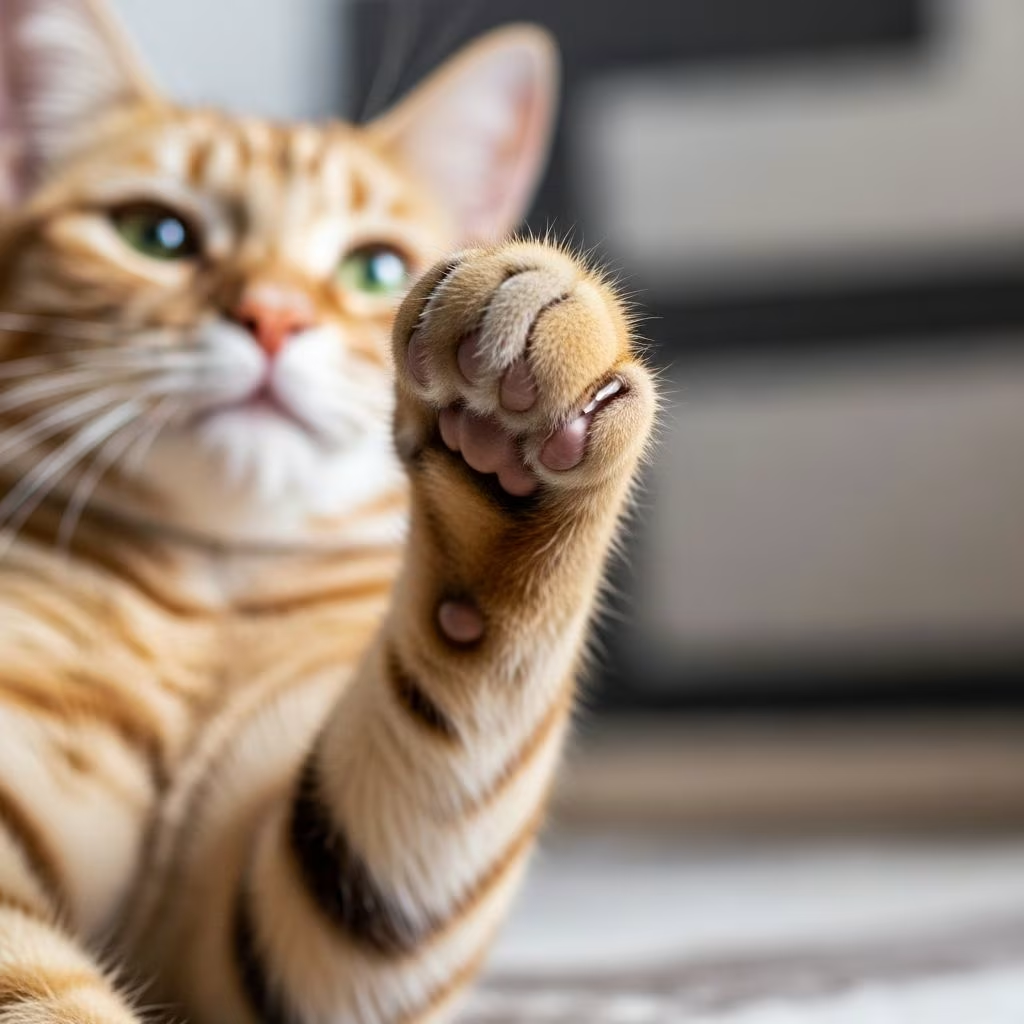
Domestic cats exhibit individual paw preferences, unlike humans’ population-level right-handedness. Research shows about 70-80% of cats have a clear paw preference for tasks like reaching for food, navigating stairs, or using the litter box, with the rest being ambilateral. Paw preference in cats correlates with gender, temperament, and cognitive abilities, offering insights into feline behavior and welfare.
How Common Is Paw Preference in Cats?
Studies consistently find that most cats display a paw preference, though it varies by task and individual. In one home-based observation of 44 cats, 73% showed preference when reaching for food, 70% when stepping down stairs, and 66% when stepping over litter box edges. Preferences were consistent across tasks for most cats.
Another study using a food-reaching test on 66 cats found 51.5% right-preferent, 36.4% left-preferent, and 12.1% ambilateral. Paw preferences remained stable over at least 10 days, with no evidence of learning bias during testing.
A review of paw preference research indicates about 80% of cats strongly prefer one paw, split evenly between left and right, while 20% are ambidextrous.
Gender Differences in Cat Paw Preference
A robust finding across studies is that paw preference differs by sex. Male cats significantly favor their left paw, while female cats prefer their right paw.
- In the Queen’s University Belfast study of 44 cats (24 males, 20 females), males showed strong left-paw preference across reaching for food, stepping down, and stepping over tasks; females favored the right paw.
- The same pattern held in a food-reaching test: females had stronger right-paw bias than males, though left-paw strength was similar between sexes.
- Additional research confirms females are substantially more right-pawed, males left-pawed, with no sleeping side preference.
These sex differences mirror patterns in other mammals but contrast human handedness, where ~90% are right-handed regardless of sex.
| Sex | Preferred Paw | Tasks Showing Preference | Source |
|---|---|---|---|
| Male | Left (strong) | Food reach (73%), stairs (70%), litter (66%) | |
| Female | Right (stronger than males) | Same tasks; consistent across |
Measuring Paw Preference: Methods and Tests
Researchers use simple, non-invasive tests to assess paw preference, often food-motivated or behavioral observations. Consistency across 50+ trials determines laterality index (LI), where higher absolute LI indicates stronger preference.
- Food Maze Tower: Treats placed in a two-level maze; cat reaches with paw recorded over 50 attempts.
- Food-Reaching Test: Food behind a small opening; paw use tallied over days.
- Home Observations: Owners monitor natural behaviors like food reaching, stair descent, litter box use.
- Lid-Opening Tests: Cats open food container lids; Easy version: 31.5% left, 26.3% right, 42.1% ambilateral; Complex: 37.5% left, 27.5% right, 35% ambilateral.
Apparatuses are zoometrically fitted for most breeds. Cats’ smell guides them to rewards via scented holes.
Paw Preference and Cat Temperament
Strong paw preference links to better temperament. Cats with clear laterality (right- or left-pawed) score higher on the Feline Temperament Profile (FTP), which evaluates responses to an unfamiliar person (high scores = friendly, low = aggressive).
- Ambilateral cats had lower FTP scores than pawed cats.
- Owners rated ambilaterals as less affectionate, obedient, friendly; more aggressive.
- Right-pawed cats seen as more playful than left-pawed or ambilaterals.
- Stronger paw preference correlated with higher confidence, affection, friendliness; lower aggression.
Strength of laterality matters more than direction. Pet cats may represent a temperament-selected sample, potentially limiting generalizability.
Paw Preference and Problem-Solving in Cats
Lateralized cats outperform ambilaterals in cognitive tasks. Cats with strong paw preference (high LI) solved lid-opening puzzles faster, using fewer paw movements and opening more lids on average.
- Strongly pawed cats needed fewer actions for both simple and complex tasks.
- Ambidextrous cats sometimes tried ineffective mouth/head strategies first.
- This suggests evolutionary advantage: clear paw dominance aids hunting success, as in wildcats.
Recent studies link lateralization to emotional reactivity by breed (e.g., Maine Coon less reactive than Bengal).
Why Does Paw Preference Matter?
Understanding paw laterality reveals brain hemispheric specialization, aiding survival via efficient motor skills. For owners:
- Predict temperament: Strong preference = calmer, friendlier cat.
- Assess welfare: Ambilaterality may signal stress or poor adjustment.
- Breeding/rehoming: Helps match cats to homes, improving owner-cat bonds.
- Evolution: Mirrors human laterality research, informs mammal biology.
No population bias exists, unlike humans, but individual and sex differences are pronounced.
How to Test Your Cat’s Paw Preference at Home
Replicate studies safely:
- Food Reach: Place treat behind a jar opening too small for head. Record paw over 50 trials.
- Stair Test: Observe first paw on stairs down.
- Litter Box: Note leading paw over edge.
- Calculate LI: (Right – Left reaches) / Total. |LI| > 0.7 = strong preference.
Test multiple days for consistency. Consult vet if ambilateral with behavior issues.
Frequently Asked Questions (FAQs)
What determines if a cat is left- or right-pawed?
Sex is key: males left-pawed, females right-pawed. Tested via 50+ food reaches or behaviors; strong preference if |LI| high.
Do all cats have a paw preference?
No, 20-42% are ambilateral, showing no strong bias. These may struggle more in problem-solving.
Is paw preference linked to cat personality?
Yes, strong preference correlates with better temperament: more affectionate, less aggressive per FTP and owner ratings.
Can I train my cat to use the other paw?
Paw preference is innate and stable over days/months; no learning bias seen in tests.
Does breed affect paw preference?
Possibly via emotional reactivity (e.g., Bengals more ambilateral?), but more research needed.
Conclusion
Cat paw preference research illuminates sex differences, temperament ties, and cognitive edges from lateralization. Owners can test at home to better understand their pets, enhancing welfare.
References
- Paw Preference and Temperament in Cats — American Psychological Association. 2019-06-01. https://www.apa.org/pubs/highlights/spotlight/issue-95
- If Your Cat Swats with Its Left Paw, It’s Probably Male — Live Science. 2018-05-18. https://www.livescience.com/61517-cat-paw-dominance-study.html
- Queen’s Researchers Discover Female Cats More Likely to Be Right-Handed — Queen’s University Belfast. 2018-05-15. https://www.qub.ac.uk/News/Allnews/2018/Queensresearchersdiscoverthatfemalecatsaremorelikelytoberight-handed.html
- Paw Preference, Gender, and Personality — DVM360. 2018-05-20. https://www.dvm360.com/view/paw-preference-gender-and-personality-
- Paw Preference in Cats: Distribution and Sex Differences — PubMed (Journal of Comparative Psychology). 1990-08. https://pubmed.ncbi.nlm.nih.gov/2265897/
- Measuring Paw Preferences in Dogs, Cats and Rats — Taylor & Francis (Laterality: Asymmetries of Body, Brain and Cognition). 2024-04-24. https://www.tandfonline.com/doi/full/10.1080/1357650X.2024.2341459
- Problem-Solving and Pawed-ness in Cats — American Veterinary Society of Animal Behavior. 2021-01-15. https://avsab.org/problem-solving-and-pawed-ness-in-cats-is-there-a-relationship/



