

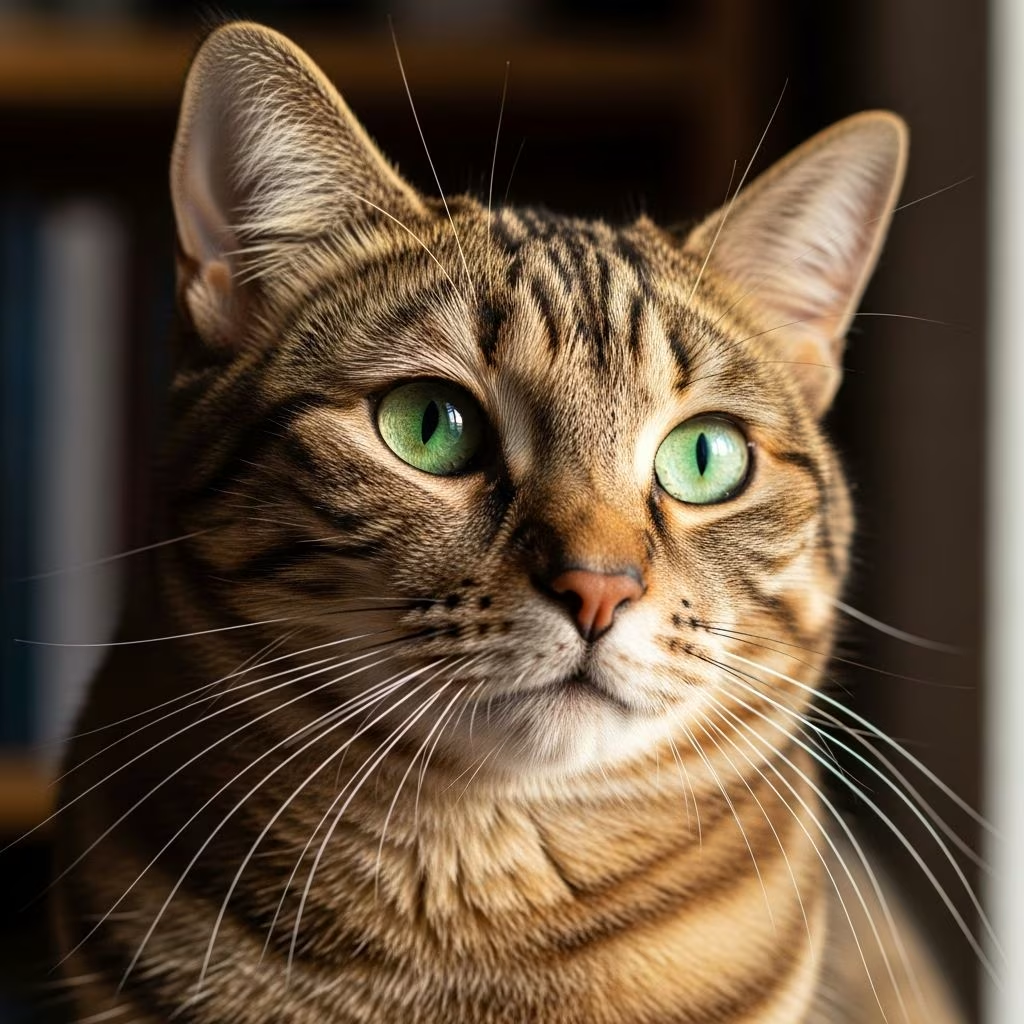
Domestic cats have long been viewed as aloof companions who tune out human chatter, but recent scientific investigations challenge this notion. Research demonstrates that cats can swiftly connect spoken words to visual images, a foundational skill in language comprehension that they master more rapidly than human toddlers.
The Science Behind Feline Word Learning
Cognitive studies have pinpointed a remarkable talent in cats: the rapid formation of picture-word associations. In controlled experiments, researchers exposed cats to pairings of nonsense words spoken by their owners and animated visuals, such as a red sun or a blue unicorn. After minimal exposure—just two nine-second trials—cats detected when these pairings were swapped, gazing longer at the mismatched combinations. This reaction, marked by extended attention and even pupil dilation in some cases, signals that cats had internalized the links between sounds and sights.
Published in Scientific Reports, the study from Azabu University involved 31 adult cats and used a “switched stimuli task” originally designed for infants. Cats habituated to the initial pairings, showing reduced interest, but perked up by 15% on average when switched, proving they noticed the discrepancy. Human infants, by contrast, need at least four 20-second exposures to achieve similar results, making cats four times faster in this metric.
Comparing Cats to Other Learners
| Learner Type | Trials Needed | Exposure Time per Trial | Total Exposure |
|---|---|---|---|
| Cats | 2 | 9 seconds | 18 seconds |
| Human Toddlers | 4+ | 20 seconds | 80+ seconds |
| Dogs (trained) | Varies | Multiple sessions | Hours |
This table highlights the efficiency of cats in word-image linking. While dogs excel in following commands after extensive training, cats demonstrate innate quickness in associative learning without prior conditioning.
Human Speech vs. Other Sounds
A key experiment variant replaced owner voices with electronic tones. Cats still showed some detection of switches, but the effect was weaker and not statistically significant compared to human speech pairings. This hints at a preference for human vocalizations, possibly honed by domestication and daily interactions. Cats in the study, whether indoor or outdoor, performed similarly, unaffected by living environment.
Observations included cats fixating intently, with dilated pupils during mismatches— a sign of heightened arousal and processing. Lead researcher Saho Takagi noted the cats’ serious engagement, underscoring their cognitive investment.
Implications for Domestication and Evolution
Why do cats possess this skill? Theories point to their 10,000-year coexistence with humans. Unlike wild felines, domestic cats attune to our voices, recognizing names, emotional tones, and even mapping voices to faces. They distinguish their own names from similar words and represent familiar cats upon hearing their names, suggesting deeper referential understanding.
Yet, origins remain debated: innate feline cognition or learned through human proximity? Future studies on feral or less-socialized cats could clarify. Vocalizations in cats serve affiliation with humans beyond mere conflict or mating, supporting referential potential.
Everyday Signs of Your Cat’s Comprehension
- Name Response: Cats perk up or approach when hearing their name amid chatter, ignoring others.
- Command Awareness: Phrases like “dinner” or “treat” prompt eager looks, even if not always obeyed.
- Tone Sensitivity: They differentiate scolding from praise by vocal inflection.
- Object Recall: Calling a toy’s name might draw their gaze to it after repetition.
- Context Clues: Routine words like “outside” trigger door-rushing behaviors.
These behaviors indicate passive vocabulary absorption. Pet owners unwittingly train cats through consistent naming and talking.
Training Tips to Boost Communication
Leverage this ability with structured play:
- Use Consistent Words: Pair names with actions or objects daily, like “ball” while tossing it.
- Short Sessions: Mimic study brevity—repeat pairings 2-3 times per session.
- Owner’s Voice: Record yourself for playback to strengthen personal bonds.
- Visual Aids: Show images or objects with words to reinforce links.
- Reward Attention: Treats for correct responses build positive associations.
Start simple: Teach “food bowl” by saying it while filling. Progress to toys. Patience yields responsive cats who “listen” more.
Limitations and Future Research Directions
Studies exclude uncooperative cats, introducing bias toward engaged felines. Small sample sizes limit generalizations, and innate vs. learned debates persist. Does this extend to meaningful vocabulary? Can cats follow multi-step instructions like dogs?
Upcoming work may test kittens, ferals, or cross-species comparisons. Neuroimaging could reveal brain activation during associations.
Benefits for Pet Parents
Understanding feline smarts fosters stronger bonds. Talkative homes yield attuned cats, reducing misunderstandings. Enrichment via word games combats boredom, enhancing welfare. Pet insurance covers related health, as cognitive stimulation supports mental health.
Frequently Asked Questions
Can all cats learn word associations?
Most domestic cats show potential, but personality and exposure vary results. Social cats excel faster.
How does this compare to dog intelligence?
Dogs learn 100+ words via training; cats favor quick, passive associations over commands.
Is this ability genetic or trained?
Likely both—domestication amplifies innate skills through human interaction.
Should I talk more to my cat?
Yes; it builds trust and leverages their listening prowess for better companionship.
What if my cat ignores words?
They comprehend but choose responses. Consistency and rewards improve engagement.
References
- Cats are better at word association than human babies are, study finds — Live Science. 2024-10-04. https://www.livescience.com/animals/domestic-cats/cats-are-better-at-word-association-than-human-babies-are-study-finds
- Rapid formation of picture-word association in cats — PMC / NIH (Scientific Reports). 2024-10-04. https://pmc.ncbi.nlm.nih.gov/articles/PMC11452650/
- Cats Associate Words With Images Faster Than Babies, New Study — Kinship. 2024. https://www.kinship.com/cat-behavior/cats-associate-words-with-images-study-news
- New Study Reveals Cats’ Surprising Word Comprehension Abilities — Hanne Grice. 2024. https://www.hannegrice.com/walk-the-dog/new-study-reveals-cats-surprising-word-comprehension-abilities/



