

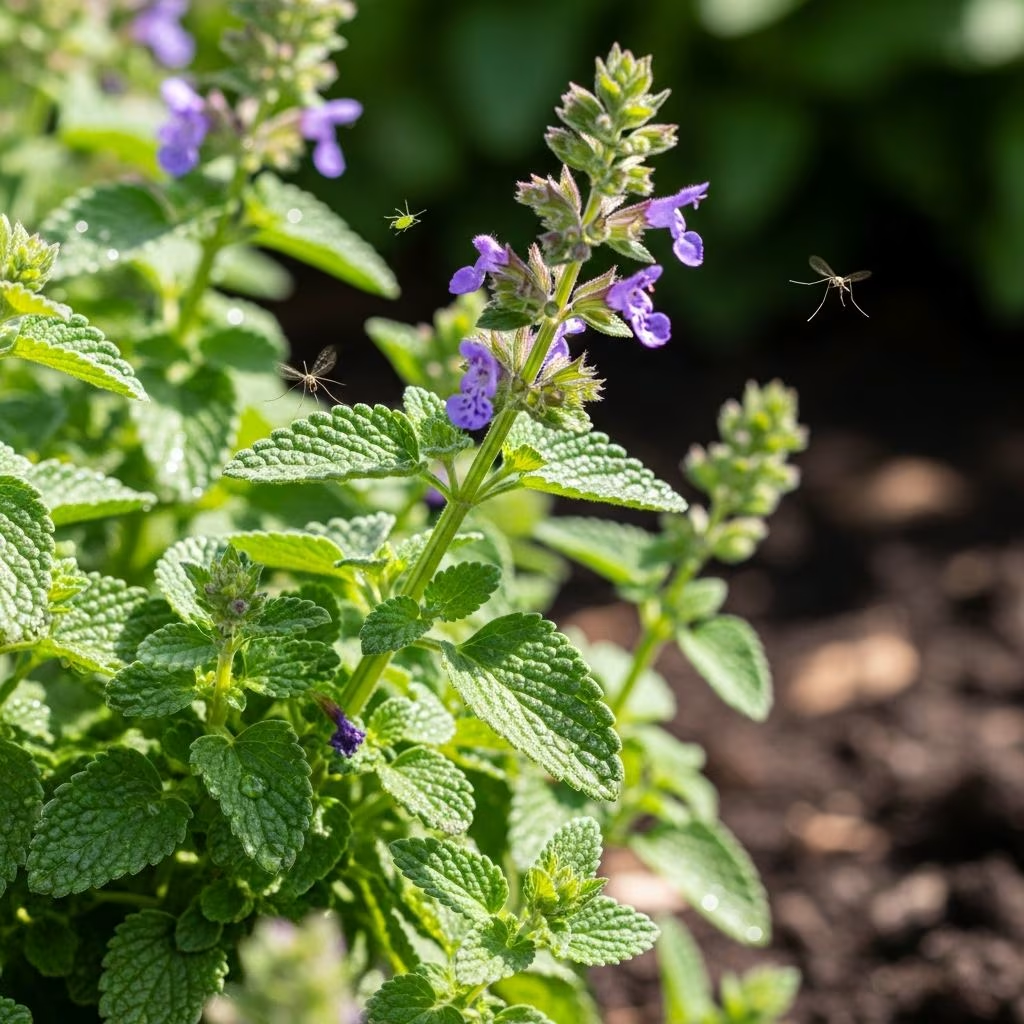
Catnip, scientifically known as Nepeta cataria, is renowned for its euphoric effects on cats but holds powerful potential as a natural pest repellent for humans and pets. Its active compound, nepetalactone, disrupts insect behavior, offering an eco-friendly alternative to synthetic chemicals like DEET. Research demonstrates high repellency rates against mosquitoes, flies, and other pests, with low toxicity profiles making it suitable for household use.
What Is Catnip and Why Does It Repel Pests?
Catnip is a perennial herb in the mint family, native to Europe and Asia, now widespread globally. While cats react strongly due to nepetalactone binding to olfactory receptors, insects perceive it as an irritant. Studies show nepetalactone activates the TRPA1 receptor in insects like mosquitoes and fruit flies, triggering aversion without affecting humans similarly.
This mechanism explains catnip’s broad-spectrum repellency. Unlike attractants, it acts as a spatial and contact repellent, deterring pests from approaching or feeding. Lab tests confirm catnip oil outperforms controls in olfactometer assays, with mosquitoes avoiding treated areas.
- Nepetalactone isomers: Key components include E,Z-nepetalactone and Z,E-nepetalactone, responsible for 70-90% of essential oil content.
- Plant parts used: Leaves and flowers yield the highest oil concentrations.
- Availability: Fresh/dried catnip or commercial essential oils.
Scientific Evidence: How Effective Is Catnip as a Repellent?
Multiple peer-reviewed studies validate catnip’s efficacy. In lab bioassays, catnip essential oil at 20 mg achieved 96% repellency against stable flies (Stomoxys calcitrans) and 79-86% against houseflies (Musca domestica). Even at 2 mg, it repelled houseflies effectively.
Against mosquitoes, results vary by assay type. Spatial repellency exceeds DEET in olfactometers, but bite deterrence on skin is comparable or slightly less. One study found >95% repellency for Aedes aegypti using purified nepetalactone isomers.
| Pest Type | Dosage | Repellency Rate | Source |
|---|---|---|---|
| Stable Flies | 20 mg | 96% | |
| Houseflies | 2-20 mg | 79-86% | |
| Mosquitoes (Aedes) | 20 µg/cm² | >95% | |
| Fruit Flies | Nepetalactone | Reduced egg-laying |
Comparative trials show catnip oil rivals DEET in vitro but may require higher doses for prolonged field protection. No significant synergy among nepetalactone isomers was noted, yet the whole oil performs best.
Safety Profile: Is Catnip Safe for Humans, Pets, and the Environment?
Toxicity studies classify catnip oil as ‘virtually non-toxic.’ Acute oral LD50 in rats is 2710-3160 mg/kg BW; dermal LD50 >5000 mg/kg BW; inhalation LC50 >10,000 mg/m³. It causes moderate skin irritation in rabbits but is practically non-irritating to eyes.
For cats, nepetalactone is safe in moderation, mimicking a harmless high. No adverse effects reported in pest control contexts. Environmentally, as a plant-derived biopesticide, it biodegrades quickly without harming beneficial insects like bees when used diluted.
- Human use: Dilute essential oil (1-5%) for skin; patch test first.
- Pet safety: Avoid eyes/mucous membranes; cats may roll in it attractively.
- EPA status: Aligns with approved biopesticides; low mammalian risk.
How to Use Catnip as a Pest Repellant
Practical applications leverage catnip’s versatility. DIY recipes use accessible forms for gardens, homes, and personal protection.
Garden and Plant Protection
Plant catnip borders around veggies or companion plant with tomatoes/roses. Crush leaves for immediate release. Studies confirm repellency against aphids, squash bugs, and termites.
- Scatter dried catnip around seedlings.
- Brew tea spray: Steep 1 cup leaves in 2 cups hot water, strain, apply.
Homemade Sprays and Lotions
Basic Spray: Mix 10-20 drops catnip oil with 2 oz witch hazel + 2 oz water. Shake, spray on skin/clothes. Reapply every 2 hours.
Lotion: Blend 15 drops oil into 4 oz unscented lotion. Effective for 1-3 hours against mosquitoes.
Tested formulations show 2-5 hour protection; combine with citronella for synergy.
Indoor and Pet Applications
Sprinkle dried catnip in entryways or pet bedding to deter flies. For cats, it doubles as enrichment while repelling fleas (anecdotal support; dilute oil for safety).
Catnip vs. Commercial Repellents: Pros and Cons
| Aspect | Catnip | DEET/SS220 |
|---|---|---|
| Efficacy | High spatial; good contact (79-96%) | Superior bite deterrence |
| Duration | 1-3 hours | 4-8+ hours |
| Safety | Low toxicity; natural | Potential skin irritation |
| Cost | Low (grow/DIY) | Moderate |
| Environmental | Biodegradable | Persistent |
Catnip excels for short-term, natural needs but may need reapplication. Ideal for sensitive skin or eco-conscious users.
FAQs
Does catnip really repel mosquitoes?
Yes, catnip oil and nepetalactone provide strong repellency, often >95% in lab tests, via TRPA1 activation making it aversive.
Is catnip safe for dogs and children?
Safe when diluted; low oral/dermal toxicity. Avoid ingestion; supervise pets/children.
How long does catnip repellent last?
1-3 hours on skin; longer spatially (e.g., gardens). Reapply as needed.
Can I grow catnip for repellent use?
Absolutely; it’s hardy in zones 3-9. Harvest leaves/flowers for oils/sprays.
Is catnip better than DEET?
Comparable spatially; less for prolonged bite protection but safer/natural.
Conclusion
Catnip offers a scientifically backed, natural solution for pest control, balancing efficacy, safety, and sustainability. Integrate it into routines for chemical-free protection.
References
- Efficacy and Safety of Catnip (Nepeta cataria) as a Novel Filth Fly Repellent — Zhu et al. USDA ARS. 2009-10-01. https://digitalcommons.unl.edu/cgi/viewcontent.cgi?article=1401&context=usdaarsfacpub
- Feeding Deterrent Effects of Catnip Oil Components Compared with DEET — Journal of Medical Entomology, Oxford Academic. 2005-08-01. https://academic.oup.com/jme/article/42/4/643/912008
- Catnip Essential Oil and Its Nepetalactone Isomers as Repellents for Mosquitoes — Iowa State University Digital Repository. 2007-01-01. https://dr.lib.iastate.edu/server/api/core/bitstreams/c9324ba3-e6ec-4a87-9967-b22a4bcca7d7/content
- How catnip plant repels insects: Mosquitoes, chemical receptor — Science News. 2021-03-04. https://www.sciencenews.org/article/how-catnip-plant-repels-insects-mosquitoes-chemical-receptor
- Study: The irritant receptor TRPA1 mediates the mosquito repellent effect of catnip — Northwestern University News. 2021-03-08. https://news.weinberg.northwestern.edu/2021/03/08/study-the-irritant-receptor-trpa1-mediates-the-mosquito-repellent-effect-of-catnip/
- Repellency Assessment of Nepeta cataria Essential Oils — PMC/NIH. 2019-02-20. https://pmc.ncbi.nlm.nih.gov/articles/PMC6365536/
- Efficacy and safety of catnip (Nepeta cataria) as a novel filth fly repellent — Wiley Online Library. 2009-06-01. https://resjournals.onlinelibrary.wiley.com/doi/abs/10.1111/j.1365-2915.2009.00809.x



