

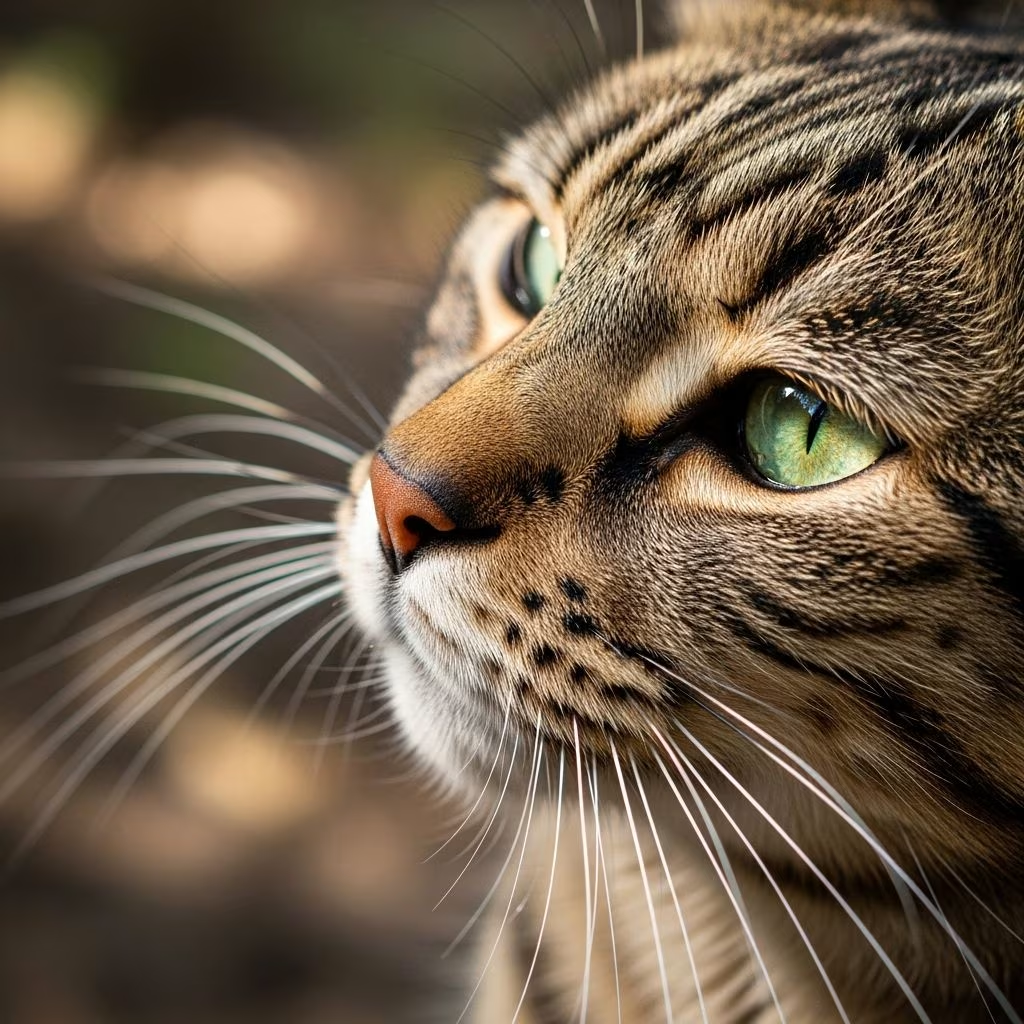
Cat whiskers, known scientifically as vibrissae, represent one of nature’s most ingenious adaptations for survival. Far from mere facial adornments, these specialized structures equip cats with an advanced sensory network that rivals high-tech detection systems. Embedded deeply in the skin and linked directly to the nervous system, whiskers detect subtle environmental cues, enabling precise navigation, effective hunting, and instant protection.
The Remarkable Anatomy of Feline Vibrissae
Whiskers differ significantly from regular fur. Each vibrissa is roughly three times thicker, with roots penetrating three times deeper into the follicle. This deep embedding connects to a rich supply of nerves—up to 200 per follicle—along with muscles that allow independent movement. A unique blood sinus surrounds the base, amplifying even the slightest deflection into neural signals sent straight to the brain.
These hairs consist of keratin, the same tough protein in human nails, but their enhanced structure makes them extraordinarily sensitive. Unlike ordinary hairs that shed and regrow unnoticed, whiskers follow a cyclical renewal process, typically lasting several months before replacement. This design ensures constant sensory readiness.
- Thickness: 2-3 times wider than typical fur strands.
- Depth: Roots extend deep into dermal layers with nerve-rich sinuses.
- Mobility: Attached to muscles for forward/backward and independent row movements.
- Sensitivity: Equivalent to human fingertips, detecting vibrations and air shifts.
Strategic Locations Across the Cat’s Body
Cats possess whiskers not just on their faces but in key body positions for comprehensive environmental monitoring. The primary array features about 24 mystacial whiskers on the muzzle—12 per side in four rows—forming a fingerprint-like pattern unique to each cat.
Beyond the muzzle, smaller sets appear above the eyes for protection, on the chin for ground sensing, and crucially on the backs of the front legs (carpal whiskers) for prey handling and climbing feedback.
| Whisker Zone | Typical Count (Per Side) | Main Role | Average Length |
|---|---|---|---|
| Muzzle (Mystacial) | 12 | Navigation & Detection | 2-4 inches |
| Above Eyes | 3 | Eye Safeguard | 1-2 inches |
| Chin | 2-4 | Close-Range Sensing | 0.5-1 inch |
| Front Legs (Carpal) | 3-5 | Manipulation & Balance | 1-1.5 inches |
In total, cats sport 40-50 whiskers, creating a full-body radar system. Leg whiskers, often overlooked, prove vital during hunts or traversals over uneven terrain.
Navigation and Spatial Mastery
A cat’s whiskers excel in spatial judgment. Positioned at body width, muzzle whiskers gauge passage sizes, preventing squeezes into too-narrow gaps. As cats age or gain weight, whisker length—genetically fixed—may no longer match, complicating tight maneuvers.
Whiskers also compensate for vision limits; cats struggle to focus closer than 30cm, relying on vibrissae for near-field mapping. Forward-pointing whiskers probe ahead during prowls, while backward sweeps check pursuits.
Hunting Prowess Enhanced by Whiskers
In predation, whiskers transform cats into stealthy assassins. They sense air disturbances from prey movement, even in pitch darkness, discerning size, shape, and distance via vibration patterns. Hunters fan whiskers forward to ‘scan’ targets, confirming vitality through micro-vibrations from breathing or heartbeats.
During the kill, whiskers pinpoint neck arteries for precise bites, minimizing struggle. Carpal whiskers on legs secure wriggling captures, aiding in dispatch or transport.
Protection Mechanisms and Reflexes
Eyebrow whiskers trigger the blink reflex against threats, shielding corneas from scratches or debris. Any deflection prompts rapid eyelid closure, a lifesaving response in dense foliage or fights.
Chin and leg whiskers alert to ground hazards, preventing trips or injuries during leaps. This multi-layered defense underscores whiskers’ role in overall safety.
Balance, Communication, and Emotional Signals
Whiskers contribute to proprioception, sensing head tilt and body orientation via gravity on their lengths. Integrated with inner ear data, this aids mid-air corrections, enabling right-side-up landings from falls.
Socially, whisker positions convey moods: forward for curiosity, flat for aggression, relaxed for contentment. Cats ‘moustache’ each other during greetings, sharing scent via whisker brushes.
Care Tips: Preserving Whisker Health
Avoid trimming whiskers; even slight shortening disorients cats, causing clumsiness or anxiety. They regrow, but the process takes weeks, leaving sensory gaps.
- Provide wide bowls to prevent whisker fatigue from constant rubbing.
- Steer clear of sticky substances that weigh them down.
- Monitor for damage from fights or accidents.
- Ensure balanced diet for healthy keratin production.
Obese cats may outgrow whisker utility; weight management restores functionality.
Common Myths About Cat Whiskers
Myth 1: Whiskers feel sensations themselves. Reality: They transmit follicle nerve signals; the hair is insensate.
Myth 2: All cats have identical whisker counts. Reality: Patterns vary slightly by individual and breed.
Myth 3: Whiskers shed like fur without issue. Reality: Loss affects senses until regrowth.
Frequently Asked Questions (FAQs)
Do cat whiskers grow back if cut?
Yes, whiskers regrow naturally in 2-3 months, but avoid cutting as it impairs senses temporarily.
Why do some cats have curly whiskers?
Genetic traits or breeds like Selkirk Rex cause curls, but function remains intact if not broken.
Can kittens be born without whiskers?
Rarely; whiskers emerge early in utero for immediate post-birth navigation.
Do indoor cats need whiskers as much?
Absolutely; they still hunt toys, jump, and navigate furniture in low light.
What happens if all whiskers are lost?
Cats become disoriented, bumping objects and showing stress until regrowth.
Whiskers in Evolution and Modern Understanding
Veterinary research highlights whiskers’ brain allocation: nearly 40% of sensory cortex processes whisker input, emphasizing their primacy. Evolutionary biologists note vibrissae conservation across mammals, from seals to rodents, for similar survival roles.
Recent studies using high-speed imaging confirm whisker-airflow interactions, validating ancient observations with modern tech.
References
- Structure and Function of the Whiskers in Cats — PetPlace.com. Accessed 2026. https://www.petplace.com/article/cats/pet-health/structure-and-function-of-the-whiskers-in-cats
- Why Do Cats Have Whiskers? Functions & Anatomy Guide — The Refined Feline. Accessed 2026. https://www.therefinedfeline.com/why-do-cats-have-whiskers/
- Why Do Cats Have Whiskers? — VCA Animal Hospitals. Accessed 2026. https://vcahospitals.com/know-your-pet/why-do-cats-have-whiskers
- Why Do Cats Have Whiskers? — Blue Cross. Accessed 2026. https://www.bluecross.org.uk/advice/cat/wellbeing-and-care/why-do-cats-have-whiskers
- The Function of Cat Whiskers — JW.ORG. 2015-04-01. https://www.jw.org/en/library/magazines/g201504/function-of-cat-whiskers/
- Cat Whiskers 101 — Zoetis Petcare. Accessed 2026. https://www.zoetispetcare.com/blog/article/cat-whiskers-101



