

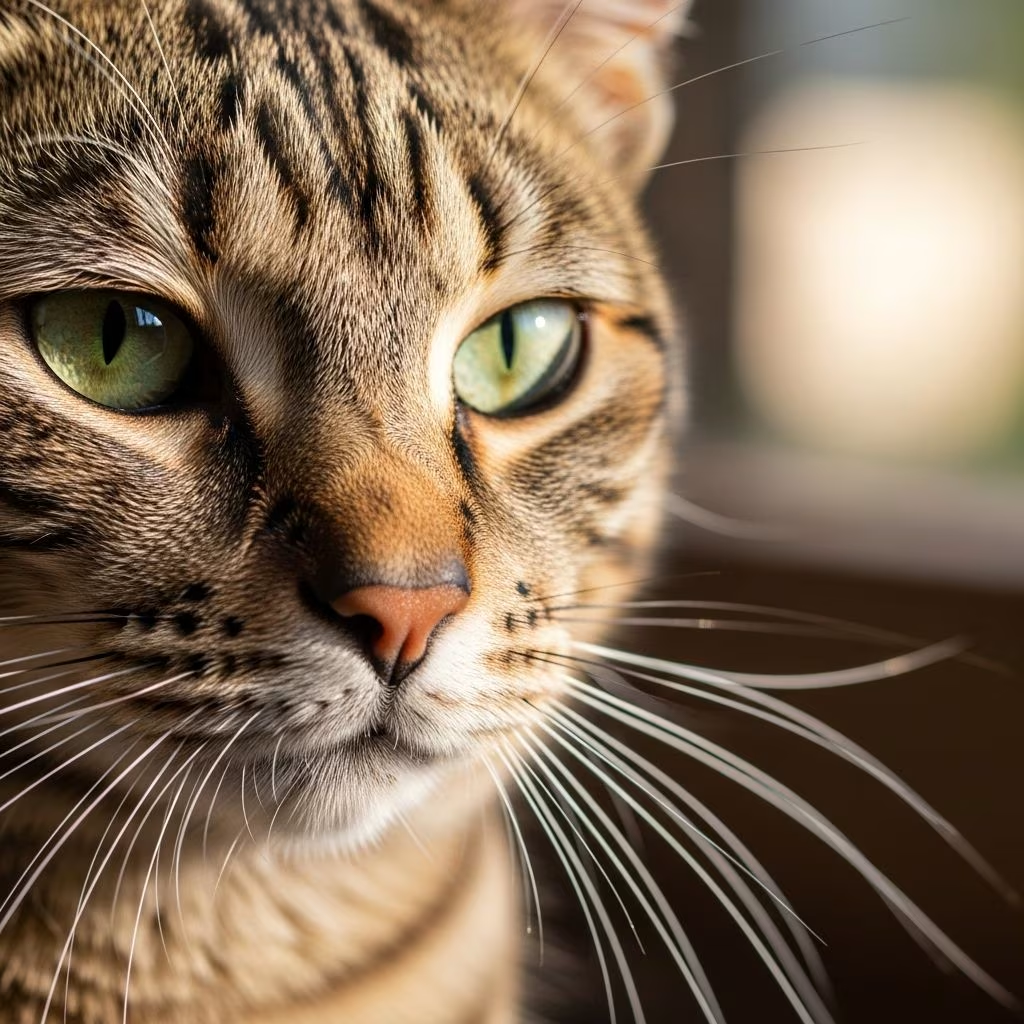
When you observe a cat’s face, the long, distinctive hairs extending from its muzzle, eyes, and chin might appear to be merely aesthetic features. However, these structures represent one of nature’s most sophisticated biological sensory systems. Cat whiskers are specialized sensory organs called vibrissae that function as an external nervous system, enabling cats to perceive and interact with their environment in ways fundamentally different from human capability. Rather than serving as decorative elements, whiskers operate as precision instruments that cats employ for navigation, hunting, communication, and maintaining balance. Understanding the remarkable engineering behind these facial hairs reveals the sophistication of feline biology.
The Anatomical Structure Behind Sensory Excellence
Whiskers possess a distinctly different structure compared to the regular fur covering a cat’s body. While both whiskers and standard hair emerge from follicles, whiskers exhibit several critical differences that enable their sensory capabilities. Each whisker is approximately three times thicker than ordinary fur and penetrates the skin to a depth roughly three times greater than regular hairs. This deeper embedding proves essential to their function, as the follicles contain densely packed blood vessels and nerve endings that create an incredibly responsive sensory apparatus.
The composition of whiskers mirrors that of other mammalian hair, primarily consisting of alpha-keratin protein, the same material found in human hair and nails. However, their unique structural properties make them substantially more robust and responsive. Each whisker follicle contains between 100 and 200 nerve fibers, compared to regular hair follicles that typically contain only 2 to 3 nerve connections. This dramatic difference in neural density transforms whiskers into highly sensitive touch receptors that transmit minute environmental changes directly to the brain’s sensory processing centers.
The base of each whisker contains specialized sensory organs called proprioceptors that detect vibrations and gravitational orientation. These microscopic organs enable cats to gauge their position in space and respond to the slightest movements in their surroundings. The combination of abundant nerve fibers and proprioceptive sensory organs creates a biological sensing system comparable to advanced technological instruments, yet evolved over millions of years of feline development.
Whisker Distribution Patterns Across the Feline Face
The placement of whiskers follows a precise anatomical pattern that varies somewhat by breed but remains consistent across the domestic cat species. Most cats possess a total of 40 to 50 individual whiskers distributed across multiple facial and bodily locations. This strategic distribution ensures maximum environmental coverage while maintaining optimal sensory information gathering.
The most prominent whiskers are the mystacial whiskers located on the upper lip, arranged in four distinct rows on each side of the muzzle. These whiskers typically measure between 2 and 4 inches in length and constitute the primary sensory array for detecting nearby objects and obstacles. Most cats have 12 whiskers on each side of the face, creating a balanced sensory grid that facilitates navigation and environmental assessment. The organization follows a length gradient, with shorter whiskers positioned toward the front gradually increasing in length toward the back rows, allowing for comprehensive spatial awareness.
Additional whisker locations supplement the facial array and provide specialized sensory information:
- Superciliary whiskers positioned above the eyes help protect vision and provide upper-level environmental information
- Genal whiskers on the cheeks between the eyes and upper lip offer lateral sensory coverage
- Mandibular whiskers beneath the chin detect ground-level obstacles and surfaces
- Carpal whiskers on the back of the front legs at the wrists assist with prey manipulation and climbing navigation
| Whisker Type | Location | Average Quantity Per Side | Primary Function | Typical Length |
|---|---|---|---|---|
| Mystacial | Upper lip muzzle | 12 whiskers | Navigation and prey detection | 2-4 inches |
| Superciliary | Above eyes | 3 whiskers | Eye protection and upper sensing | 1-2 inches |
| Mandibular | Chin area | 2-4 whiskers | Ground-level obstacle detection | 0.5-1 inch |
| Carpal | Back of front legs | 3-5 whiskers | Prey manipulation and climbing | 1-1.5 inches |
The Sensory Mechanism: From Hair to Brain
The process by which whiskers translate environmental stimuli into neural signals represents a marvel of biological engineering. When air currents flow across a whisker or an object makes contact with the hair, the whisker vibrates microscopically. This vibration stimulates the sensory cells surrounding the whisker follicle, triggering the transmission of detailed information to the feline brain. The system operates so sensitively that it can detect air disturbances from nearby movement and transmit information about object size, shape, texture, and distance.
Importantly, the whiskers themselves do not possess tactile sensation in the traditional sense. Instead, they function as sensory antennae that detect movement and vibration, subsequently transmitting this information through neural pathways. The brain interprets these signals to construct a detailed three-dimensional model of the immediate environment. Almost 40% of the brain’s sensory cortex area corresponds with body regions containing whiskers, indicating the tremendous importance cats place on processing whisker-derived information.
Each whisker is attached to muscles that allow cats to consciously control its movement, positioning whiskers for optimal sensory gathering during different activities. During hunting, exploration, or navigation through confined spaces, cats can orient their whiskers to maximize environmental information collection. This active sensory control, combined with passive vibration detection, creates a comprehensive environmental sensing system unmatched by most other terrestrial species.
Navigation and Environmental Awareness
One of the most critical functions whiskers serve involves enabling cats to navigate their environment with precision. Cats possess a vision limitation that necessitates whisker reliance: they cannot focus on objects closer than approximately 30 centimeters in front of them. This farsightedness means that cats lack clear visual information about immediate surroundings directly ahead of their faces. Whiskers compensate for this visual gap, providing tactile information that allows cats to navigate obstacles, assess confined spaces, and interact with nearby objects.
The mystacial whiskers positioned on the upper lip prove particularly valuable for this function, as they match the width of a cat’s body. When a cat approaches a narrow opening or confined space, it can assess whether the remainder of its body will fit by observing whether the whiskers bend or flex upon contact with the space’s boundaries. This biological measurement system prevents cats from becoming wedged in unsuitable spaces and enables confident navigation through complex environments. The sensitivity of whiskers allows detection of obstacles that might escape visual notice, particularly in low-light conditions where cats’ visual acuity decreases.
Hunting Excellence Through Sensory Integration
Whiskers transform cats into extraordinarily effective hunters by providing sensory information crucial during predatory sequences. Small prey creates subtle air disturbances through movement and respiration, vibrations that whiskers can detect with remarkable sensitivity. This capability enables cats to locate and track prey even in complete darkness when visual information becomes unreliable. During the final moments of a hunt, when a cat has successfully pounced on prey and secured it within its paws, vision becomes compromised by proximity and positioning.
At this critical juncture, whiskers guide the delivery of the killing bite by detecting the prey’s precise location, movement, and even vital signs through vibrations. The whiskers can sense a small animal’s breathing and heartbeat, allowing the cat to determine optimal bite placement. This sensory guidance ensures swift, efficient kills that minimize prey suffering. The integration of whisker-based tactical information with visual input and proprioceptive awareness creates a comprehensive sensory system that has evolved over millennia to maximize hunting success.
Balance, Proprioception, and the Righting Reflex
Beyond navigation and hunting, whiskers contribute significantly to cats’ legendary balance and coordination. The proprioceptors embedded at whisker bases respond to gravitational pull on the hairs, providing information about head position and body orientation in space. This gravitational sensing, combined with inner ear balance information, enables cats to maintain awareness of their position even during complex movements. When a cat leaps, climbs, or tumbles, whisker-derived proprioceptive data contributes to the split-second adjustments necessary for graceful landings and precision movements.
The famous “righting reflex” that allows cats to land on their feet during falls benefits significantly from whisker-mediated proprioceptive input. As gravity pulls on the whiskers during a fall, the brain receives continuous information about the cat’s orientation relative to the ground. This input, processed in conjunction with visual and inner ear data, enables the cat to rotate its body appropriately during the fall to achieve a safe landing position. Cats with intact whiskers demonstrate superior balance and coordination compared to those with damaged or absent whiskers, underscoring the critical role these sensory organs play in feline athleticism.
Communication and Social Interaction
While primarily serving sensory functions, whiskers also contribute to feline communication and social signaling. The position and movement of whiskers can convey emotional states and intentions to other cats and observant humans. Forward-pointing whiskers often indicate confidence or interest, while whiskers drawn back flat against the face suggest fear, aggression, or defensive posturing. These subtle cues form part of the complex non-verbal communication system cats employ when interacting with their environment and with other members of their species.
The muscles controlling whiskers enable cats to adjust whisker position consciously, allowing them to fine-tune the sensory information they gather from specific directions. This active control transforms whiskers from passive sensors into dynamic tools that cats manipulate to gather information relevant to immediate behavioral needs. Whether investigating a novel object, stalking prey, or assessing another cat’s intentions, whisker positioning reflects the cat’s cognitive focus and emotional state.
Frequently Asked Questions About Feline Whiskers
Do cats feel pain if their whiskers are cut?
While whiskers themselves lack pain receptors, they are embedded in follicles rich with nerve endings. Cutting whiskers can cause discomfort and disorient cats by eliminating crucial sensory input, though the hairs themselves do not feel sharp pain. Cats should never have their whiskers trimmed, as this impairs their sensory capabilities and creates temporary disorientation.
Do all cat breeds have the same number of whiskers?
While the distribution pattern remains consistent across domestic cats, the exact number and length of whiskers vary slightly by breed. Long-haired breeds may have less prominent whiskers against their extended fur, while short-haired breeds display whiskers more visibly. The range of 40 to 50 whiskers represents a typical count, though individual variation occurs.
Can cats regrow lost whiskers?
Yes, cats can regrow whiskers that are lost naturally or through injury. The regrowth process typically takes several weeks, during which the cat experiences reduced sensory acuity. Newly grown whiskers gradually return to full sensitivity as the neural connections in the follicles reestablish and mature.
How do whiskers differ between kittens and adult cats?
Kittens are born with whiskers that develop alongside their other sensory systems. As kittens mature, whisker length and sensitivity increase in proportion to body growth and developmental needs. Adult whisker length corresponds to body width, maintaining the spatial awareness function throughout life.
Conclusion: Nature’s Sensory Engineering
Cat whiskers represent a triumph of evolutionary sensory engineering, providing felines with a sophisticated apparatus for navigating, hunting, and balancing within their environments. These seemingly simple facial hairs conceal an intricate system of neural connections, sensory organs, and muscular controls that enable cats to perceive environmental information in ways humans cannot readily comprehend. From the moment a kitten’s whiskers develop until the cat’s final years, these sensory organs remain essential tools for survival and flourishing. Understanding whisker function deepens appreciation for the remarkable biological adaptations that make cats such successful, graceful, and enigmatic companions.
References
- Why Do Cats Have Whiskers? Functions & Anatomy Guide — The Refined Feline. 2024. https://www.therefinedfeline.com/why-do-cats-have-whiskers/
- A Cat’s Whiskers: How Do they Work? — NASC LIVE. 2024. https://www.nasc.cc/cat/a-cats-whiskers-how-do-they-work/
- Why Do Cats Have Whiskers? — VCA Animal Hospitals. 2024. https://vcahospitals.com/know-your-pet/why-do-cats-have-whiskers
- Cats and Whiskers: FAQ — Blue Cross. 2024. https://www.bluecross.org.uk/advice/cat/wellbeing-and-care/why-do-cats-have-whiskers
- Cat Whiskers 101 — Zoetis Petcare. 2024. https://www.zoetispetcare.com/blog/article/cat-whiskers-101



