

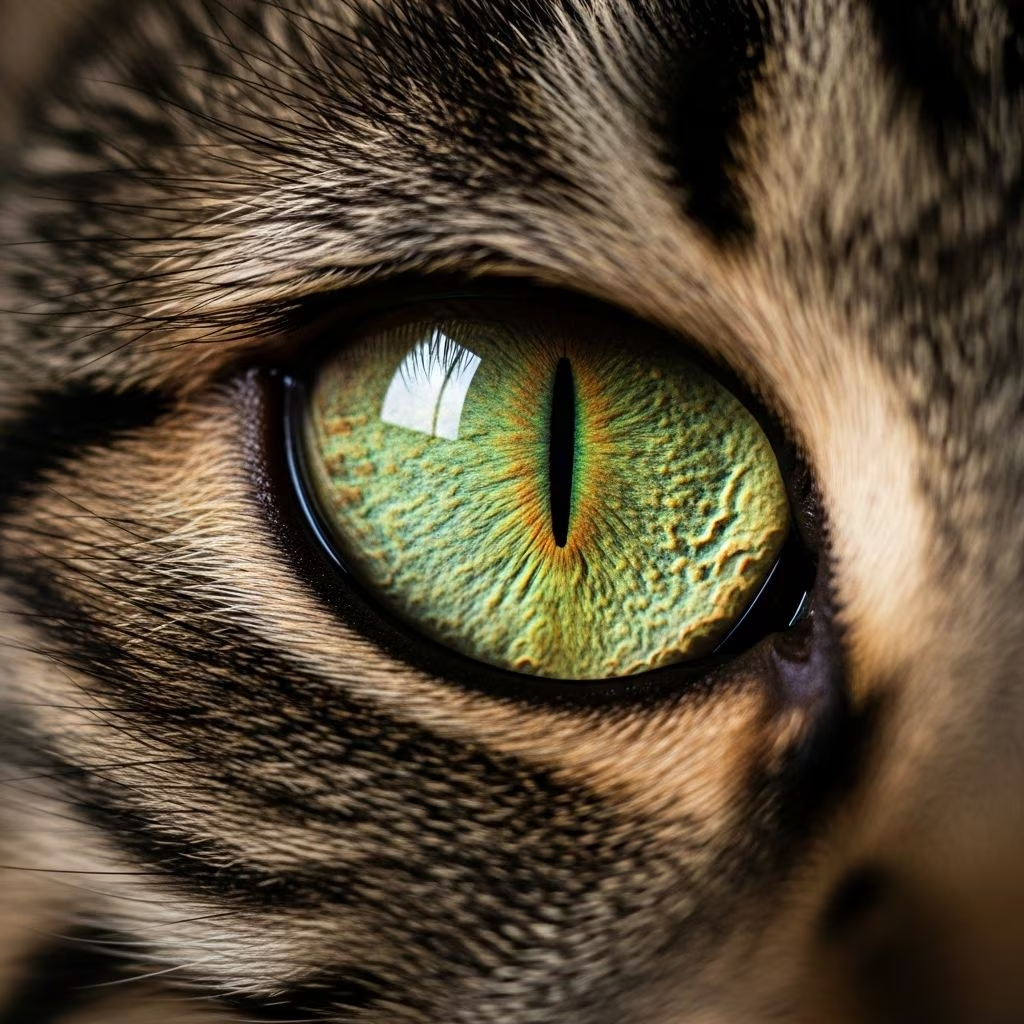
Cats possess a remarkable visual system finely tuned for their predatory lifestyle, excelling in low-light conditions and offering a broader field of view than humans. This specialized eyesight stems from unique anatomical features that prioritize motion detection and nocturnal hunting over sharp daytime detail or full color spectrum perception.
The Intricate Anatomy of Feline Eyes
A cat’s eye is a sophisticated organ protected within a bony structure known as the orbit, which houses muscles, nerves, blood vessels, and tear-producing glands for optimal function. The outermost layer, the sclera, forms the tough white exterior, while a thin conjunctiva lines the eyelids and inner surfaces, appearing pink when healthy.
At the front, the transparent cornea acts as a protective dome, refracting light to focus it precisely onto the retina at the eye’s rear. Behind this lies the iris, the colored portion encircling the pupil, which dynamically adjusts light intake: dilating wide in darkness and narrowing to slits in brightness for retinal protection and enhanced depth judgment during pursuits.
- Cornea: Larger than in humans, admits more light for brighter images.
- Iris and Pupil: Vertical slit pupils enable precise control, aiding daytime hunts.
- Lens: Positioned nearer the retina, it thickens via ciliary muscles for near-focus and thins for distant objects like elusive prey.
The retina, lined with photoreceptors, processes light into neural signals sent via the optic nerve to the brain. Its tapetum lucidum—a reflective layer absent in humans—bounces light back through photoreceptors, amplifying dim illumination for superior night vision. Cats also benefit from a third eyelid, or nictitating membrane, shielding eyes from debris during activity.
Photoreceptors: Rods vs. Cones in Feline Sight
Central to vision are rods and cones. Rods dominate in cats, outnumbering cones 6-8 times, enabling exceptional low-light sensitivity and peripheral motion detection crucial for stalking.
| Feature | Cats | Humans |
|---|---|---|
| Rods Concentration | High (night vision excel) | Moderate |
| Cones Concentration | Low (reduced acuity/color) | High (sharp detail/color) |
| Visual Acuity | Low-resolution, motion-focused | High-resolution |
Cones handle color discrimination and fine detail, but cats’ relative scarcity yields blurrier images at distance, prioritizing speed and distance assessment over precision. The area centralis, a densely packed retinal zone, sharpens central vision for targeting.
Nighttime Supremacy: How Cats Dominate the Dark
Cats’ nocturnal edge arises from multiple adaptations. Their expansive corneas and forward-placed lenses capture maximal light, while the tapetum lucidum doubles exposure by reflection, creating the eerie eyeshine. Vertical pupils constrict effectively against glare, preserving sensitivity.
With a 200-degree visual field versus humans’ 180 degrees, cats monitor surroundings undetected, ideal for ambushes. Rod abundance further boosts peripheral awareness, turning twilight into a well-lit hunting ground.
Color Perception: A Muted Feline Palette
Debate persists on feline color vision due to sparse cones. Evidence suggests cats discern blues and greens but struggle with reds, viewing the world in grayscale tinges rather than our vivid hues. This trade-off favors low-light prowess over chromatic richness, suiting crepuscular (dawn/dusk) activity.
Field of View and Depth Mastery
Forward-facing eyes grant binocular overlap for stereopsis—depth perception vital for pouncing. Vertical pupils sharpen this during stalks, while wider peripheral span spots flanks. Though distant focus lags, near-motion tracking shines, embodying evolutionary hunter design.
Comparing Cat and Human Vision
Humans excel in daylight with cone-heavy retinas for color and acuity up to 20/20 equivalent, but falter post-sunset. Cats reverse this: 6-8x better low-light sensitivity, yet 20/100 to 20/200 daytime acuity—functional for survival, not scrutiny.
- Daylight: Humans superior in detail/color.
- Night: Cats brighter, wider view.
- Motion: Cats detect faster flickers.
Eye Health Essentials for Pet Cats
Domestic life demands vigilance against vision threats. Watch for cloudiness (cataracts), discharge, squinting, or pupil asymmetry signaling issues like glaucoma or infections. Routine vet exams catch congenital defects or trauma early.
Nutrition supports sight: antioxidants like lutein/zeaxanthin, omega-3s, taurine prevent retinal degeneration. Minimize hazards—secure windows, avoid toxins. Kittens develop full vision by 8 weeks; seniors risk age-related clouding.
FAQs on Feline Vision
Can cats see in complete darkness?
No, but minimal light suffices thanks to rods and tapetum; total black yields nothing.
Do cats dream in color?
Likely muted tones mirroring their perception, though brain processing remains speculative.
How far can cats see clearly?
Optimal 6-20 feet for hunting; beyond, detail fades rapidly.
Why do cat eyes glow green?
Tapetum lucidum reflects flashlight wavelengths, varying by individual pigment.
Is laser play safe for cat eyes?
Avoid direct beams; potential retinal burns exist despite low power.
Enhancing Your Cat’s Visual World
Enrich environments with elevated perches for oversight, dim-lit play for night prowess, and varied textures testing whisker-vision synergy. Toys mimicking prey motion engage innate skills, promoting welfare.
Understanding these traits fosters empathy: a cat ignores fine print but tracks your shadow stealthily. Tailor interactions—dusk games thrill, bright noon rests suit.
References
- Eye Structure and Function in Cats — Dr. Leslie Brooks, My Lovely Feline. 2023. https://mylovelyfeline.com/en-ca/blogs/content/eye-structure-and-function-in-cats
- Eye Structure and Function in Cats – Cat Owners — MSD Veterinary Manual. 2024-10-15. https://www.msdvetmanual.com/cat-owners/eye-disorders-of-cats/eye-structure-and-function-in-cats
- How Do Cats See the World? What To Know about Cat Vision — PetMD. 2024. https://www.petmd.com/cat/general-health/cat-vision
- Cat Vision — All About Vision. 2023. https://www.allaboutvision.com/eye-care/pets-animals/cat-vision/
- How Anatomy Shapes Their Sight — Catwatch Newsletter. 2022. https://www.catwatchnewsletter.com/features/how-anatomy-shapes-their-sight/



