

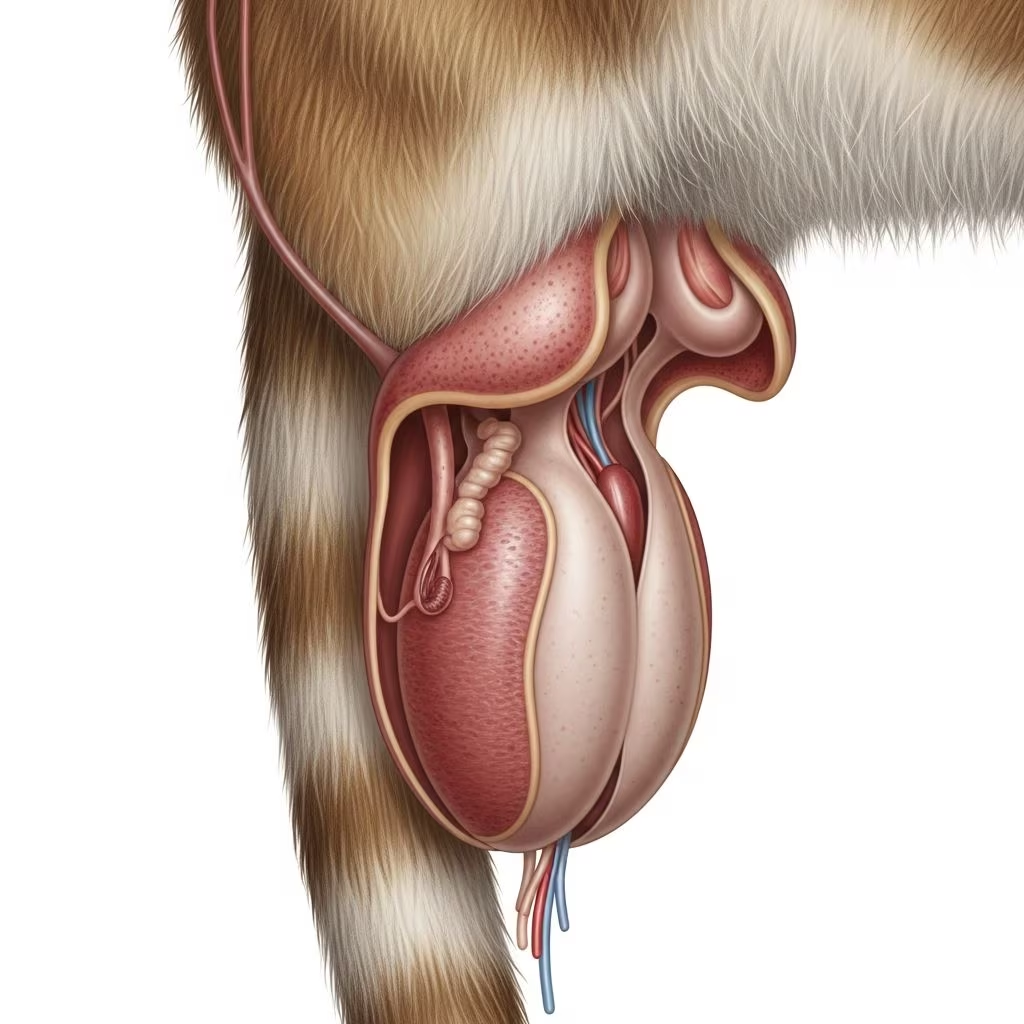
The testicles in male cats, also known as testes, are crucial organs responsible for sperm production and hormone secretion that drive reproductive behaviors and secondary sexual traits. Understanding their structure and role helps owners monitor health and make informed decisions about neutering.
The External Housing: Scrotum and Its Importance
The scrotum serves as the external pouch containing the testicles, positioned ventral to the anus in cats, close to the ischial arch. Unlike in dogs, the feline scrotum is covered with hair, aiding in its protective function during the vertical copulation typical of cats.
This structure maintains a temperature several degrees cooler than the abdominal cavity, essential for spermatogenesis, which halts above 40°C. The cremaster muscle adjusts testicle position based on ambient temperature, while the tunica vaginalis—a double-layered peritoneal evagination—wraps the testes and spermatic cord, including the pampiniform plexus that cools arterial blood.
- Temperature regulation: Keeps testes at optimal coolness for sperm viability.
- Protection: Dense hair and median septum divide the scrotum, separating each testicle.
- Mobility: Cremaster muscle raises/lowers testes dynamically.
Internal Anatomy of Feline Testes
Each testicle is oval-shaped, weighing about 1.2 grams, with a pale pink to off-white parenchyma. They house seminiferous tubules—comprising 88% of testicular volume, around 23 meters long and 220 micrometers wide—where spermatogenesis occurs over approximately 47 days, producing 2.6 spermatozoa per primary spermatocyte.
Sertoli cells nourish developing sperm, while Leydig cells in the interstitium produce testosterone. The rete testis channels sperm to efferent ducts leading to the epididymis. Sonographically, testes appear homogeneous with an echogenic mediastinum; the epididymis is less echogenic.
| Component | Description | Function |
|---|---|---|
| Seminiferous Tubules | Long, coiled structures (223 μm wide) | Sperm production |
| Leydig Cells | Interstitial cells | Testosterone synthesis |
| Mediastinum Testis | Central echogenic area | Sperm collection point |
The Epididymis: Sperm Maturation Hub
Attached to each testicle’s caudal edge, the epididymis is a coiled tube with head (cranial), body (dorsal), and tail (caudal) sections. It stores and matures sperm, allowing slow transport to the ductus deferens (vas deferens)—muscular tubes propelling sperm during ejaculation.
Sperm enter via rete testis efferents, gaining motility over days in this environment. Histology confirms sperm presence in mature cats, with loose collagen, capillaries, and Leydig cells surrounding tubules.
Accessory Structures in Male Reproduction
The male feline genital tract includes the penis with 120-150 backward-facing spines (appearing at 12 weeks, gone post-neutering), prepuce sheath, and os penis (rare, 3-5mm in old toms). The urethra runs through, narrowing where bulbourethral glands open.
The prostate, small near the pelvic brim, surrounds urethral origins and ductus deferens ends, secreting minimally. Bulbourethral (Cowper’s) glands flank the urethra, producing thick mucous for semen. These contribute alkaline fluid neutralizing urethral acidity, boosting sperm survival.
Primary Functions and Hormonal Influence
Testes dual-produce sperm and testosterone, vital for accessory glands, sexual organs, behaviors like spraying, and traits like cheek rubbing. Follicle-stimulating hormone aids maturation; ductus deferens transports during ejaculation.
Seminiferous tubules handle gametogenesis; Leydig cells drive libido and muscle development. Scrotal positioning ensures viability. Disruptions like cryptorchidism impair this, raising cancer risk.
Health Monitoring: Normal vs. Abnormal Signs
Regular checks reveal healthy testes as firm, symmetrical ovals without pain or swelling. Palpate gently; asymmetry or heat suggests issues like orchitis or torsion.
- Normal traits: Oval, mobile, non-painful, uniform size.
- Warning signs: Swelling, hardness, discharge, lethargy.
- Diagnostic tools: Ultrasound, semen analysis, biopsy.
Reproductive diseases are rare but include infections or neoplasia, diagnosed via exams, labs, or imaging.
Neutering: Benefits and What Happens Post-Surgery
Castration removes testes via scrotal incision, eliminating sperm/testosterone production. Spines regress within six weeks; behaviors like roaming cease.
Benefits: Prevents overpopulation, reduces cancers, aggression, urine marking (90% drop), and roaming injuries. Obesity risk rises, so diet adjustment is key. Procedure is routine, low-risk under anesthesia.
| Pre-Neutering | Post-Neutering |
|---|---|
| High testosterone | No testosterone |
| Reproductive behaviors | Reduced marking/roaming |
| Fertility | Sterile |
Cryptorchidism: The Hidden Testicle Concern
In cryptorchid cats, one/both testes fail abdominal descent, risking neoplasia (seminomas, Sertoli cell tumors). Surgical removal advised, even unilaterally, as it persists fertile. Prevalence is low but demands neutering.
Reproductive Physiology Across Life Stages
Kittens’ testes descend by 2-6 weeks; puberty at 6-9 months triggers spines/full function. Spermatogenesis cycles 8 stages over 46.8 days. Aging reduces efficiency; old toms may develop os penis.
Seasonal breeders, toms respond to queens’ pheromones, ejaculating multiple times rapidly.
FAQs on Male Cat Reproductive Health
At what age do cat testicles descend?
Typically by 2-6 weeks, allowing early cryptorchid detection.
Do neutered cats still have testicles?
No, castration removes them; scrotum may shrink over time.
Can you feel cat testicles?
Yes, they are palpable as firm ovals in the scrotum post-descent.
Why do male cats have penile spines?
They stimulate ovulation in queens during mating.
Is neutering painful for cats?
Minimal with modern anesthesia; recovery is quick, 1-2 days.
Preventive Care Tips for Owners
Annual vet checks include testicular exams. Neutering by 4-6 months ideal. Watch for heat, asymmetry. Balanced diet prevents obesity post-neuter.
- Palpate monthly from 8 weeks.
- Vet consult for abnormalities.
- Neutering reduces health risks significantly.
This knowledge empowers owners to ensure feline vitality.
References
- Structure and Function of the Male Feline Reproductive Tract — PetPlace. Accessed 2026. https://www.petplace.com/article/cats/pet-health/structure-and-function-of-the-male-feline-reproductive-tract
- The Gonads and Genital Tract of Cats — MSD Veterinary Manual. Accessed 2026. https://www.msdvetmanual.com/cat-owners/reproductive-disorders-of-cats/the-gonads-and-genital-tract-of-cats
- Functional Anatomy of the Normal Male Cat (Tom) — VetReproPath. 2022. http://vetrepropath.com/male/Male_feline/normal_tomcat.html
- Testes and Scrotum — Veterian Key. Accessed 2026. https://veteriankey.com/testes-and-scrotum/
- Methods for Evaluating Testicular Function in Domestic Cats — PMC (NCBI). 2024. https://pmc.ncbi.nlm.nih.gov/articles/PMC11889521/
- Reproductive System of the Dog and Cat Part 2 – The Male System — BVNA. Accessed 2026. https://bvna.org.uk/blog/reproductive-system-of-the-dog-and-cat-part-2-the-male-system-by-victoria-aspinall/
- Anatomy of the Male, Female, and Everything in Between — DVM360. Accessed 2026. https://www.dvm360.com/view/anatomy-male-female-and-everything-between-proceedings-0



